
Many-colored Chaco Finch

Many-colored Chaco Finch

Saltatricula multicolor

Silhouette: Sheatherius · PhyloPic

Daily sighting probability ~10% · With luck
at Cordoba

In 3 days ~20% in a week ~40%

141 Verified sightings at Cordoba
29 In 1 park From 2019 to 2026
May Best month
☀️ Diurnal When it's spotted

About the Many-colored Chaco Finch

The many-colored Chaco finch (Saltatricula multicolor) is a species of bird in the family Thraupidae, the tanagers and allies. It is found in Argentina, Bolivia, Uruguay, Paraguay, and as a vagrant in Brazil. The many-colored Chaco finch was formally described by Hermann Burmeister in 1860 with the binomial Saltator multicolor. A year later Burmeister erected the genus Saltatricula with multicolor as the type species. The genus spent time in the family Emberizidae before being moved to its present family Thraupidae in the early 2000s.

The many-colored Chaco finch's taxonomy is not settled as of August 2026. Most taxonomic systems retain it in Saltatricula. However, BirdLife International's Handbook of the Birds of the World (HBW) moved it from that genus back to Saltator in 2016.

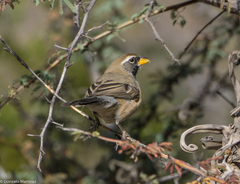
All of the systems agree that the species is monotypic. The many-colored Chaco finch is 17 cm (6.7 in) to 18 cm (7.1 in) long. It weighs 20 to 25 g (0.71 to 0.88 oz). The sexes have essentially the same plumage though females are generally slightly duller than males and have a paler face. Adult males have a black face from the lores to the eye and down the cheek... Wikipedia →

Sounds

Song0:52

Argentina · 2019

© Niels Krabbe · XC506222 · CC BY-NC-SA 4.0

Call0:21

Argentina · 2023

© Bernard BOUSQUET · XC830825 · CC BY-NC-SA 4.0

Song0:42

Argentina · 2013

© Peter Boesman · XC272918 · CC BY-NC-ND 4.0

Global Distribution

Parks Where Found

# Park Country Daily sighting probability
1 El Impenetrable National Park 🇦🇷 Argentina
~10%

More parks will be added in future updates.

Cities Where Found

# City Country Daily sighting probability
1 Cordoba 🇦🇷 Argentina
~10%
2 Buenos Aires 🇦🇷 Argentina
<5%

Before you go

What are the chances of seeing a Many-colored Chaco Finch in Cordoba?

With luck

About 10% of wildlife watchers report a Many-colored Chaco Finch sighting in Cordoba on a given day, based on 141 verified sightings from GBIF citizen-science data. It is the 65th most-seen of the 176 birds we can rate there. Over three days the chance rises to about 20%, and over a week to about 40%, if each day is a fresh chance.

When is the best time to see a Many-colored Chaco Finch in Cordoba?

April–August and December–February

In those months about 10% of wildlife watchers report a Many-colored Chaco Finch in Cordoba on a given day, against under 5% in March and September–November, the lowest months.

What time of day is best to see a Many-colored Chaco Finch?

Between 9 am and noon

Across all the parks we cover, that three-hour window holds the most Many-colored Chaco Finch sightings with a recorded time, and about 9 in 10 of them come between 6 am and 6 pm: it is a daytime animal.

Is Cordoba the best place to see a Many-colored Chaco Finch?

Yes

Of the 2 cities where we can rate Many-colored Chaco Finch sightings, Cordoba has the highest daily chance: about 10%. Next come Buenos Aires (Argentina, under 5%).

Which relatives of the Many-colored Chaco Finch live in Cordoba?

Same family: Thraupidae

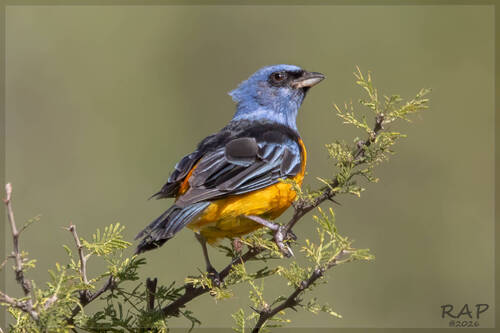
The closest relatives of the Many-colored Chaco Finch that you can see in Cordoba (family Thraupidae, Tanagers and Allies) are Saffron Finch (about 50%), Blue-and-yellow Tanager (about 20%) and Golden-billed Saltator (about 20%), with each one's daily chance of a sighting.

Where does the Many-colored Chaco Finch sighting chance come from?

GBIF citizen-science records

It is estimated from how often the Many-colored Chaco Finch is recorded against all the birds logged in Cordoba (141 verified sightings), calibrated against known sighting rates. Figures are rounded to the nearest 10% because citizen-science data supports honest approximations, not decimals, and months with records from fewer than five people show "—". How it works.

← Back to Cordoba