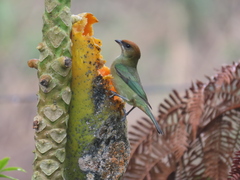
Chestnut-backed Tanager

Chestnut-backed Tanager

Stilpnia preciosa

Silhouette: Sheatherius · PhyloPic

Daily sighting probability ~20% · Possible
at Curitiba

In 3 days ~50% in a week ~80%

314 Verified sightings at Curitiba
69 In all 3 parks From 2019 to 2026
March Best month
☀️ Diurnal When it's spotted

About the Chestnut-backed Tanager

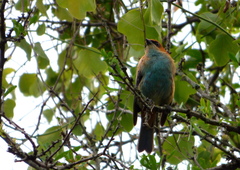
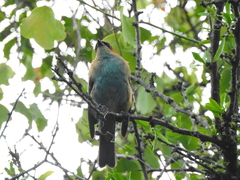
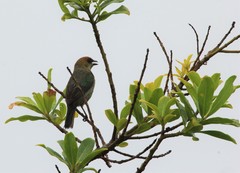
The chestnut-backed tanager (Stilpnia preciosa) is a species of bird in the family Thraupidae. It is found in southern Brazil, north-eastern Argentina, eastern Paraguay, and Uruguay in mature forests (especially edges) up to 1000m elevation. It is closely related to the rarer black-backed tanager, which have identical plumage except for the males' mantle (back feathers). Females of the two species are virtually indistinguishable by plumage. This bird is characterized by its blue-green breast and chestnut back. It was previously considered a color morph of the black-backed tanager (Stilpnia peruviana); however, Stilpnia is not known to be polymorphic, and the two species have different habitat preferences and breeding range. The tanager is reported as fairly common in part of its range and unlikely to face any particular threats; as a result, the IUCN has listed it as being of Least Concern.

The tanager eats a variety of arthropods and wild and cultivated fruits. It can be found in pairs and in small (often mixed-species) flocks. Wikipedia →

Sounds

Recording0:31

Argentina · 2026

© Faustino Hollmann · XC1176774 · CC BY-NC-SA 4.0

Call0:16

Brazil · 2025

© JAYRSON ARAUJO DE OLIVEIRA · XC1053019 · CC BY-NC-SA 4.0

Song0:20

Brazil · 2015

© Romulo Vitoria · XC330821 · CC BY-NC-SA 4.0

Global Distribution

Parks Where Found

# Park Country Daily sighting probability
1 El Palmar National Park 🇦🇷 Argentina
~10%
2 Iguazú National Park 🇦🇷 Argentina
<5%
3 Iguaçu National Park 🇧🇷 Brazil
<5%

Cities Where Found

# City Country Daily sighting probability
1 Curitiba 🇧🇷 Brazil
~20%
2 Porto Alegre 🇧🇷 Brazil
<5%

Zoos & Centres Where Found

# Zoo / Centre Country
1 São Paulo Zoo 🇧🇷 Brazil In captivity
2 Berlin Zoological Garden 🇩🇪 Germany In captivity
3 Aquarium Berlin 🇩🇪 Germany In captivity

Before you go

What are the chances of seeing a Chestnut-backed Tanager in Curitiba?

Possible

About 20% of wildlife watchers report a Chestnut-backed Tanager sighting in Curitiba on a given day, based on 314 verified sightings from GBIF citizen-science data. It is the 43rd most-seen of the 247 birds we can rate there. Over three days the chance rises to about 50%, and over a week to about 80%, if each day is a fresh chance.

When is the best time to see a Chestnut-backed Tanager in Curitiba?

March–April and June–August

In those months about 30% of wildlife watchers report a Chestnut-backed Tanager in Curitiba on a given day, against about 10% in January, the lowest month.

What time of day is best to see a Chestnut-backed Tanager?

Between 9 am and noon

Across all the parks we cover, that three-hour window holds the most Chestnut-backed Tanager sightings with a recorded time, and about 9 in 10 of them come between 6 am and 6 pm: it is a daytime animal.

Is Curitiba the best place to see a Chestnut-backed Tanager?

Yes

Of the 2 cities where we can rate Chestnut-backed Tanager sightings, Curitiba has the highest daily chance: about 20%. Next come Porto Alegre (Brazil, under 5%).

Which relatives of the Chestnut-backed Tanager live in Curitiba?

Same family: Thraupidae

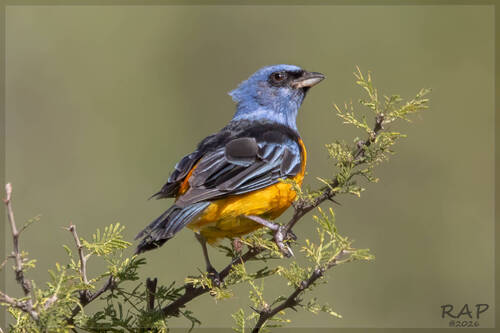
The closest relatives of the Chestnut-backed Tanager that you can see in Curitiba (family Thraupidae, Tanagers and Allies) are Sayaca Tanager (about 70%), Saffron Finch (about 60%) and Blue-and-yellow Tanager (about 30%), with each one's daily chance of a sighting.

Where does the Chestnut-backed Tanager sighting chance come from?

GBIF citizen-science records

It is estimated from how often the Chestnut-backed Tanager is recorded against all the birds logged in Curitiba (314 verified sightings), calibrated against known sighting rates. Figures are rounded to the nearest 10% because citizen-science data supports honest approximations, not decimals, and months with records from fewer than five people show "—". How it works.

← Back to Curitiba