Audouin's Gull

Audouin's Gull

Ichthyaetus audouinii

Silhouette: Sheatherius · PhyloPic

Daily sighting probability ~10% · With luck
at Dakar

In 3 days ~30% in a week ~50%

23 Verified sightings at Dakar
205 In 1 park From 2019 to 2026
December Best month
🌅 Crepuscular When it's spotted

About the Audouin's Gull

Audouin's gull (Ichthyaetus audouinii) is a large gull restricted to the Mediterranean and the western coast of Saharan Africa and the Iberian Peninsula. The genus name is from Ancient Greek ikhthus, "fish", and aetos, "eagle", and

the specific audouinii and the English name are after the French naturalist Jean Victoire Audouin. It breeds on small islands colonially or alone, laying 2–3 eggs on a ground nest. As is the case with many gulls, it has traditionally been placed in the genus Larus.

In the late 1960s, this was one of the world's rarest gulls, with a population of only 1,000 pairs. It has established new colonies, but remains rare with a population of about 10,000 pairs. This species, unlike many large gulls, rarely scavenges, but is a specialist fish eater, and is therefore strictly coastal and pelagic. This bird will feed at night, often well out to sea, but also slowly patrols close into beaches, occasionally dangling its legs to increase drag.

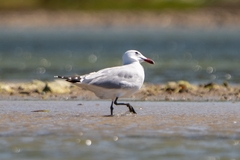
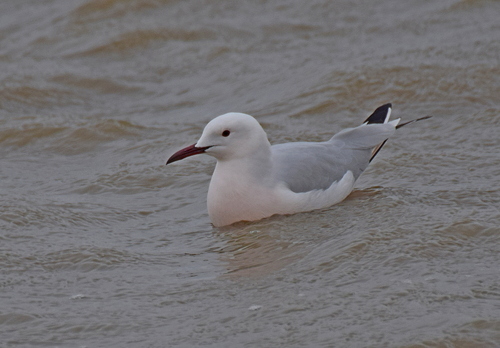
The adult resembles a small European herring gull, the most noticeable differences being the short stubby red bill and "string of pearls" white wing primary tips, rather than the large "mirrors" of some other species. The legs are grey-green. It takes four years to reach adult plumage.

Audouin's gull is one of the species to which the Agreement on the Conservation of African-Eurasian Migratory Waterbirds (AEWA) applies. Wikipedia →

Sounds

Nocturnal flight call0:45

Spain · 2026

© Bosco Dies / BirdingAlbufera · XC1101977 · CC BY-NC-SA 4.0

Call0:19

Italy · 2025

© Francesco Sottile · XC999432 · CC BY-NC-SA 4.0

Flight call0:33

Spain · 2024

© BirdingAlbufera · XC891875 · CC BY-NC-SA 4.0

Global Distribution

Parks Where Found

# Park Country Daily sighting probability
1 Doñana National Park 🇪🇸 Spain
<5%

More parks will be added in future updates.

Cities Where Found

# City Country Daily sighting probability
1 Casablanca 🇲🇦 Morocco
~10%
2 Valencia 🇪🇸 Spain
~10%
3 Dakar 🇸🇳 Senegal
~10%
4 Barcelona 🇪🇸 Spain
~10%
5 Tangier 🇲🇦 Morocco
~10%
6 Rabat 🇲🇦 Morocco
<5%
7 Porto 🇵🇹 Portugal
<5%
8 Lisbon 🇵🇹 Portugal
<5%

Before you go

What are the chances of seeing an Audouin's Gull in Dakar?

With luck

About 10% of wildlife watchers report an Audouin's Gull sighting in Dakar on a given day, based on 23 verified sightings from GBIF citizen-science data. It is the 91st most-seen of the 152 birds we can rate there. Over three days the chance rises to about 30%, and over a week to about 50%, if each day is a fresh chance.

When is the best time to see an Audouin's Gull in Dakar?

December

In that month about 20% of wildlife watchers report an Audouin's Gull in Dakar on a given day, against under 5% in February, April–May and August, the lowest months. That is one of Dakar's driest months, with about 15 mm of rain against 190 mm in August.

What time of day is best to see an Audouin's Gull?

Between 6 and 9 pm

Across all the parks we cover, that three-hour window holds the most Audouin's Gull sightings with a recorded time, and about 7 in 10 of them come between 6 am and 6 pm: it is most active around dawn and dusk.

Is Dakar the best place to see an Audouin's Gull?

Among the best

Of the 8 cities where we can rate Audouin's Gull sightings, Dakar ranks 3rd at about 10%, level with the leaders once rounded. The best odds are in Casablanca (Morocco, about 10%) and Valencia (Spain, about 10%).

Which relatives of the Audouin's Gull live in Dakar?

Same family: Laridae

The closest relatives of the Audouin's Gull that you can see in Dakar (family Laridae, Gulls, Terns, and Skimmers) are Sandwich Tern (about 50%), Caspian Tern (about 40%) and West African Crested Tern (about 40%), with each one's daily chance of a sighting.

Where does the Audouin's Gull sighting chance come from?

GBIF citizen-science records

It is estimated from how often the Audouin's Gull is recorded against all the birds logged in Dakar (23 verified sightings), calibrated against known sighting rates. Figures are rounded to the nearest 10% because citizen-science data supports honest approximations, not decimals, and months with records from fewer than five people show "—". How it works.

← Back to Dakar