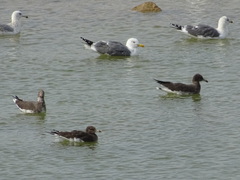
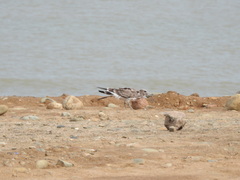
Sooty Gull

Sooty Gull

Ichthyaetus hemprichii

Silhouette: Sheatherius · PhyloPic

Daily sighting probability ~20% · Possible
at Dar es-Salaam

In 3 days ~40% in a week ~70%

30 Verified sightings at Dar es-Salaam
10 In 1 park From 2019 to 2026
December Best month
☀️ Diurnal When it's spotted

About the Sooty Gull

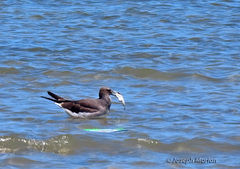
The sooty gull (Ichthyaetus hemprichii) is a species of gull in the family Laridae, also known as the Aden gull or Hemprich's gull. It is found in Bahrain, Djibouti, Egypt, Eritrea, India, Iran, Israel, Jordan, Kenya, Lebanon, Maldives, Mozambique, Oman, Pakistan, Palestine, Qatar, Saudi Arabia, Somalia, Sri Lanka, Sudan, Tanzania, United Arab Emirates, and Yemen. As is the case with many gulls, it has traditionally been placed in the genus Larus. The sooty gull is named in honour of the German naturalist Wilhelm Hemprich who died in 1825 while on a scientific expedition to Egypt and the Middle East with his friend Christian Gottfried Ehrenberg.

The sooty gull is native to the Red Sea, the Gulf of Aden, the Gulf of Oman, the Persian Gulf and its range extends as far east as Pakistan. It is also native to the east coast of Africa as far south as Tanzania and Mozambique. It occurs as a vagrant in India, Sri Lanka, the Maldives, Jordan, Lebanon, Palestine and Bahrain. It is a coastal bird, seldom going further out to sea than about 10 km (6 mi) beyond coastal reefs although it has occasionally been seen 140 km (87 mi) from land. It frequents ports and harbours... Wikipedia →

Sounds

Call0:12

Oman · 2024

© Christian Kerihuel · XC952003 · CC BY-NC-SA 4.0

Flight call0:04

Oman · 2023

© Alain Malengreau · XC864560 · CC BY-NC-SA 4.0

Mobbing0:15

Saudi Arabia · 2021

© David Darrell-Lambert · XC740144 · CC BY-NC-SA 4.0

Global Distribution

Parks Where Found

# Park Country Daily sighting probability
1 Addo Elephant National Park 🇿🇦 South Africa
~10%

More parks will be added in future updates.

Cities Where Found

# City Country Daily sighting probability
1 Zanzibar City 🇹🇿 Tanzania
~40%
2 Jeddah 🇸🇦 Saudi Arabia
~30%
3 Dar es-Salaam 🇹🇿 Tanzania
~20%
4 Mombasa 🇰🇪 Kenya
~10%
5 Dubai 🇦🇪 United Arab Emirates
<5%

Before you go

What are the chances of seeing a Sooty Gull in Dar es-Salaam?

Possible

About 20% of wildlife watchers report a Sooty Gull sighting in Dar es-Salaam on a given day, based on 30 verified sightings from GBIF citizen-science data. It is the 53rd most-seen of the 138 birds we can rate there. Over three days the chance rises to about 40%, and over a week to about 70%, if each day is a fresh chance.

When is the best time to see a Sooty Gull in Dar es-Salaam?

December

In that month about 40% of wildlife watchers report a Sooty Gull in Dar es-Salaam on a given day, against about 10% in February, April–August and October, the lowest months.

What time of day is best to see a Sooty Gull?

Between 9 am and noon

Across all the parks we cover, that three-hour window holds the most Sooty Gull sightings with a recorded time, and about 9 in 10 of them come between 6 am and 6 pm: it is a daytime animal.

Is Dar es-Salaam the best place to see a Sooty Gull?

3rd of 5

Of the 5 cities where we can rate Sooty Gull sightings, Dar es-Salaam ranks 3rd at about 20%. The best odds are in Zanzibar City (Tanzania, about 40%) and Jeddah (Saudi Arabia, about 30%).

Which relatives of the Sooty Gull live in Dar es-Salaam?

Same family: Laridae

The closest relatives of the Sooty Gull that you can see in Dar es-Salaam (family Laridae, Gulls, Terns, and Skimmers) are Lesser Crested Tern (about 20%), Gull-billed Tern (about 10%) and Lesser Black-backed Gull (about 10%), with each one's daily chance of a sighting.

Where does the Sooty Gull sighting chance come from?

GBIF citizen-science records

It is estimated from how often the Sooty Gull is recorded against all the birds logged in Dar es-Salaam (30 verified sightings), calibrated against known sighting rates. Figures are rounded to the nearest 10% because citizen-science data supports honest approximations, not decimals, and months with records from fewer than five people show "—". How it works.

← Back to Dar es-Salaam