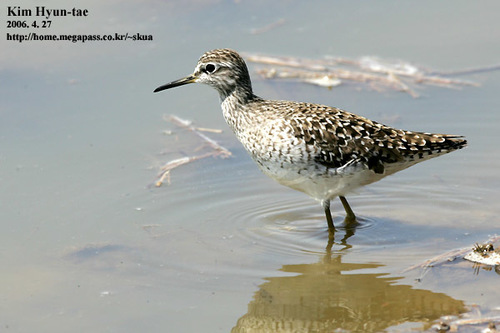
Marsh Sandpiper

Marsh Sandpiper

Tringa stagnatilis

Silhouette: Andy Wilson · PhyloPic

LCLeast ConcernNTVUENCR
Daily sighting probability ~20% · Possible
at Dar es-Salaam

In 3 days ~40% in a week ~70%

25 Verified sightings at Dar es-Salaam
4,070 In all 51 parks From 2019 to 2026
January Best month
☀️ Diurnal When it's spotted

About the Marsh Sandpiper

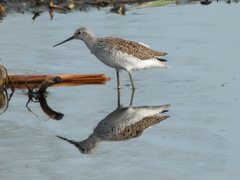
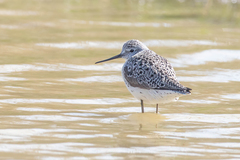
The marsh sandpiper (Tringa stagnatilis) is a small wader. It is a rather small shank, and breeds in open grassy steppe and taiga wetlands from easternmost Europe to the Russian Far East. The genus name Tringa is the Neo-Latin name given to the green sandpiper by Aldrovandus in 1599 based on Ancient Greek trungas, a thrush-sized, white-rumped, tail-bobbing wading bird mentioned by Aristotle. The specific stagnatilis is from Latin stagnum, "swamp".

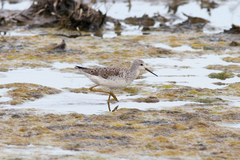
The marsh sandpiper resembles a small elegant greenshank, with a long fine bill and very long yellowish legs. Like the greenshank, it is greyish brown in breeding plumage, paler in winter, and has a white wedge up its back that is visible in flight. However, it is more closely related to the common redshank and the wood sandpiper. Together, they form a group of smallish shanks which tend to have red or reddish legs, and in breeding plumage are generally a subdued, light brown above with some darker mottling, with a pattern of somewhat diffuse small brownish spots on the breast and neck. The length is 22–26 cm (8.7–10.2 in), wingspan is 55–59 cm (22–23 in) and weight is 45–120 g (1.6–4.2 oz).

The marsh sandpiper... Wikipedia →

Sounds

Call0:06

China · 2026

© Peter Boesman · XC1147839 · CC BY-NC-ND 4.0

Song0:27

Sweden · 2019

© Lars Edenius · XC915491 · CC BY-NC-SA 4.0

Alarm call0:22

Russian Federation · 2023

© Mikhail Nevsky · XC805107 · CC BY-NC-SA 4.0

Global Distribution

Parks Where Found

# Park Country Daily sighting probability
1 Yala National Park 🇱🇰 Sri Lanka
~30%
2 Lake Nakuru National Park 🇰🇪 Kenya
~20%
3 Amboseli National Park 🇰🇪 Kenya
~20%
4 Wilpattu National Park 🇱🇰 Sri Lanka
~20%
5 West Coast National Park 🇿🇦 South Africa
~20%
6 Ngorongoro Conservation Area 🇹🇿 Tanzania
~20%
7 Keoladeo National Park 🇮🇳 India
~10%
8 Arusha National Park 🇹🇿 Tanzania
~10%
9 Serengeti National Park 🇹🇿 Tanzania
~10%
10 Tarangire National Park 🇹🇿 Tanzania
~10%
11 Lake Manyara National Park 🇹🇿 Tanzania
~10%
12 Udawalawe National Park 🇱🇰 Sri Lanka
~10%
13 Ranthambore National Park 🇮🇳 India
~10%
14 Queen Elizabeth National Park 🇺🇬 Uganda
~10%
15 Moremi Game Reserve 🇧🇼 Botswana
~10%
16 Nairobi National Park 🇰🇪 Kenya
~10%
17 Gonarezhou National Park 🇿🇼 Zimbabwe
~10%
18 Kaziranga National Park 🇮🇳 India
~10%
19 South Luangwa National Park 🇿🇲 Zambia
~10%
20 Bali Barat National Park 🇮🇩 Indonesia
~10%
21 Lower Zambezi National Park 🇿🇲 Zambia
~10%
22 Mana Pools National Park 🇿🇼 Zimbabwe
~10%
23 Liwonde National Park 🇲🇼 Malawi
<5%
24 Murchison Falls National Park 🇺🇬 Uganda
<5%
25 Kafue National Park 🇿🇲 Zambia
<5%
26 Etosha National Park 🇳🇦 Namibia
<5%
27 Mikumi National Park 🇹🇿 Tanzania
<5%
28 Tsavo East National Park 🇰🇪 Kenya
<5%
29 iSimangaliso Wetland Park 🇿🇦 South Africa
<5%
30 Kiskunság National Park 🇭🇺 Hungary
<5%
31 Chobe National Park 🇧🇼 Botswana
<5%
32 Semuliki National Park 🇺🇬 Uganda
<5%
33 Kruger National Park 🇿🇦 South Africa
<5%
34 Akagera National Park 🇷🇼 Rwanda
<5%
35 Hwange National Park 🇿🇼 Zimbabwe
<5%
36 Tsavo West National Park 🇰🇪 Kenya
<5%
37 Garden Route National Park 🇿🇦 South Africa
<5%
38 Kakadu National Park 🇦🇺 Australia
<5%
39 Camargue 🇫🇷 France
<5%
40 Satpura National Park 🇮🇳 India
<5%
41 Hortobágy National Park 🇭🇺 Hungary
<5%
42 Fertő-Hanság National Park 🇭🇺 Hungary
<5%
43 Masai Mara National Reserve 🇰🇪 Kenya
<5%
44 Lake Mburo National Park 🇺🇬 Uganda
<5%
45 Bandhavgarh National Park 🇮🇳 India
<5%
46 Nagarhole National Park 🇮🇳 India
<5%
47 Samburu National Reserve 🇰🇪 Kenya
<5%
48 Kanha National Park 🇮🇳 India
<5%
49 Jim Corbett National Park 🇮🇳 India
<5%
50 Bandipur National Park 🇮🇳 India
<5%
51 Wadden Sea National Park 🇩🇪 Germany
<5%

Cities Where Found

# City Country Daily sighting probability
1 Quanzhou 🇨🇳 China
~30%
2 Karachi 🇵🇰 Pakistan
~30%
3 Zanzibar City 🇹🇿 Tanzania
~20%
4 Kuwait City 🇰🇼 Kuwait
~20%
5 Agra 🇮🇳 India
~20%
6 Dar es-Salaam 🇹🇿 Tanzania
~20%
7 Tuen Mun 🇨🇳 China
~10%
8 Vasai-Virar 🇮🇳 India
~10%
9 Mumbai 🇮🇳 India
~10%
10 Prayagraj 🇮🇳 India
~10%

Before you go

What are the chances of seeing a Marsh Sandpiper in Dar es-Salaam?

Possible

About 20% of wildlife watchers report a Marsh Sandpiper sighting in Dar es-Salaam on a given day, based on 25 verified sightings from GBIF citizen-science data. It is the 49th most-seen of the 138 birds we can rate there. Over three days the chance rises to about 40%, and over a week to about 70%, if each day is a fresh chance.

When is the best time to see a Marsh Sandpiper in Dar es-Salaam?

January and October

In those months about 30% of wildlife watchers report a Marsh Sandpiper in Dar es-Salaam on a given day, against about 10% in February to July, the lowest months.

What time of day is best to see a Marsh Sandpiper?

Between 10 am and 1 pm

Across all the parks we cover, that three-hour window holds the most Marsh Sandpiper sightings with a recorded time, and about 9 in 10 of them come between 6 am and 6 pm: it is a daytime animal.

Is Dar es-Salaam the best place to see a Marsh Sandpiper?

6th of 65

Of the 65 cities where we can rate Marsh Sandpiper sightings, Dar es-Salaam ranks 6th at about 20%. The best odds are in Quanzhou (China, about 30%), Karachi (Pakistan, about 30%) and Zanzibar City (Tanzania, about 20%).

Which relatives of the Marsh Sandpiper live in Dar es-Salaam?

Same genus: Tringa

The closest relatives of the Marsh Sandpiper that you can see in Dar es-Salaam (genus Tringa, Shanks, Tattlers, and Allies) are Common Greenshank (about 10%) and Wood Sandpiper (about 10%), with each one's daily chance of a sighting.

Where does the Marsh Sandpiper sighting chance come from?

GBIF citizen-science records

It is estimated from how often the Marsh Sandpiper is recorded against all the birds logged in Dar es-Salaam (25 verified sightings), calibrated against known sighting rates. Figures are rounded to the nearest 10% because citizen-science data supports honest approximations, not decimals, and months with records from fewer than five people show "—". How it works.

← Back to Dar es-Salaam