Great Crested Canopy Lizard

Great Crested Canopy Lizard

Bronchocela jubata

Silhouette: Michael Scroggie · PhyloPic

LCLeast ConcernNTVUENCR
Daily sighting probability ~10% · With luck
at Denpasar

In 3 days ~30% in a week ~60%

5 Verified sightings at Denpasar
July Best month
☀️🌙 Day & Night When it's spotted

About the Great Crested Canopy Lizard

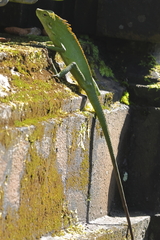
Bronchocela jubata, commonly known as the maned forest lizard, is a species of agamid lizard found mainly in Indonesia on the islands of Singkep, Java, Bali, parts of Malaysia Sulawesi, Karakelang, Salibabu; Nias Island, Singkap Island, Borneo (Kalimantan) also in Thailand, Cambodia and Philippines. Although in the past it was thought the species may be found in India, either on the mainland or in the Nicobars, this is not the case according to herpetologist Das. It is also known by the common name of "bloodsucker", although this is a misnomer.

Bronchocela jubata is 550 mm (22 in) in total length, with a long hanging tail making up four fifths of its total length. It has a jagged crest on its neck which more closely resemble hairs, as opposed to the crest of its close relative, B. cristatella, which more closely resembles the points on a crown. The crest consists of elongated scales, although it is flabby like skin.

The head is square in shape, and there is a soft sack under the chin. It has large, flexible eyelids made of fine speckled scales. The dorsal area is coloured from light green to dark green, and the lizard can change to brown or black if feeling threatened... Wikipedia →

Global Distribution

Parks Where Found

# Park Country Daily sighting probability

More parks will be added in future updates.

Cities Where Found

# City Country Daily sighting probability
1 Yogyakarta 🇮🇩 Indonesia
~70%
2 Jakarta 🇮🇩 Indonesia
~60%
3 Tasikmalaya 🇮🇩 Indonesia
~50%
4 Malang 🇮🇩 Indonesia
~50%
5 Surakarta 🇮🇩 Indonesia
~40%
6 Bandung 🇮🇩 Indonesia
~30%
7 Semarang 🇮🇩 Indonesia
~30%
8 Surabaya 🇮🇩 Indonesia
~20%
9 Denpasar 🇮🇩 Indonesia
~10%

Zoos & Centres Where Found

# Zoo / Centre Country
1 Jakarta Aquarium 🇮🇩 Indonesia In captivity

Before you go

What are the chances of seeing a Great Crested Canopy Lizard in Denpasar?

With luck

About 10% of wildlife watchers report a Great Crested Canopy Lizard sighting in Denpasar on a given day, based on 5 verified sightings from GBIF citizen-science data. It is the 26th most-seen of the 28 reptiles we can rate there. Over three days the chance rises to about 30%, and over a week to about 60%, if each day is a fresh chance.

When is the best time to see a Great Crested Canopy Lizard in Denpasar?

June–July and November–December

In those months about 20% of wildlife watchers report a Great Crested Canopy Lizard in Denpasar on a given day, against under 5% in January–May and August–October, the lowest months.

What time of day is best to see a Great Crested Canopy Lizard?

Between 7 and 10 pm

Across all the parks we cover, that three-hour window holds the most Great Crested Canopy Lizard sightings with a recorded time, and about half of them come between 6 am and 6 pm: it is seen both by day and at night.

Is Denpasar the best place to see a Great Crested Canopy Lizard?

9th of 9

Of the 9 cities where we can rate Great Crested Canopy Lizard sightings, Denpasar ranks 9th at about 10%. The best odds are in Yogyakarta (Indonesia, about 70%), Jakarta (Indonesia, about 60%) and Tasikmalaya (Indonesia, about 50%).

Which relatives of the Great Crested Canopy Lizard live in Denpasar?

Same family: Agamidae

The closest relatives of the Great Crested Canopy Lizard that you can see in Denpasar (family Agamidae, Dragons) are Common Flying Dragon (about 30%) and Oriental Garden Lizard (about 20%), with each one's daily chance of a sighting.

Where does the Great Crested Canopy Lizard sighting chance come from?

GBIF citizen-science records

It is estimated from how often the Great Crested Canopy Lizard is recorded against all the reptiles logged in Denpasar (5 verified sightings), calibrated against known sighting rates. Figures are rounded to the nearest 10% because citizen-science data supports honest approximations, not decimals, and months with records from fewer than five people show "—". How it works.

← Back to Denpasar