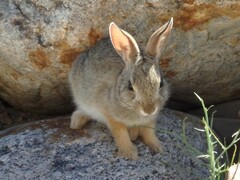
Mountain Cottontail

Mountain Cottontail

Sylvilagus nuttallii

Silhouette: T. Michael Keesey · PhyloPic

LCLeast ConcernNTVUENCR
Daily sighting probability ~10% · With luck
at Denver

In 3 days ~20% in a week ~50%

58 Verified sightings at Denver
158 In all 3 parks From 2019 to 2026
November Best month
🌅 Crepuscular When it's spotted

About the Mountain Cottontail

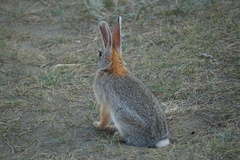
The mountain cottontail or Nuttall's cottontail (Sylvilagus nuttallii) is a species of rabbit found in western Canada and the United States. It is a medium- to small-sized rabbit with pale brown fur, white undersides, a two-colored tail, and black-tipped, rounded ears with densely furred insides. It has notably rusty-colored legs and an orange nape. The mountain cottontail appears largely among coniferous forests in mountainous regions, including the slopes of the Rocky Mountains and the Cascade-Sierra Nevada mountain ranges, and adapts to a variety of elevations and vegetation. Its diet is made up of various grasses, shrubs, and sagebrush, as well as twigs, bark, or fungi in lesser amounts or when foliage is scarce.

The mountain cottontail was first described in 1837 by naturalist John Bachman and named Lepus nuttallii; the specific name commemorates zoologist Thomas Nuttall. Marcus Ward Lyon Jr. placed the species in the genus Sylvilagus in 1904. The species is closely related to the desert cottontail, and less so to the swamp rabbit and marsh rabbit. There are three subspecies of the mountain cottontail, and limited evidence points to the three as each making up distinct species.

The range of the mountain cottontail has shrunk as a result of climate change and competition from the eastern cottontail and other leporids, though the species is sympatric with the snowshoe hare, with the mountain cottontail generally occupying lower elevations in the same region. It is a target of rabbiting and is seasonally protected by hunting authorities as game. The mountain cottontail also has many predators and is affected by various parasites and diseases such as tularemia and Rocky Mountain spotted fever. Across its entire range, the species is assessed as "least concern" by the International Union for Conservation of Nature (IUCN), but province- and state-specific conservation assessments vary, with Arizona and British Columbia marking it as "vulnerable". Wikipedia →

Global Distribution

Parks Where Found

# Park Country Daily sighting probability
1 Rocky Mountain National Park 🇺🇸 United States
~20%
2 Yellowstone National Park 🇺🇸 United States
~10%
3 Badlands National Park 🇺🇸 United States
~10%

Cities Where Found

# City Country Daily sighting probability
1 Calgary 🇨🇦 Canada
~20%
2 Salt Lake City 🇺🇸 United States
~10%
3 Denver 🇺🇸 United States
~10%

Before you go

What are the chances of seeing a Mountain Cottontail in Denver?

With luck

About 10% of wildlife watchers report a Mountain Cottontail sighting in Denver on a given day, based on 58 verified sightings from GBIF citizen-science data. It is the 11th most-seen of the 19 mammals we can rate there. Over three days the chance rises to about 20%, and over a week to about 50%, if each day is a fresh chance.

When is the best time to see a Mountain Cottontail in Denver?

November to September

In those months about 10% of wildlife watchers report a Mountain Cottontail in Denver on a given day, against under 5% in October, the lowest month.

What time of day is best to see a Mountain Cottontail?

Between 6 and 9 pm

Across all the parks we cover, that three-hour window holds the most Mountain Cottontail sightings with a recorded time, and about 6 in 10 of them come between 6 am and 6 pm: it is most active around dawn and dusk.

Is Denver the best place to see a Mountain Cottontail?

3rd of 3

Of the 3 cities where we can rate Mountain Cottontail sightings, Denver ranks 3rd at about 10%. The best odds are in Calgary (Canada, about 20%) and Salt Lake City (United States, about 10%).

Which relatives of the Mountain Cottontail live in Denver?

Same genus: Sylvilagus

The closest relatives of the Mountain Cottontail that you can see in Denver (genus Sylvilagus, Cottontail Rabbits) are Desert Cottontail (about 10%) and Eastern Cottontail (about 10%), with each one's daily chance of a sighting.

Where does the Mountain Cottontail sighting chance come from?

GBIF citizen-science records

It is estimated from how often the Mountain Cottontail is recorded against all the mammals logged in Denver (58 verified sightings), calibrated against known sighting rates. Figures are rounded to the nearest 10% because citizen-science data supports honest approximations, not decimals, and months with records from fewer than five people show "—". How it works.

← Back to Denver