Black-tailed Prairie Dog

Black-tailed Prairie Dog

Cynomys ludovicianus

Silhouette: Steven Traver · PhyloPic

LCLeast ConcernNTVUENCR
Daily sighting probability ~40% · Likely
at Denver

In 3 days ~70% in a week >90%

819 Verified sightings at Denver
671 In 1 park From 2019 to 2026
October Best month
☀️ Diurnal When it's spotted

About the Black-tailed Prairie Dog

The black-tailed prairie dog (Cynomys ludovicianus) is a rodent of the family Sciuridae (the squirrels) found in the Great Plains of North America from about the United States–Canada border to the United States–Mexico border. Unlike some other prairie dogs, these animals do not truly hibernate. The black-tailed prairie dog can be seen above ground in midwinter. A black-tailed prairie dog town in Texas was reported to cover 25,000 mi2 (64,000 km2) and included 400,000,000 individuals. Prior to habitat destruction, the species may have been the most abundant prairie dog in central North America. It was one of two prairie dogs described by the Lewis and Clark Expedition in the journals and diaries of their expedition.

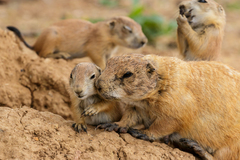
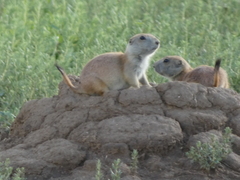
Black-tailed prairie dogs are generally tan in color, with lighter-colored bellies. They may have color variation in their pelt, such as dark fur on their back in black and brown tones. Their tails have black tips, from which their name is derived. Adults can weigh from 1.5 to 3.0 lb (0.68 to 1.36 kg), males are typically heavier than females. Body length is normally from 14 to 17 in (36 to 43 cm), with a 3-to-4-inch (7.6 to 10.2 cm) tail. The black-tailed... Wikipedia →

Sounds

Alarm call0:09

United States · 2011

© Chris Harrison · XC1046112 · CC BY-NC-SA 4.0

Recording0:07

United States · 2025

© Amelia Fernández Rodríguez · iNaturalist · CC BY-NC 4.0

Recording0:09

United States · 2025

© eweber713 · iNaturalist · CC BY-NC 4.0

Global Distribution

Parks Where Found

# Park Country Daily sighting probability
1 Badlands National Park 🇺🇸 United States
~90%

More parks will be added in future updates.

Cities Where Found

# City Country Daily sighting probability
1 Denver 🇺🇸 United States
~40%

Zoos & Centres Where Found

# Zoo / Centre Country
1 Everland 🇰🇷 South Korea In captivity
2 San Diego Zoo 🇺🇸 United States In captivity
3 Prague Zoo 🇨🇿 Czechia In captivity
4 National Zoological Park 🇺🇸 United States In captivity
5 Basel Zoo 🇨🇭 Switzerland In captivity
6 Leipzig Zoological Garden 🇩🇪 Germany In captivity
7 Copenhagen Zoo 🇩🇰 Denmark In captivity
8 Tierpark Berlin 🇩🇪 Germany In captivity
9 Natura Artis Magistra 🇳🇱 Netherlands In captivity
10 Barcelona Zoo 🇪🇸 Spain In captivity
11 Le Pal 🇫🇷 France In captivity
12 Parc Phœnix 🇫🇷 France In captivity
13 Bali Zoo 🇮🇩 Indonesia In captivity
14 Olomouc Zoo 🇨🇿 Czechia In captivity
15 Zoo Hluboka 🇨🇿 Czechia In captivity
16 Brno Zoo 🇨🇿 Czechia In captivity
17 Abilene Zoological Gardens 🇺🇸 United States In captivity
18 Parc Omega 🇨🇦 Canada In captivity
19 Zoo Sauvage de St-Félicien 🇨🇦 Canada In captivity
20 Zoo sauvage Saint-Félicien 🇨🇦 Canada In captivity
21 Minnesota Zoo 🇺🇸 United States In captivity
22 Lee G. Simmons Wildlife Safari Park 🇺🇸 United States In captivity
23 Columbus Zoo and Aquarium 🇺🇸 United States In captivity
24 Bronx Zoo 🇺🇸 United States In captivity
25 Parc animalier de Sainte-Croix 🇫🇷 France In captivity
26 Sedgwick County Zoo 🇺🇸 United States In captivity
27 Seoul Zoo 🇰🇷 South Korea In captivity
28 Omaha’s Henry Doorly Zoo and Aquarium 🇺🇸 United States In captivity
29 Milwaukee County Zoo 🇺🇸 United States In captivity
30 Blair Drummond Safari and Adventure Park 🇬🇧 United Kingdom In captivity
31 Banham Zoo 🇬🇧 United Kingdom In captivity
32 Cotswold Wildlife Park 🇬🇧 United Kingdom In captivity
33 Nuremberg Zoo 🇩🇪 Germany In captivity
34 Tiergarten Am Tiergarten 28 in Nürnberg 🇩🇪 Germany In captivity
35 Phoenix Zoo 🇺🇸 United States In captivity
36 The Maryland Zoo 🇺🇸 United States In captivity
37 Detroit Zoo 🇺🇸 United States In captivity
38 Parco Natura Viva 🇮🇹 Italy In captivity
39 Wildgehege Hellenthal 🇩🇪 Germany In captivity
40 Bear Country USA 🇺🇸 United States In captivity
41 Dakota Zoo 🇺🇸 United States In captivity
42 Zoológico de San Juan de Aragón 🇲🇽 Mexico In captivity
43 Oklahoma City Zoo and Botanical Garden 🇺🇸 United States In captivity
44 Saint Louis Zoo 🇺🇸 United States In captivity
45 Southwick's Zoo 🇺🇸 United States In captivity
46 Burgers' Ocean 🇳🇱 Netherlands In captivity
47 Royal Burgers' Zoo 🇳🇱 Netherlands In captivity
48 Terra Natura Benidorm 🇪🇸 Spain In captivity
49 Jerusalem Biblical Zoo 🇮🇱 Israel In captivity
50 San Francisco Zoo 🇺🇸 United States In captivity

Before you go

What are the chances of seeing a Black-tailed Prairie Dog in Denver?

Likely

About 40% of wildlife watchers report a Black-tailed Prairie Dog sighting in Denver on a given day, based on 819 verified sightings from GBIF citizen-science data. It is the 2nd most-seen of the 19 mammals we can rate there. Over three days the chance rises to about 70%, and over a week to over 90%, if each day is a fresh chance.

When is the best time to see a Black-tailed Prairie Dog in Denver?

March–April and June–October

In those months about 40% of wildlife watchers report a Black-tailed Prairie Dog in Denver on a given day, against about 20% in December, the lowest month.

What time of day is best to see a Black-tailed Prairie Dog?

Between 9 am and noon

Across all the parks we cover, that three-hour window holds the most Black-tailed Prairie Dog sightings with a recorded time, and about 9 in 10 of them come between 6 am and 6 pm: it is a daytime animal.

Where else can you see a Black-tailed Prairie Dog?

Only Denver, in our data

Denver is the only city on Wallace's Line with enough records to rate Black-tailed Prairie Dog sightings: about 40% of wildlife watchers there report one on a given day.

Where does the Black-tailed Prairie Dog sighting chance come from?

GBIF citizen-science records

It is estimated from how often the Black-tailed Prairie Dog is recorded against all the mammals logged in Denver (819 verified sightings), calibrated against known sighting rates. Figures are rounded to the nearest 10% because citizen-science data supports honest approximations, not decimals, and months with records from fewer than five people show "—". How it works.

← Back to Denver