Western Grebe

Western Grebe

Aechmophorus occidentalis

Silhouette: PhyloPic

LCLeast ConcernNTVUENCR
Daily sighting probability ~10% · With luck
at Denver

In 3 days ~20% in a week ~40%

3,093 Verified sightings at Denver
4,661 In all 14 parks From 2019 to 2026
May Best month
☀️ Diurnal When it's spotted

About the Western Grebe

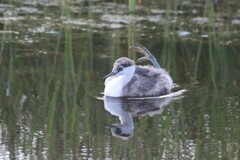
The western grebe (Aechmophorus occidentalis) is a species in the grebe family of water birds. Folk names include "dabchick", "swan grebe" and "swan-necked grebe". Western grebe fossils from the Late Pleistocene of southwest North America were described as a distinct species, but later ranked as a paleosubspecies Aechmophorus occidentalis lucasi. Later studies found them to fall within the variation now known to exist in today's birds.

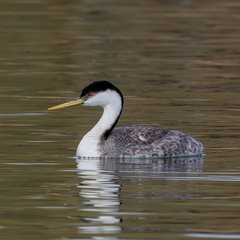
The western grebe is the largest North American grebe. It is 55–75 cm (22–30 in) long, weighs 795–2,000 g (1.753–4.409 lb) and measures 79–102 cm (31–40 in) across the wings. It is black-and-white, with a long, slender, swan-like neck and red eyes. It is easily confused with Clark's grebe, which shares similar features, body size, behavior and habitat, and hybrids are known. Clark's grebes generally populate more of the southern part of North America Other differences are whiter flanks and paler gray backs when comparing Clark's grebe to the western grebe.

The western grebe has black around the eyes and a straight greenish-yellow bill whereas Clark's grebe has white around the eyes and an up-turned bright yellow bill. The downy young... Wikipedia →

Sounds

Begging call0:18

United States · 2020

© Paul Marvin · XC581827 · CC BY-NC-SA 4.0

Call0:46

United States · 2018

© Richard E. Webster · XC565880 · CC BY-NC-SA 4.0

Song0:08

United States · 2020

© Thomas G. Graves · XC527697 · CC BY-NC-SA 4.0

Global Distribution

Parks Where Found

# Park Country Daily sighting probability
1 Channel Islands National Park 🇺🇸 United States
~30%
2 El Vizcaíno Biosphere Reserve 🇲🇽 Mexico
~20%
3 Redwood National Park 🇺🇸 United States
~20%
4 Elk Island National Park 🇨🇦 Canada
~10%
5 Olympic National Park 🇺🇸 United States
~10%
6 Yellowstone National Park 🇺🇸 United States
~10%
7 Grand Teton National Park 🇺🇸 United States
~10%
8 Riding Mountain National Park 🇨🇦 Canada
~10%
9 Pacific Rim National Park Reserve 🇨🇦 Canada
~10%
10 Great Bear Rainforest 🇨🇦 Canada
~10%
11 Banff National Park 🇨🇦 Canada
<5%
12 Zion National Park 🇺🇸 United States
<5%
13 Glacier National Park 🇺🇸 United States
<5%
14 Rocky Mountain National Park 🇺🇸 United States
<5%

Cities Where Found

# City Country Daily sighting probability
1 Ciudad Juárez 🇲🇽 México
~20%
2 Los Angeles 🇺🇸 United States
~10%
3 San Francisco 🇺🇸 United States
~10%
4 San Diego 🇺🇸 United States
~10%
5 Mesa 🇺🇸 United States
~10%
6 Tijuana 🇲🇽 México
~10%
7 Denver 🇺🇸 United States
~10%
8 Seattle 🇺🇸 United States
~10%
9 Portland 🇺🇸 United States
<5%
10 Las Vegas 🇺🇸 United States
<5%

Zoos & Centres Where Found

# Zoo / Centre Country
1 SeaWorld San Diego 🇺🇸 United States In captivity

Before you go

What are the chances of seeing a Western Grebe in Denver?

With luck

About 10% of wildlife watchers report a Western Grebe sighting in Denver on a given day, based on 3,093 verified sightings from GBIF citizen-science data. It is the 71st most-seen of the 299 birds we can rate there. Over three days the chance rises to about 20%, and over a week to about 40%, if each day is a fresh chance.

When is the best time to see a Western Grebe in Denver?

April–May and September–December

In those months about 10% of wildlife watchers report a Western Grebe in Denver on a given day, against under 5% in January–March and June–August, the lowest months.

What time of day is best to see a Western Grebe?

Between 9 am and noon

Across all the parks we cover, that three-hour window holds the most Western Grebe sightings with a recorded time, and about 8 in 10 of them come between 6 am and 6 pm: it is a daytime animal.

Is Denver the best place to see a Western Grebe?

7th of 20

Of the 20 cities where we can rate Western Grebe sightings, Denver ranks 7th at about 10%. The best odds are in Ciudad Juárez (México, about 20%), Los Angeles (United States, about 10%) and San Francisco (United States, about 10%).

Where does the Western Grebe sighting chance come from?

GBIF citizen-science records

It is estimated from how often the Western Grebe is recorded against all the birds logged in Denver (3,093 verified sightings), calibrated against known sighting rates. Figures are rounded to the nearest 10% because citizen-science data supports honest approximations, not decimals, and months with records from fewer than five people show "—". How it works.

← Back to Denver