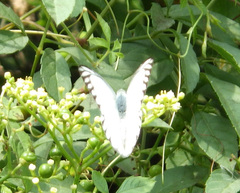
Western Striped Albatross

Western Striped Albatross

Appias libythea

Daily sighting probability ~30% · Possible
at Dhaka

In 3 days ~70% in a week ~90%

33 Verified sightings at Dhaka
54 In all 4 parks From 2019 to 2026
December Best month
☀️ Diurnal When it's spotted

About the Western Striped Albatross

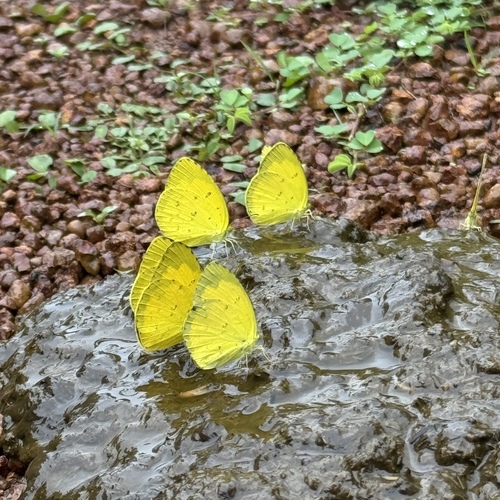
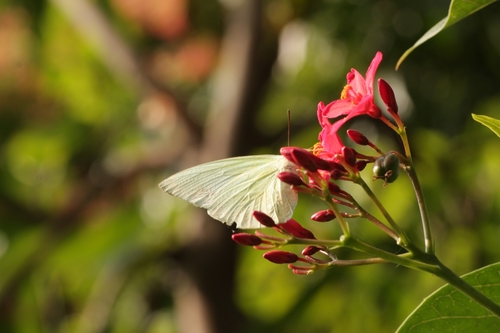
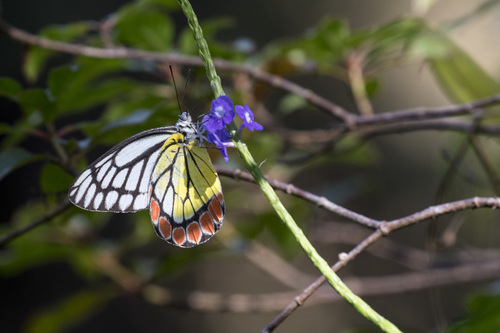
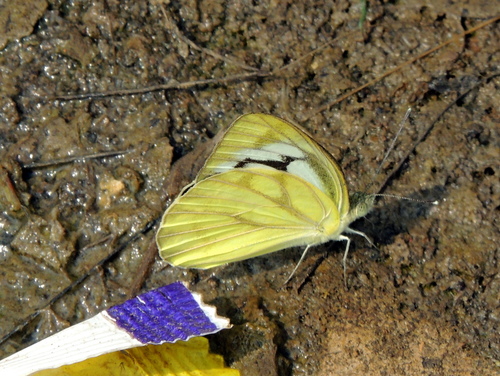
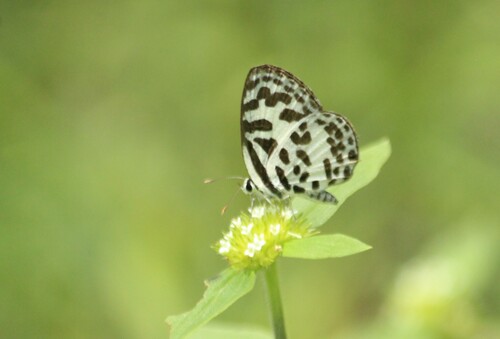
Appias libythea, the striped albatross, is a small butterfly of the family Pieridae, that is, the yellows and whites, which is found in south and southeast Asia. Wet-season brood: Male. Upperside greyish-white. Forewing with black costal edge, and grey-black scaled irrorated basal costal border; a black-scaled very narrow exterior marginal dentated baud decreasing from the subcostal to the submedian. Hindwing with very small indistinct blackish-scaled marginal vein-points, which are obsolete in some specimens that probably emerged near the dry season. Underside white. Forewing with the costal and outer edge slightly blackish; a few greyish-black scales along the base of costa. Hindwing unmarked. Female. Upperside greyish-white. Forewing with greyish-black costal edge, a broad longitudinal band from base of the costa and filling up the cell — with the exception of a thin streak above the median vein, this black cell-band more or less thinly extends along the upper median veinlet and joins a broad outer-marginal decreasing band extending sinuously from before the apex to posterior angle, enclosing the white sub-apical oblique quadrate patch, the outer band showing faint... Wikipedia →

Global Distribution

Parks Where Found

# Park Country Daily sighting probability
1 Cat Tien National Park 🇻🇳 Vietnam
~20%
2 Gunung Leuser National Park 🇮🇩 Indonesia
~10%
3 Kaeng Krachan National Park 🇹🇭 Thailand
~10%
4 Khao Yai National Park 🇹🇭 Thailand
~10%

Cities Where Found

# City Country Daily sighting probability
1 Cần Thơ 🇻🇳 Vietnam
~50%
2 Yogyakarta 🇮🇩 Indonesia
~40%
3 Davao City 🇵🇭 Philippines
~30%
4 Dhaka 🇧🇩 Bangladesh
~30%
5 Jakarta 🇮🇩 Indonesia
~30%
6 Guwahati 🇮🇳 India
~30%
7 Jamshedpur 🇮🇳 India
~30%
8 Ho Chi Minh City 🇻🇳 Vietnam
~30%
9 Bhubaneshwar 🇮🇳 India
~30%
10 Salem 🇮🇳 India
~30%

Before you go

What are the chances of seeing a Western Striped Albatross in Dhaka?

Possible

About 30% of wildlife watchers report a Western Striped Albatross sighting in Dhaka on a given day, based on 33 verified sightings from GBIF citizen-science data. It is the 12th most-seen of the 92 insects we can rate there. Over three days the chance rises to about 70%, and over a week to about 90%, if each day is a fresh chance.

When is the best time to see a Western Striped Albatross in Dhaka?

December

In that month about 50% of wildlife watchers report a Western Striped Albatross in Dhaka on a given day, against under 5% in January, the lowest month. That is one of Dhaka's driest months, with about 20 mm of rain against 440 mm in July.

What time of day is best to see a Western Striped Albatross?

Between 9 am and noon

Across all the parks we cover, that three-hour window holds the most Western Striped Albatross sightings with a recorded time, and about 9 in 10 of them come between 6 am and 6 pm: it is a daytime animal.

Is Dhaka the best place to see a Western Striped Albatross?

4th of 32

Of the 32 cities where we can rate Western Striped Albatross sightings, Dhaka ranks 4th at about 30%. The best odds are in Cần Thơ (Vietnam, about 50%), Yogyakarta (Indonesia, about 40%) and Davao City (Philippines, about 30%).

Which relatives of the Western Striped Albatross live in Dhaka?

Same family: Pieridae

The closest relatives of the Western Striped Albatross that you can see in Dhaka (family Pieridae, Whites, Yellows, and Sulphurs) are Common Grass Yellow (about 40%), Psyche (about 30%) and Lemon Migrant (about 20%), with each one's daily chance of a sighting.

Where does the Western Striped Albatross sighting chance come from?

GBIF citizen-science records

It is estimated from how often the Western Striped Albatross is recorded against all the insects logged in Dhaka (33 verified sightings), calibrated against known sighting rates. Figures are rounded to the nearest 10% because citizen-science data supports honest approximations, not decimals, and months with records from fewer than five people show "—". How it works.

← Back to Dhaka