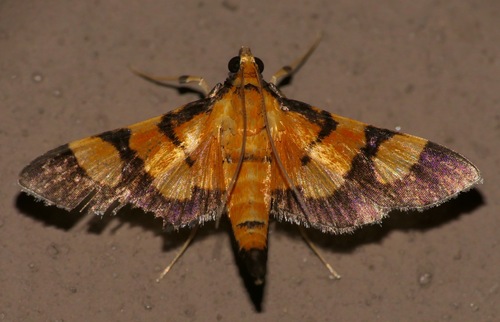
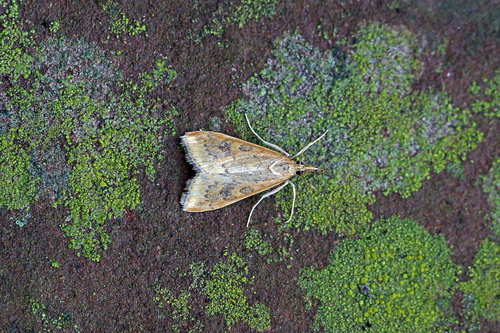
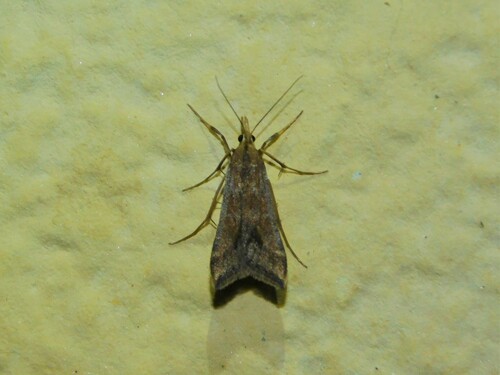
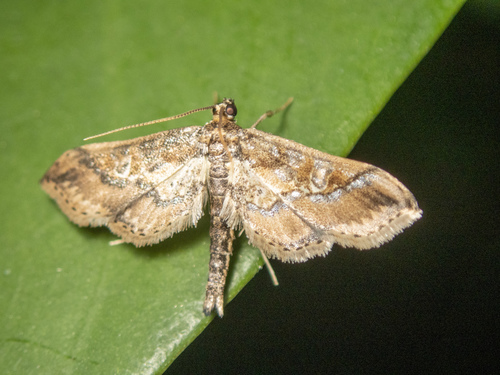
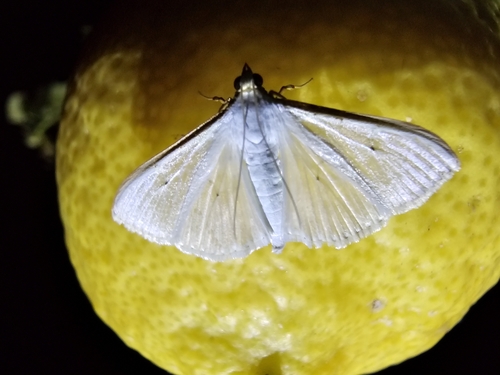
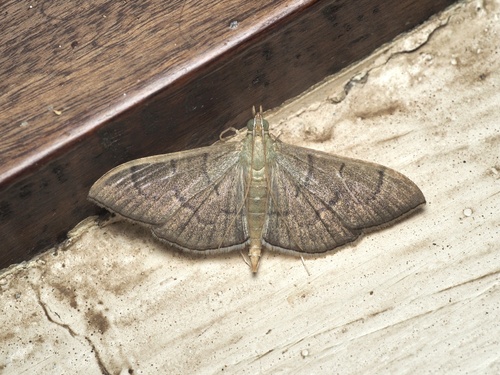
European Pepper Moth

European Pepper Moth

Duponchelia fovealis

Daily sighting probability <5% · Rare
at Durban

In 3 days ~10% in a week ~30%

8 Verified sightings at Durban
22 In all 2 parks From 2019 to 2026
May Best month
☀️🌙 Day & Night When it's spotted

About the European Pepper Moth

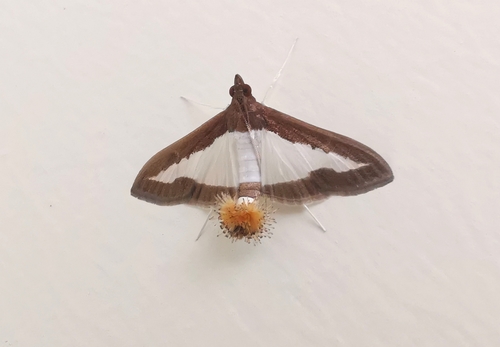
Duponchelia fovealis is a species of moth of the family Crambidae described by Philipp Christoph Zeller in 1847. It is endemic to the area surrounding the Mediterranean Sea, and the Canary Islands, but has extended its range to other parts of Africa, Europe, the Middle East and North America.

Adult wingspan is about 20 mm. The moth flies from May to June, depending on the location. The larvae feed on various plants. Hosts include a wide range of mostly herbaceous ornamental plants and field crops, such as Anemone, Anthurium, Begonia, Cyclamen, Euphorbia, Gerbera, Kalanchoe, Limonium, Rosa, certain aquatic plants, corn, cucumbers, peppers, pomegranate, tomatoes, and certain herbs.

The first record of Duponchelia fovealis in North America was in California where live larvae were detected in a shipment of begonias at a Home Depot in the city of Concord in Contra Costa County from the city of San Marcos in San Diego County (CDFA, NAPIS, 2005). In the spring of 2005, this species was discovered in three greenhouses in southern Ontario, Canada. In July, 2010, four male moths were collected in a pheromone trap in San Diego County, California... Wikipedia →
Global Distribution

Parks Where Found

# Park Country Daily sighting probability
1 Addo Elephant National Park 🇿🇦 South Africa
~10%
2 Kruger National Park 🇿🇦 South Africa
<5%

Cities Where Found

# City Country Daily sighting probability
1 Tel Aviv 🇮🇱 Israel
~10%
2 Athens 🇬🇷 Greece
~10%
3 Rome 🇮🇹 Italy
~10%
4 Istanbul 🇹🇷 Turkey
~10%
5 Durban 🇿🇦 South Africa
<5%
6 Milan 🇮🇹 Italy
<5%
7 Barcelona 🇪🇸 Spain
<5%
8 Lisbon 🇵🇹 Portugal
<5%
9 Dallas 🇺🇸 United States
<5%
10 San Diego 🇺🇸 United States
<5%

Before you go

What are the chances of seeing a European Pepper Moth in Durban?

Rare

Under 5% of wildlife watchers report a European Pepper Moth sighting in Durban on a given day, based on 8 verified sightings from GBIF citizen-science data. It is the 248th most-seen of the 401 insects we can rate there. Over three days the chance rises to about 10%, and over a week to about 30%, if each day is a fresh chance.

When is the best time to see a European Pepper Moth in Durban?

May and August–September

In those months about 10% of wildlife watchers report a European Pepper Moth in Durban on a given day, against under 5% in June–July and October–April, the lowest months. Those are among Durban's driest months, with about 55 mm of rain a month against 210 mm in January.

What time of day is best to see a European Pepper Moth?

Between 7 and 10 pm

Across all the parks we cover, that three-hour window holds the most European Pepper Moth sightings with a recorded time, and about 6 in 10 of them come between 6 pm and 6 am: it is seen both by day and at night.

Is Durban the best place to see a European Pepper Moth?

5th of 13

Of the 13 cities where we can rate European Pepper Moth sightings, Durban ranks 5th at under 5%. The best odds are in Tel Aviv (Israel, about 10%), Athens (Greece, about 10%) and Rome (Italy, about 10%).

Which relatives of the European Pepper Moth live in Durban?

Same family: Crambidae

The closest relatives of the European Pepper Moth that you can see in Durban (family Crambidae, Crambid Snout Moths) are Dotted Sable (about 10%), Hawaiian Beet Webworm Moth (about 10%) and Cucumber Moth (about 10%), with each one's daily chance of a sighting.

Where does the European Pepper Moth sighting chance come from?

GBIF citizen-science records

It is estimated from how often the European Pepper Moth is recorded against all the insects logged in Durban (8 verified sightings), calibrated against known sighting rates. Figures are rounded to the nearest 10% because citizen-science data supports honest approximations, not decimals, and months with records from fewer than five people show "—". How it works.

← Back to Durban