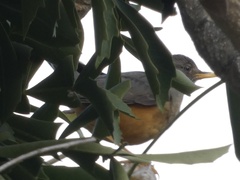
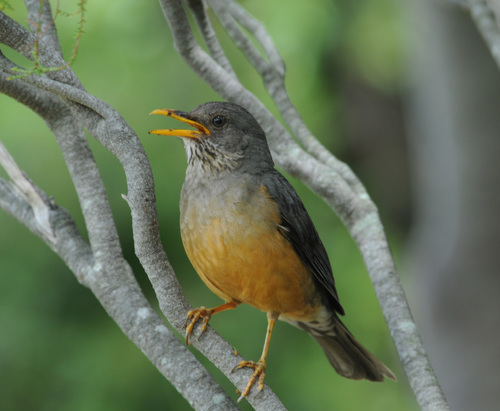
Olive Thrush

Olive Thrush

Turdus olivaceus

Silhouette: Sharon Wegner-Larsen · PhyloPic

LCLeast ConcernNTVUENCR
Daily sighting probability <5% · Rare
at Durban

In 3 days ~10% in a week ~30%

47 Verified sightings at Durban
4,228 In all 8 parks From 2019 to 2026
September Best month
☀️ Diurnal When it's spotted

About the Olive Thrush

The olive thrush (Turdus olivaceus) is, in its range, one of the most common members of the thrush family (Turdidae). It occurs in African highlands from the montane regions in Eastern and Central Africa in the north to the Cape of Good Hope in the south. It is a bird of forest and woodland, but has locally adapted to parks and large gardens in suburban areas.

In 1760 the French zoologist Mathurin Jacques Brisson included a description of the olive thrush in his Ornithologie based on a specimen collected from the Cape of Good Hope in South Africa. He used the French name Le merle olive du Cap de Bonne Espérance and the Latin Merula Olivacea Capitis Bonae Spei. Although Brisson coined Latin names, these do not conform to the binomial system and are not recognised by the International Commission on Zoological Nomenclature. When in 1766 the Swedish naturalist Carl Linnaeus updated his Systema Naturae for the twelfth edition, he added 240 species that had been previously described by Brisson. One of these was the olive thrush. Linnaeus included a brief description, coined the binomial name Turdus olivaceus and cited Brisson's work.

Six subspecies are recognised: Turdus... Wikipedia →

Sounds

Song0:41

Malawi · 2023

© Dries Van de Loock · XC858868 · CC BY-NC-ND 4.0

Dawn song0:54

South Africa · 2021

© Lynette Rudman · XC674301 · CC BY-NC-SA 4.0

Call0:22

South Africa · 2019

© Tony Archer · XC502734 · CC BY-NC-SA 4.0

Global Distribution

Parks Where Found

# Park Country Daily sighting probability
1 Table Mountain National Park 🇿🇦 South Africa
~40%
2 Garden Route National Park 🇿🇦 South Africa
~40%
3 Addo Elephant National Park 🇿🇦 South Africa
~20%
4 Golden Gate Highlands National Park 🇿🇦 South Africa
~10%
5 De Hoop Nature Reserve 🇿🇦 South Africa
<5%
6 West Coast National Park 🇿🇦 South Africa
<5%
7 Kruger National Park 🇿🇦 South Africa
<5%
8 iSimangaliso Wetland Park 🇿🇦 South Africa
<5%

Cities Where Found

# City Country Daily sighting probability
1 Cape Town 🇿🇦 South Africa
~40%
2 Durban 🇿🇦 South Africa
<5%

Zoos & Centres Where Found

# Zoo / Centre Country
1 Monkeyland 🇿🇦 South Africa In captivity
2 World of Birds Wildlife Sanctuary and Monkey Park 🇿🇦 South Africa In captivity
3 Birds of Eden 🇿🇦 South Africa In captivity

Before you go

What are the chances of seeing an Olive Thrush in Durban?

Rare

Under 5% of wildlife watchers report an Olive Thrush sighting in Durban on a given day, based on 47 verified sightings from GBIF citizen-science data. It is the 106th most-seen of the 219 birds we can rate there. Over three days the chance rises to about 10%, and over a week to about 30%, if each day is a fresh chance.

When is the best time to see an Olive Thrush in Durban?

August–September and November–January

In those months about 10% of wildlife watchers report an Olive Thrush in Durban on a given day, against under 5% in February–July and October, the lowest months.

What time of day is best to see an Olive Thrush?

Between 8 and 11 am

Across all the parks we cover, that three-hour window holds the most Olive Thrush sightings with a recorded time, and nearly all of them come between 6 am and 6 pm: it is a daytime animal.

Is Durban the best place to see an Olive Thrush?

2nd of 2

Of the 2 cities where we can rate Olive Thrush sightings, Durban ranks 2nd at under 5%. The best odds are in Cape Town (South Africa, about 40%).

Where does the Olive Thrush sighting chance come from?

GBIF citizen-science records

It is estimated from how often the Olive Thrush is recorded against all the birds logged in Durban (47 verified sightings), calibrated against known sighting rates. Figures are rounded to the nearest 10% because citizen-science data supports honest approximations, not decimals, and months with records from fewer than five people show "—". How it works.
← Back to Durban