White-eared Barbet

White-eared Barbet

Stactolaema leucotis

Silhouette: PhyloPic

LCLeast ConcernNTVUENCR
Daily sighting probability ~20% · Possible
at Durban

In 3 days ~50% in a week ~80%

200 Verified sightings at Durban
1,384 In all 7 parks From 2019 to 2026
June Best month
☀️ Diurnal When it's spotted

About the White-eared Barbet

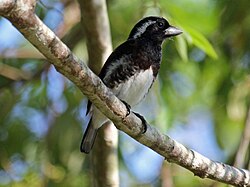
The white-eared barbet (Stactolaema leucotis) is a species of bird in the family Lybiidae (African barbets). It is found in Eswatini, Kenya, Malawi, Mozambique, South Africa, Tanzania, and Zimbabwe. Size is 17–18 cm. Weight 48–63 g. Dark brown woodland barbet with white belly and dark head; eyes brown with grey-black orbital skin, legs and feet black to grey-brown, with grey soles, and black bill. The amount of white on the face, rump, and wings varies geographically, but there is always a white stripe behind the eye. Sexes alike. Immature blacker than adult.

Highland forest and moist primary and secondary forest and some forest edge, also nearby gardens and plantations where fruiting trees present, and where dead trees and limbs are available for excavation; appears able to use Eucalyptus plantations in some areas, including for breeding, provided some native trees and understory remain. In Malawi, can be found up to elevations of 2600 m in the north and to at least 1600 m in the south, often on forested slopes.

Diet comprises fruits, including figs, guavas, pawpaws, mangoes, juniper, Celtis gomphophylla, and other berries. Also... Wikipedia →

Sounds

Call0:20

South Africa · 2024

© Daan van der Hoeven · XC934651 · CC BY-NC-SA 4.0

Begging call0:18

Tanzania · 2022

© isaac kilusu · XC703362 · CC BY-NC-SA 4.0

Song0:38

Tanzania · 2019

© Peter Ericsson · XC467156 · CC BY-NC-SA 4.0

Global Distribution

Parks Where Found

# Park Country Daily sighting probability
1 iSimangaliso Wetland Park 🇿🇦 South Africa
~50%
2 Arusha National Park 🇹🇿 Tanzania
~50%
3 Meru National Park 🇰🇪 Kenya
~10%
4 uMkhuze Game Reserve 🇿🇦 South Africa
~10%
5 Hluhluwe-Imfolozi Park 🇿🇦 South Africa
~10%
6 Mkomazi National Park 🇹🇿 Tanzania
<5%
7 Tarangire National Park 🇹🇿 Tanzania
<5%

Cities Where Found

# City Country Daily sighting probability
1 Durban 🇿🇦 South Africa
~20%

Before you go

What are the chances of seeing a White-eared Barbet in Durban?

Possible

About 20% of wildlife watchers report a White-eared Barbet sighting in Durban on a given day, based on 200 verified sightings from GBIF citizen-science data. It is the 37th most-seen of the 219 birds we can rate there. Over three days the chance rises to about 50%, and over a week to about 80%, if each day is a fresh chance.

When is the best time to see a White-eared Barbet in Durban?

June, August and December

In those months about 30% of wildlife watchers report a White-eared Barbet in Durban on a given day, against about 10% in February and March, the lowest months.

What time of day is best to see a White-eared Barbet?

Between 7 and 10 am

Across all the parks we cover, that three-hour window holds the most White-eared Barbet sightings with a recorded time, and about 9 in 10 of them come between 6 am and 6 pm: it is a daytime animal.

Where else can you see a White-eared Barbet?

Only Durban, in our data

Durban is the only city on Wallace's Line with enough records to rate White-eared Barbet sightings: about 20% of wildlife watchers there report one on a given day.

Which relatives of the White-eared Barbet live in Durban?

Same family: Lybiidae

The closest relatives of the White-eared Barbet that you can see in Durban (family Lybiidae, African Barbets) are Black-collared Barbet (about 50%), Yellow-rumped Tinkerbird (about 40%) and Crested Barbet (about 10%), with each one's daily chance of a sighting.

Where does the White-eared Barbet sighting chance come from?

GBIF citizen-science records

It is estimated from how often the White-eared Barbet is recorded against all the birds logged in Durban (200 verified sightings), calibrated against known sighting rates. Figures are rounded to the nearest 10% because citizen-science data supports honest approximations, not decimals, and months with records from fewer than five people show "—". How it works.

← Back to Durban