Tundra Swan

Tundra Swan

Cygnus columbianus

Silhouette: Andy Wilson · PhyloPic

LCLeast ConcernNTVUENCR
Daily sighting probability <5% · Rare
at Edmonton

In 3 days <5% in a week ~10%

88 Verified sightings at Edmonton
579 In all 13 parks From 2019 to 2026
October Best month
☀️ Diurnal When it's spotted

About the Tundra Swan

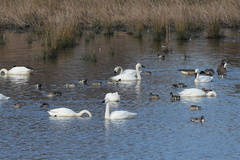
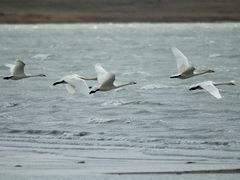
The tundra swan (Cygnus columbianus) is a species of swan which breeds in the arctic, and overwinters in North America, Europe, and Asia. It is the smallest of the Holarctic swans, at 115–150 cm (45–59 in) in length, 168–211 cm (66–83 in) in wingspan and 3.4–9.6 kg (7.5–21.2 lb) in weight. Typically, the plumage of adults is entirely white, with solid black feet, a black beak that has varying amounts of yellow, and a thin streak of pink along the mouthline, although colour variation is common.

In the summer, they mainly eat aquatic vegetation, while at other times of year they often eat leftover crops, such as potatoes. They have few natural predators, although sometimes Arctic foxes, parasitic jaegers, and glaucous gulls will prey upon their eggs and chicks. Their main cause of death is poaching. During the breeding season, tundra swans become aggressive, and may attack passing animals and other tundra swans; outside of the breeding season, they can form groups. They make a high-pitched honk, similar to a black goose.

Tundra swans live for an average of 10 years in the wild. They mate in spring, and are monogamous, mating for life. In May, they build a nest beside water using plant material, and lay 2–7 eggs, which incubate for about 30 days. The young fledge quickly after 60–75 days, twice as fast as the young of mute swans. They remain with their parents for their first winter migration. Sometimes, in their winter grounds, the families are joined offspring from previous breeding seasons. Wikipedia →

Sounds

Nocturnal flight call0:35

Denmark · 2026

© Flemming H. Nielsen · XC1090812 · CC BY-NC-SA 4.0

Flight call0:22

Russian Federation · 2025

© Albert Lastukhin · XC1080593 · CC BY-NC-ND 4.0

Call0:22

China · 2023

© Bo Shunqi薄顺奇 · XC890267 · CC BY-NC-SA 4.0

Global Distribution

Parks Where Found

# Park Country Daily sighting probability
1 Katmai National Park 🇺🇸 United States
~10%
2 Biebrza National Park 🇵🇱 Poland
<5%
3 Wadden Sea National Park 🇩🇪 Germany
<5%
4 Riding Mountain National Park 🇨🇦 Canada
<5%
5 Camargue 🇫🇷 France
<5%
6 Elk Island National Park 🇨🇦 Canada
<5%
7 Kluane National Park 🇨🇦 Canada
<5%
8 Point Pelee National Park 🇨🇦 Canada
<5%
9 Banff National Park 🇨🇦 Canada
<5%
10 Pacific Rim National Park Reserve 🇨🇦 Canada
<5%
11 Great Bear Rainforest 🇨🇦 Canada
<5%
12 Glacier National Park 🇺🇸 United States
<5%
13 Shenandoah National Park 🇺🇸 United States
<5%

Cities Where Found

# City Country Daily sighting probability
1 Beijing 🇨🇳 China
<5%
2 San Diego 🇺🇸 United States
<5%
3 Sendai 🇯🇵 Japan
<5%
4 Suzhou 🇨🇳 China
<5%
5 Hangzhou 🇨🇳 China
<5%
6 Edmonton 🇨🇦 Canada
<5%
7 Saint Petersburg 🇷🇺 Russia
<5%
8 Sacramento 🇺🇸 United States
<5%
9 Calgary 🇨🇦 Canada
<5%
10 Toronto 🇨🇦 Canada
<5%

Zoos & Centres Where Found

# Zoo / Centre Country
1 Moscow Zoo 🇷🇺 Russia In captivity
2 Prague Zoo 🇨🇿 Czechia In captivity
3 Leipzig Zoological Garden 🇩🇪 Germany In captivity
4 Zürich Zoo 🇨🇭 Switzerland In captivity
5 Zoo Hluboka 🇨🇿 Czechia In captivity
6 Chengdu Research Base of Giant Panda Breeding 🇨🇳 China In captivity
7 Bronx Zoo 🇺🇸 United States In captivity
8 Shanghai Zoo 🇨🇳 China In captivity
9 Los Angeles Zoo 🇺🇸 United States In captivity
10 Slimbridge Wetland Centre 🇬🇧 United Kingdom In captivity
11 Berlin Zoological Garden 🇩🇪 Germany In captivity
12 Temaikén 🇦🇷 Argentina In captivity
13 无锡动物园 🇨🇳 China In captivity
14 Zoologischer Garten Leipzig 🇩🇪 Germany In captivity
15 Centro Cicogne e Anatidi 🇮🇹 Italy In captivity
16 British Columbia Wildlife Park 🇨🇦 Canada In captivity
17 Soğanlı Zoo 🇹🇷 Türkiye In captivity
18 Connecticut's Beardsley Zoo 🇺🇸 United States In captivity
19 Ueno Zoo 🇯🇵 Japan In captivity
20 Kazan Zoo & Botanical Garden 🇷🇺 Russia In captivity
21 Ueno Zoological Gardens (West Garden) 🇯🇵 Japan In captivity
22 Leningrad Zoo 🇷🇺 Russia In captivity
23 Lincoln Park Zoo 🇺🇸 United States In captivity
24 Ochsner Park Zoo 🇺🇸 United States In captivity
25 Aquarium Berlin 🇩🇪 Germany In captivity
26 Rákosův pavilon 🇨🇿 Czechia In captivity
27 Velemlokárium 🇨🇿 Czechia In captivity
28 Cochrane Polar Bear Habitat 🇨🇦 Canada In captivity
29 Les Oiseaux du Marais Poitevin 🇫🇷 France In captivity
30 Wolfgang-Köhler-Primaten-Forschungszentrum 🇩🇪 Germany In captivity

Before you go

What are the chances of seeing a Tundra Swan in Edmonton?

Rare

Under 5% of wildlife watchers report a Tundra Swan sighting in Edmonton on a given day, based on 88 verified sightings from GBIF citizen-science data. It is the 123rd most-seen of the 190 birds we can rate there. Over three days the chance rises to under 5%, and over a week to about 10%, if each day is a fresh chance.

When is the best time to see a Tundra Swan in Edmonton?

Any time of year

In every month with enough records, under 5% of wildlife watchers report a Tundra Swan in Edmonton on a given day, so our monthly data shows no clear season.

What time of day is best to see a Tundra Swan?

Between 9 am and noon

Across all the parks we cover, that three-hour window holds the most Tundra Swan sightings with a recorded time, and about 7 in 10 of them come between 6 am and 6 pm: it is a daytime animal.

Is Edmonton the best place to see a Tundra Swan?

Among the best

Of the 27 cities where we can rate Tundra Swan sightings, Edmonton ranks 6th at under 5%, level with the leaders once rounded. The best odds are in Beijing (China, under 5%), San Diego (United States, under 5%) and Sendai (Japan, under 5%).

Where does the Tundra Swan sighting chance come from?

GBIF citizen-science records

It is estimated from how often the Tundra Swan is recorded against all the birds logged in Edmonton (88 verified sightings), calibrated against known sighting rates. Figures are rounded to the nearest 10% because citizen-science data supports honest approximations, not decimals, and months with records from fewer than five people show "—". How it works.

← Back to Edmonton