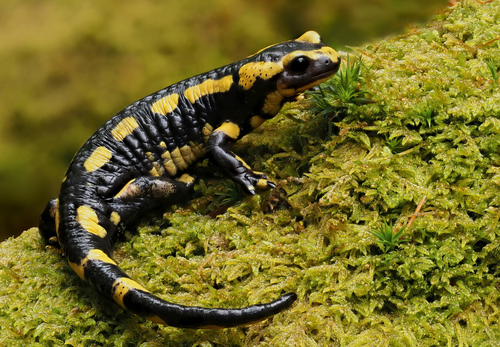
Alpine Newt

Alpine Newt

Ichthyosaura alpestris

Silhouette: Kryp · PhyloPic

Daily sighting probability ~20% · Possible
at Essen

In 3 days ~50% in a week ~80%

53 Verified sightings at Essen
160 In all 6 parks From 2019 to 2026
September Best month
☀️ Diurnal When it's spotted

About the Alpine Newt

The alpine newt (Mesotriton alpestris) is a species of newt native to continental Europe and introduced to Great Britain and New Zealand. Adults measure 7–12 cm (2.8–4.7 in) and are usually dark grey to blue on the back and sides, with an orange belly and throat. Males are more conspicuously coloured than the drab females, especially during breeding season.

The alpine newt occurs at high altitude as well as in the lowlands. Living mainly in forested land habitats for most of the year, the adults migrate to puddles, ponds, lakes or similar water bodies for breeding. Males court females with a ritualised display and deposit a spermatophore. After fertilisation, females usually fold their eggs into leaves of water plants. The aquatic larvae grow up to 5 cm (2.0 in) in around three months before metamorphosing into terrestrial juvenile efts, which mature into adults at around three years. In the southern range, the newts sometimes do not metamorphose but keep their gills and stay aquatic as paedomorphic adults. Larvae and adults feed mainly on diverse invertebrates and themselves fall prey to dragonfly larvae, large beetles, fish, snakes, birds or mammals.

Populations of the alpine newt started to diverge around 20 million years ago. At least four subspecies are distinguished, and some argue there are several distinct, cryptic species. Although still relatively common and classified as Least Concern on the IUCN Red List, alpine newt populations are decreasing and have locally gone extinct. The main threats are habitat destruction, pollution and the introduction of fish such as trout into breeding sites. Where it has been introduced, the alpine newt can potentially transmit diseases to native amphibians, and it is being eradicated in New Zealand. Wikipedia →

Global Distribution

Parks Where Found

# Park Country Daily sighting probability
1 Picos de Europa National Park 🇪🇸 Spain
~50%
2 Triglav National Park 🇸🇮 Slovenia
~30%
3 Hohe Tauern National Park 🇦🇹 Austria
~30%
4 Bavarian Forest National Park 🇩🇪 Germany
~20%
5 Ecrins National Park 🇫🇷 France
~10%
6 Sierra de Guadarrama National Park 🇪🇸 Spain
~10%

Cities Where Found

# City Country Daily sighting probability
1 Essen 🇩🇪 Germany
~20%
2 Lyon 🇫🇷 France
~20%
3 Munich 🇩🇪 Germany
~10%
4 Brussels 🇧🇪 Belgium
~10%
5 Berlin 🇩🇪 Germany
~10%
6 Cologne 🇩🇪 Germany
~10%
7 Prague 🇨🇿 Czechia
~10%
8 Vienna 🇦🇹 Austria
~10%
9 Copenhagen 🇩🇰 Denmark
~10%
10 Paris 🇫🇷 France
~10%

Zoos & Centres Where Found

# Zoo / Centre Country
1 Ostrava Zoo 🇨🇿 Czechia In captivity
2 Civic Aquarium of Milan 🇮🇹 Italy In captivity
3 Slimbridge Wetland Centre 🇬🇧 United Kingdom In captivity
4 Hellabrunn Zoo 🇩🇪 Germany In captivity
5 Heidelberg Zoo 🇩🇪 Germany In captivity
6 Alpenzoo Innsbruck 🇦🇹 Austria In captivity
7 Boston Aquarial Gardens 🇺🇸 United States In captivity
8 Tierpark Schlichtweg 15 in München 🇩🇪 Germany In captivity
9 Zoo Schlichtweg 11 in München 🇩🇪 Germany In captivity
10 Zoo Siebenbrunner Straße 6 in München 🇩🇪 Germany In captivity

Before you go

What are the chances of seeing an Alpine Newt in Essen?

Possible

About 20% of wildlife watchers report an Alpine Newt sighting in Essen on a given day, based on 53 verified sightings from GBIF citizen-science data. It is the 3rd most-seen of the 6 amphibians we can rate there. Over three days the chance rises to about 50%, and over a week to about 80%, if each day is a fresh chance.

When is the best time to see an Alpine Newt in Essen?

September

In that month about 30% of wildlife watchers report an Alpine Newt in Essen on a given day, against under 5% in November and December, the lowest months.

What time of day is best to see an Alpine Newt?

Between 10 am and 1 pm

Across all the parks we cover, that three-hour window holds the most Alpine Newt sightings with a recorded time, and about 9 in 10 of them come between 6 am and 6 pm: it is a daytime animal.

Is Essen the best place to see an Alpine Newt?

Yes

Of the 11 cities where we can rate Alpine Newt sightings, Essen has the highest daily chance: about 20%. Next come Lyon (France, about 20%) and Munich (Germany, about 10%).

Which relatives of the Alpine Newt live in Essen?

Same family: Salamandridae

The closest relatives of the Alpine Newt that you can see in Essen (family Salamandridae, True Salamanders and Newts) are Smooth Newt (about 20%) and Fire Salamander (about 10%), with each one's daily chance of a sighting.

Where does the Alpine Newt sighting chance come from?

GBIF citizen-science records

It is estimated from how often the Alpine Newt is recorded against all the amphibians logged in Essen (53 verified sightings), calibrated against known sighting rates. Figures are rounded to the nearest 10% because citizen-science data supports honest approximations, not decimals, and months with records from fewer than five people show "—". How it works.

← Back to Essen