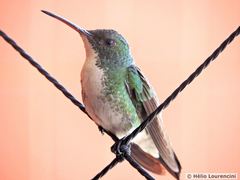
Plain-bellied Emerald

Plain-bellied Emerald

Chrysuronia leucogaster

Silhouette: Ferran Sayol · PhyloPic

LCLeast ConcernNTVUENCR
Daily sighting probability ~30% · Possible
at Fortaleza

In 3 days ~60% in a week ~90%

118 Verified sightings at Fortaleza
February Best month
☀️ Diurnal When it's spotted

About the Plain-bellied Emerald

The plain-bellied emerald (Chrysuronia leucogaster) is a species of hummingbird in the "emeralds", tribe Trochilini of subfamily Trochilinae. It is found in Brazil, the Guianas, and Venezuela. The plain-bellied emerald was formally described in 1788 by the German naturalist Johann Friedrich Gmelin in his revised and expanded edition of Carl Linnaeus's Systema Naturae. He placed it with all the other hummingbirds in the genus Trochilus and coined the binomial name Trochilus leucogaster. The species had been described and illustrated by the French naturalists Mathurin Jacques Brisson in 1760 and Georges-Louis Leclerc, Comte de Buffon in 1779. Gmelin did not specify a type locality but this was designated as Cayenne, French Guiana, by Hans von Berlepsch in 1908.

The plain-bellied emerald was for a time placed in the genus Agyrtria and then in Amazilia. A molecular phylogenetic study published in 2014 found that Amazilia was polyphyletic. In the revised classification to create monophyletic genera, the plain-bellied emerald was moved by most taxonomic systems to Chrysuronia. However, BirdLife International's Handbook of the Birds of the World retains it in... Wikipedia →

Sounds

Flight call0:10

Brazil · 2021

© Fernando Igor de Godoy · XC707605 · CC BY-NC-SA 4.0

Canto1:15

Brazil · 2017

© Caio Brito · XC427049 · CC BY-NC-SA 4.0

Call1:02

Brazil · 2013

© Dan Lane · XC121794 · CC BY-NC-SA 3.0

Global Distribution

Parks Where Found

# Park Country Daily sighting probability

More parks will be added in future updates.

Cities Where Found

# City Country Daily sighting probability
1 João Pessoa 🇧🇷 Brazil
~50%
2 Natal 🇧🇷 Brazil
~50%
3 Recife 🇧🇷 Brazil
~40%
4 São Luís 🇧🇷 Brazil
~30%
5 Fortaleza 🇧🇷 Brazil
~30%
6 Salvador 🇧🇷 Brazil
~20%
7 Maceió 🇧🇷 Brazil
~20%

Before you go

What are the chances of seeing a Plain-bellied Emerald in Fortaleza?

Possible

About 30% of wildlife watchers report a Plain-bellied Emerald sighting in Fortaleza on a given day, based on 118 verified sightings from GBIF citizen-science data. It is the 34th most-seen of the 129 birds we can rate there. Over three days the chance rises to about 60%, and over a week to about 90%, if each day is a fresh chance.

When is the best time to see a Plain-bellied Emerald in Fortaleza?

February

In that month about 40% of wildlife watchers report a Plain-bellied Emerald in Fortaleza on a given day, against about 20% in April–May and October–January, the lowest months. That is one of Fortaleza's wettest months, with about 150 mm of rain against almost none in September.

What time of day is best to see a Plain-bellied Emerald?

Between 7 and 10 am

Across all the parks we cover, that three-hour window holds the most Plain-bellied Emerald sightings with a recorded time, and about 8 in 10 of them come between 6 am and 6 pm: it is a daytime animal.

Is Fortaleza the best place to see a Plain-bellied Emerald?

5th of 7

Of the 7 cities where we can rate Plain-bellied Emerald sightings, Fortaleza ranks 5th at about 30%. The best odds are in João Pessoa (Brazil, about 50%), Natal (Brazil, about 50%) and Recife (Brazil, about 40%).

Which relatives of the Plain-bellied Emerald live in Fortaleza?

Same family: Trochilidae

The closest relatives of the Plain-bellied Emerald that you can see in Fortaleza (family Trochilidae, Hummingbirds) are Swallow-tailed Hummingbird (about 30%) and Glittering-throated Emerald (about 10%), with each one's daily chance of a sighting.

Where does the Plain-bellied Emerald sighting chance come from?

GBIF citizen-science records

It is estimated from how often the Plain-bellied Emerald is recorded against all the birds logged in Fortaleza (118 verified sightings), calibrated against known sighting rates. Figures are rounded to the nearest 10% because citizen-science data supports honest approximations, not decimals, and months with records from fewer than five people show "—". How it works.

← Back to Fortaleza