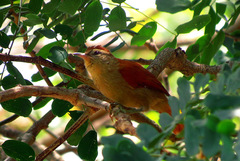
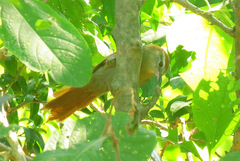

Rusty-backed Spinetail

Rusty-backed Spinetail

Cranioleuca vulpina

Silhouette: Sheatherius · PhyloPic

LCLeast ConcernNTVUENCR
Daily sighting probability ~10% · With luck
at Goiânia

In 3 days ~30% in a week ~60%

62 Verified sightings at Goiânia
543 In all 3 parks From 2019 to 2026
September Best month
☀️ Diurnal When it's spotted

About the Rusty-backed Spinetail

The rusty-backed spinetail (Cranioleuca vulpina) is a Neotropical species of bird in the Furnariinae subfamily of the ovenbird family Furnariidae. It is found in Bolivia, Brazil, Colombia, Paraguay, Peru, Venezuela, and possibly Guyana.

The rusty-backed spinetail was formally described in 1856 by the Austrian ornithologist August von Pelzeln under the binomial name Synallaxis vulpina. Its specific epithet is from Latin vulpinus meaning "fox-like" (ie reddish-brown above and white beneath). The rusty-backed spinetail is now placed in the genus Cranioleuca that was introduced in 1853 by Ludwig Reichenbach.

Four subspecies are recognized: What are now the Coiba spinetail (C. dissita) and Parker's spinetail (C. vulpecula) were previously treated as subspecies of the rusty-backed spinetail. Other subspecies have been proposed but have not been accepted as valid.

The rusty-backed spinetail is 15 to 16 cm (5.9 to 6.3 in) long and weighs 14 to 17 g (0.49 to 0.60 oz). The sexes have the... Wikipedia →

Sounds

Duet0:54

Brazil · 2025

© Joost van Bruggen · XC1050577 · CC BY-NC-ND 4.0

Song0:15

Colombia · 2022

© Frank Lambert · XC1040501 · CC BY-NC-ND 4.0

Call1:07

Brazil · 2024

© JAYRSON ARAUJO DE OLIVEIRA · XC956625 · CC BY-NC-SA 4.0

Global Distribution

Parks Where Found

# Park Country Daily sighting probability
1 Coiba National Park 🇵🇦 Panama
~40%
2 Parque Estadual Encontro das Águas 🇧🇷 Brazil
~20%
3 Anavilhanas National Park 🇧🇷 Brazil
~10%

Cities Where Found

# City Country Daily sighting probability
1 Goiânia 🇧🇷 Brazil
~10%

Before you go

What are the chances of seeing a Rusty-backed Spinetail in Goiânia?

With luck

About 10% of wildlife watchers report a Rusty-backed Spinetail sighting in Goiânia on a given day, based on 62 verified sightings from GBIF citizen-science data. It is the 81st most-seen of the 174 birds we can rate there. Over three days the chance rises to about 30%, and over a week to about 60%, if each day is a fresh chance.

When is the best time to see a Rusty-backed Spinetail in Goiânia?

January, April, June–July and September

In those months about 20% of wildlife watchers report a Rusty-backed Spinetail in Goiânia on a given day, against under 5% in March and May, the lowest months.

What time of day is best to see a Rusty-backed Spinetail?

Between 7 and 10 am

Across all the parks we cover, that three-hour window holds the most Rusty-backed Spinetail sightings with a recorded time, and about 9 in 10 of them come between 6 am and 6 pm: it is a daytime animal.

Where else can you see a Rusty-backed Spinetail?

Only Goiânia, in our data

Goiânia is the only city on Wallace's Line with enough records to rate Rusty-backed Spinetail sightings: about 10% of wildlife watchers there report one on a given day.

Which relatives of the Rusty-backed Spinetail live in Goiânia?

Same family: Furnariidae

The closest relatives of the Rusty-backed Spinetail that you can see in Goiânia (family Furnariidae, Ovenbirds and Woodcreepers) are Rufous Hornero (about 70%), Buff-throated Woodcreeper (about 10%) and Red-billed Scythebill (about 10%), with each one's daily chance of a sighting.

Where does the Rusty-backed Spinetail sighting chance come from?

GBIF citizen-science records

It is estimated from how often the Rusty-backed Spinetail is recorded against all the birds logged in Goiânia (62 verified sightings), calibrated against known sighting rates. Figures are rounded to the nearest 10% because citizen-science data supports honest approximations, not decimals, and months with records from fewer than five people show "—". How it works.

← Back to Goiânia