Canyon Tree Frog

Canyon Tree Frog

Dryophytes arenicolor

Silhouette: Robbi Bishop-Taylor · PhyloPic

LCLeast ConcernNTVUENCR
Daily sighting probability ~10% · With luck
at Guadalajara

In 3 days ~20% in a week ~30%

13 Verified sightings at Guadalajara
568 In all 4 parks From 2019 to 2026
October Best month
☀️🌙 Day & Night When it's spotted

About the Canyon Tree Frog

The canyon tree frog (Dryophytes arenicolor) is a species of tree frog native to the rocky plateau areas of southern United States, primarily in New Mexico and Arizona, but it also ranges to Utah, Texas, and Colorado, and as far south as the Mexican states of Michoacán, México, Guanajuato, Guerrero, and Oaxaca.

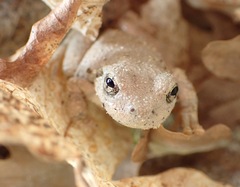
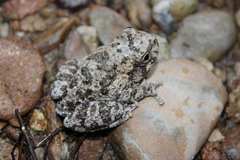
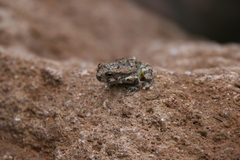
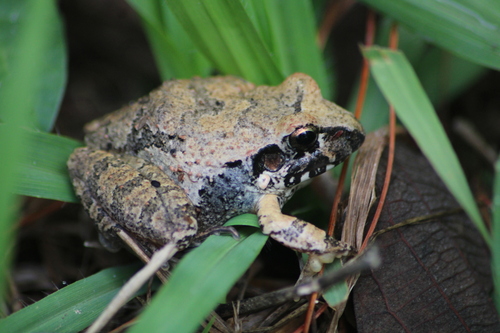
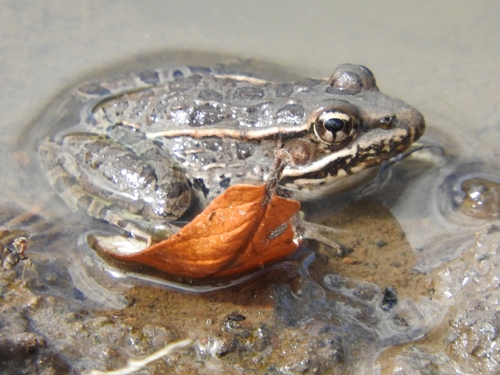
Canyon tree frogs grow to 5.0–5.5 cm (2.0–2.2 in) in length, and are typically brown, grey-brown, or grey-green in color, often with darker-colored blotching. They can vary considerably, but usually match the soil or rock coloration of their native habitats to serve as camouflage. Those from limestone habitats are lighter colored, and those from regions composed mostly of granite can even be pink in coloration. Most have bright yellow in their groin regions, and faded banding on their legs.

Canyon tree frogs are mostly nocturnal and carnivorous. They are typically found in semiarid, rocky habitats near a permanent water source. Breeding occurs during the spring rains, and large, floating egg masses of 100 or more eggs are laid on the water. During periods of low rainfall, the frogs will take refuge in rock/bolder crevices.

Desert... Wikipedia →

Sounds

Advertisement call0:29

United States · 2015

© Chris Harrison · XC890894 · CC BY-NC-SA 4.0

Recording0:12

United States · 2026

© clarksnutcracker_limberpine_shipper · iNaturalist · CC BY-NC 4.0

Recording0:57

United States · 2025

© Robert Ivens · iNaturalist · CC BY-NC 4.0

Global Distribution

Parks Where Found

# Park Country Daily sighting probability
1 Zion National Park 🇺🇸 United States
~60%
2 Grand Canyon National Park 🇺🇸 United States
~30%
3 Saguaro National Park 🇺🇸 United States
~20%
4 Big Bend National Park 🇺🇸 United States
~10%

Cities Where Found

# City Country Daily sighting probability
1 Mexico City 🇲🇽 México
~10%
2 Guadalajara 🇲🇽 México
~10%

Zoos & Centres Where Found

# Zoo / Centre Country
1 Phoenix Zoo 🇺🇸 United States In captivity
2 Arizona-Sonora Desert Museum 🇺🇸 United States In captivity
3 El Paso Zoo 🇺🇸 United States In captivity

Before you go

What are the chances of seeing a Canyon Tree Frog in Guadalajara?

With luck

About 10% of wildlife watchers report a Canyon Tree Frog sighting in Guadalajara on a given day, based on 13 verified sightings from GBIF citizen-science data. It is the 2nd most-seen of the 5 amphibians we can rate there. Over three days the chance rises to about 20%, and over a week to about 30%, if each day is a fresh chance.

When is the best time to see a Canyon Tree Frog in Guadalajara?

February, April–June, August–October and December

In those months about 10% of wildlife watchers report a Canyon Tree Frog in Guadalajara on a given day, against under 5% in January, March, July and November, the lowest months.

What time of day is best to see a Canyon Tree Frog?

Between 9 am and noon

Across all the parks we cover, that three-hour window holds the most Canyon Tree Frog sightings with a recorded time, and about 6 in 10 of them come between 6 am and 6 pm: it is seen both by day and at night.

Is Guadalajara the best place to see a Canyon Tree Frog?

Among the best

Of the 2 cities where we can rate Canyon Tree Frog sightings, Guadalajara ranks 2nd at about 10%, level with the leaders once rounded. The best odds are in Mexico City (México, about 10%).

Where does the Canyon Tree Frog sighting chance come from?

GBIF citizen-science records

It is estimated from how often the Canyon Tree Frog is recorded against all the amphibians logged in Guadalajara (13 verified sightings), calibrated against known sighting rates. Figures are rounded to the nearest 10% because citizen-science data supports honest approximations, not decimals, and months with records from fewer than five people show "—". How it works.

← Back to Guadalajara