White-edged Oriole

White-edged Oriole

Icterus graceannae

Silhouette: Matt Wilkins · PhyloPic

LCLeast ConcernNTVUENCR
Daily sighting probability <5% · Rare
at Guayaquil

In 3 days <5% in a week ~10%

12 Verified sightings at Guayaquil
30 In 1 park From 2019 to 2026
December Best month
☀️ Diurnal When it's spotted

About the White-edged Oriole

The white-edged oriole (Icterus graceannae) is a species of bird in the family Icteridae, the oropendolas, New World orioles, and New World blackbirds. It is found in Ecuador and Peru. The white-edged oriole was formally described by John Cassin in 1867 with the binomial Icterus Grace-Annae, which (with modern spelling) remains its binomial. Cassin named it "in honor of my highly esteemed friend, Miss Grace Anna Lewis...accomplished as a teacher of Natural History".

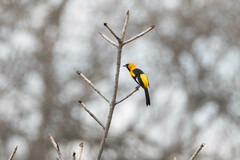
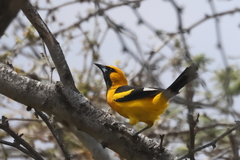
The white-edged oriole is monotypic. The white-edged oriole is 19 to 20 cm (7.5 to 7.9 in) long. Males weigh an average of about 46 g (1.6 oz) and females about 37 g (1.3 oz). The sexes have the same plumage. Adults are mostly orange-yellow. They have black lores, a black "mask", and a black "bib" from the chin to the upper breast. Their back is black. Their wings are mostly black with pale yellow lesser and median coverts. Their innermost secondaries and their tertials have the eponymous wide white edges at their bases that show as a large white patch on the closed wing. Their tail is mostly black with white edges on the outermost pair of feathers and sometimes white tips... Wikipedia →

Sounds

Call0:34

Ecuador · 2022

© Jerome Fischer · XC704613 · CC BY-NC-SA 4.0

Song0:18

Ecuador · 2014

© Vanessa Luzuriaga · XC355941 · CC BY-NC-SA 4.0

Subsong0:17

Ecuador · 2003

© John V. Moore · XC260042 · CC BY-NC-SA 4.0

Global Distribution

Parks Where Found

# Park Country Daily sighting probability
1 Machalilla National Park 🇪🇨 Ecuador
<5%

More parks will be added in future updates.

Cities Where Found

# City Country Daily sighting probability
1 Guayaquil 🇪🇨 Ecuador
<5%
2 Lima 🇵🇪 Peru
<5%

Before you go

What are the chances of seeing a White-edged Oriole in Guayaquil?

Rare

Under 5% of wildlife watchers report a White-edged Oriole sighting in Guayaquil on a given day, based on 12 verified sightings from GBIF citizen-science data. It is the 129th most-seen of the 167 birds we can rate there. Over three days the chance rises to under 5%, and over a week to about 10%, if each day is a fresh chance.

When is the best time to see a White-edged Oriole in Guayaquil?

December

In that month about 10% of wildlife watchers report a White-edged Oriole in Guayaquil on a given day, against under 5% in January to November, the lowest months. That is one of Guayaquil's driest months, with about 25 mm of rain against 220 mm in February.

What time of day is best to see a White-edged Oriole?

Between 8 and 11 am

Across all the parks we cover, that three-hour window holds the most White-edged Oriole sightings with a recorded time, and about 8 in 10 of them come between 6 am and 6 pm: it is a daytime animal.

Is Guayaquil the best place to see a White-edged Oriole?

Yes

Of the 2 cities where we can rate White-edged Oriole sightings, Guayaquil has the highest daily chance: under 5%. Next come Lima (Peru, under 5%).

Where does the White-edged Oriole sighting chance come from?

GBIF citizen-science records

It is estimated from how often the White-edged Oriole is recorded against all the birds logged in Guayaquil (12 verified sightings), calibrated against known sighting rates. Figures are rounded to the nearest 10% because citizen-science data supports honest approximations, not decimals, and months with records from fewer than five people show "—". How it works.

← Back to Guayaquil