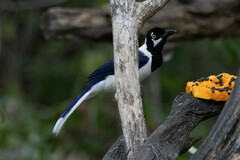
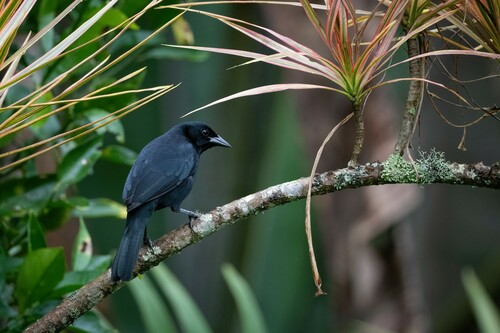
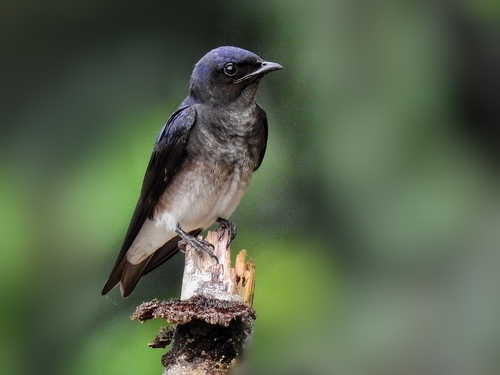
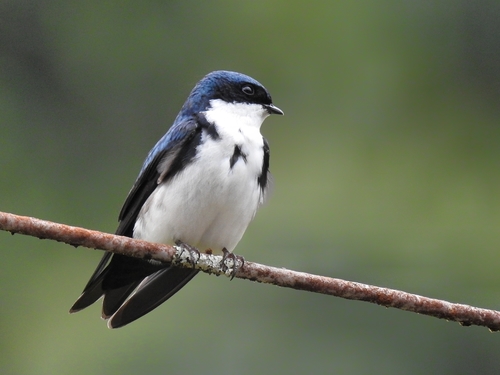
White-tailed Jay

White-tailed Jay

Cyanocorax mystacalis

Silhouette: Sheatherius · PhyloPic

LCLeast ConcernNTVUENCR
Daily sighting probability <5% · Rare
at Guayaquil

In 3 days <5%

5 Verified sightings at Guayaquil
December Best month
☀️ Diurnal When it's spotted

About the White-tailed Jay

The white-tailed jay (Cyanocorax mystacalis), also known as the moustached jay, is a species of bird in the crow family Corvidae. It is found in Ecuador and Peru. It has a black face with white spots above and below the eyes, and a small white moustachial stripe. It has a white nape, belly, and underparts. Its back and wings are greyish-blue, extending most of the way down the tail. The rectrices and tail tip are white. It has several calls, the most common being described as "cha-cha-cha-cha".

The white-tailed jay was first described by the French ornithologist Louis Ernest Gustave de Sparre in 1835 and was given the scientific name Pica mystacalis. It was later placed in the genus Cyanocorax. It is visually very similar to the tufted jay, which is found in Mexico over 4,800 km (3,000 mi) away, and the two species were incorrectly thought to be close relatives. The white-tailed jay's relationship to others in the genus Cyanocorax is still unclear.

The white-tailed jay lives in semi-humid, semi-open woodlands, preferring to remain near thick vegetation close to rivers and streams. It eats mostly insects and seeds, but has also been known to steal eggs from the nests of other birds. It forages in flocks and can be found feeding on the ground more often than other members of the genus Cyanocorax. While little is known of its breeding and nesting habits, it is known to build nests through February and March and may nest close to villages. The white-tailed jay is considered a species of least concern by the International Union for Conservation of Nature, although its population has seen notable decreases in some regions. The largest threat to its survival is habitat destruction. Wikipedia →

Sounds

Uncertain0:30

Ecuador · 2022

© Jerome Fischer · XC704795 · CC BY-NC-SA 4.0

Call0:43

Ecuador · 2019

© Leonardo Ordóñez-Delgado · XC513931 · CC BY-NC-SA 4.0

Song0:13

Ecuador · 2013

© Andrew Spencer · XC121097 · CC BY-NC-SA 3.0

Global Distribution

Parks Where Found

# Park Country Daily sighting probability

More parks will be added in future updates.

Cities Where Found

# City Country Daily sighting probability
1 Guayaquil 🇪🇨 Ecuador
<5%

Before you go

What are the chances of seeing a White-tailed Jay in Guayaquil?

Rare

Under 5% of wildlife watchers report a White-tailed Jay sighting in Guayaquil on a given day, based on 5 verified sightings from GBIF citizen-science data. It is the 161st most-seen of the 167 birds we can rate there. Over three days the chance rises to under 5%, if each day is a fresh chance.

When is the best time to see a White-tailed Jay in Guayaquil?

Any time of year

In every month with enough records, under 5% of wildlife watchers report a White-tailed Jay in Guayaquil on a given day, so our monthly data shows no clear season.

What time of day is best to see a White-tailed Jay?

Between 10 am and 1 pm

Across all the parks we cover, that three-hour window holds the most White-tailed Jay sightings with a recorded time, and about 9 in 10 of them come between 6 am and 6 pm: it is a daytime animal.

Where else can you see a White-tailed Jay?

Only Guayaquil, in our data

Guayaquil is the only city on Wallace's Line with enough records to rate White-tailed Jay sightings: under 5% of wildlife watchers there report one on a given day.

Which relatives of the White-tailed Jay live in Guayaquil?

Same order: Passeriformes

The closest relatives of the White-tailed Jay that you can see in Guayaquil (order Passeriformes, Perching Birds) are Blue-gray Tanager (about 90%), Tropical Kingbird (about 80%) and Scrub Blackbird (about 70%), with each one's daily chance of a sighting.

Where does the White-tailed Jay sighting chance come from?

GBIF citizen-science records

It is estimated from how often the White-tailed Jay is recorded against all the birds logged in Guayaquil (5 verified sightings), calibrated against known sighting rates. Figures are rounded to the nearest 10% because citizen-science data supports honest approximations, not decimals, and months with records from fewer than five people show "—". How it works.

← Back to Guayaquil