

Japanese Wood Ant

Japanese Wood Ant

Formica japonica

Daily sighting probability ~40% · Likely
at Gwangju

In 3 days ~80% in a week >90%

14 Verified sightings at Gwangju
August Best month
☀️ Diurnal When it's spotted

About the Japanese Wood Ant

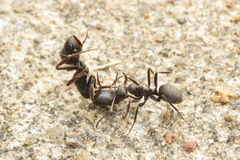
Formica japonica is a species of ant in the genus Formica. It is one of the most common ants in Japan, being found as well in Russia, Mongolia, China, Taiwan, and Korea. There is a suggestion that Formica japonica may be four separate "sibling species" as a study found four different hydrocarbon compositions throughout Japan that appeared to correspond to geographical populations, that is, the geographical populations smell different from one another. The comparisons of circular hydrocarbons revealed nestmate workers shared nearly identical blends of smells that contained all the common components of hydrocarbons but the hydrocarbon blends smelled differed among colonies. However, further research is needed to determine if the differences in hydrocarbon components are due to intraspecific variation or are due to interspecific variation and if hybridization occurs between different hydrocarbon compositions. It is not uncommon within insect taxonomy that reclassification such as this occurs, often with the continuation of time and advancement of technology, researchers are able to learn more about species. Furthermore, this delineation of species has occurred within Formica... Wikipedia →

Global Distribution

Parks Where Found

# Park Country Daily sighting probability

More parks will be added in future updates.

Cities Where Found

# City Country Daily sighting probability
1 Gwangju 🇰🇷 South Korea
~40%
2 Busan 🇰🇷 South Korea
~20%
3 Sendai 🇯🇵 Japan
~20%
4 Seoul 🇰🇷 South Korea
~20%
5 Tokyo 🇯🇵 Japan
~20%
6 Sapporo 🇯🇵 Japan
~20%
7 Nagoya 🇯🇵 Japan
~20%
8 Daejeon 🇰🇷 South Korea
~10%
9 Osaka 🇯🇵 Japan
~10%

Before you go

What are the chances of seeing a Japanese Wood Ant in Gwangju?

Likely

About 40% of wildlife watchers report a Japanese Wood Ant sighting in Gwangju on a given day, based on 14 verified sightings from GBIF citizen-science data. It is the 3rd most-seen of the 20 insects we can rate there. Over three days the chance rises to about 80%, and over a week to over 90%, if each day is a fresh chance.

When is the best time to see a Japanese Wood Ant in Gwangju?

August

In that month about 60% of wildlife watchers report a Japanese Wood Ant in Gwangju on a given day, against under 5% in July, the lowest month. That is one of Gwangju's wettest months, with about 270 mm of rain against 30 mm in January. March and December–January have too few records to rate.

What time of day is best to see a Japanese Wood Ant?

Between 7 and 10 am

Across all the parks we cover, that three-hour window holds the most Japanese Wood Ant sightings with a recorded time, and nearly all of them come between 6 am and 6 pm: it is a daytime animal.

Is Gwangju the best place to see a Japanese Wood Ant?

Yes

Of the 9 cities where we can rate Japanese Wood Ant sightings, Gwangju has the highest daily chance: about 40%. Next come Busan (South Korea, about 20%) and Sendai (Japan, about 20%).

Where does the Japanese Wood Ant sighting chance come from?

GBIF citizen-science records

It is estimated from how often the Japanese Wood Ant is recorded against all the insects logged in Gwangju (14 verified sightings), calibrated against known sighting rates. Figures are rounded to the nearest 10% because citizen-science data supports honest approximations, not decimals, and months with records from fewer than five people show "—". How it works.

← Back to Gwangju