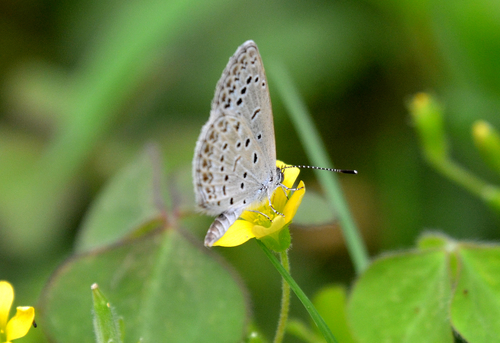
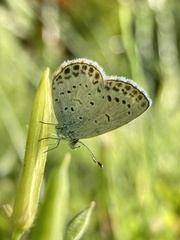
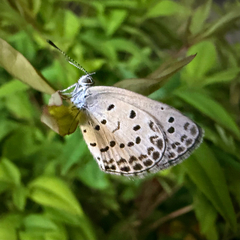
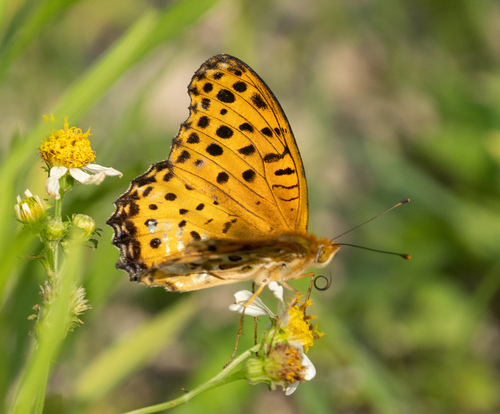


Pale Grass Blue

Pale Grass Blue

Pseudozizeeria maha

Daily sighting probability ~60% · Likely
at Gwangju

In 3 days ~90% in a week >90%

32 Verified sightings at Gwangju
26 In all 3 parks From 2019 to 2026
August Best month
☀️ Diurnal When it's spotted

About the Pale Grass Blue

Pseudozizeeria maha, the pale grass blue, is a small butterfly found in South Asia that belongs to the lycaenids or blues family. The species was first described by Vincenz Kollar in 1844. The subspecies of Pseudozizeeria maha are-

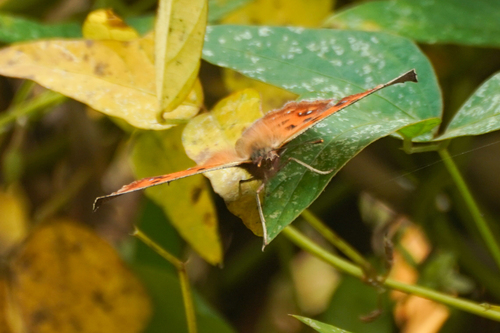
Pseudozizeeria maha saishutonis (Matsumura, 1927) – Korea Pseudozizeeria maha argia (Ménétriès, 1857) – Japan Male. Upperside silvery light blue with a satiny sheen in certain lights. Forewing: the apical half of the costa narrowly and the terminal margin for varying widths fuscous black, bounded outwardly on the latter by an obscure anteciliary black line. Hindwing: the costa broadly, the termen somewhat more narrowly fuscous black as in the forewing, with the width of this dark edging similarly variable; in addition there is a very diffuse and ill-defined subterminal series of spots darker than the fuscous margin. Underside... Wikipedia →

Global Distribution

Parks Where Found

# Park Country Daily sighting probability
1 Manas National Park 🇮🇳 India
~20%
2 Nikko National Park 🇯🇵 Japan
~20%
3 Taroko National Park 🇹🇼 Taiwan
~10%

Cities Where Found

# City Country Daily sighting probability
1 Gwangju 🇰🇷 South Korea
~60%
2 Jamshedpur 🇮🇳 India
~50%
3 Kanpur 🇮🇳 India
~40%
4 Cần Thơ 🇻🇳 Vietnam
~40%
5 Busan 🇰🇷 South Korea
~40%
6 Nagoya 🇯🇵 Japan
~40%
7 Taichung 🇹🇼 Taiwan
~40%
8 Tainan 🇹🇼 Taiwan
~30%
9 Tuen Mun 🇨🇳 China
~30%
10 Guwahati 🇮🇳 India
~30%

Before you go

What are the chances of seeing a Pale Grass Blue in Gwangju?

Likely

About 60% of wildlife watchers report a Pale Grass Blue sighting in Gwangju on a given day, based on 32 verified sightings from GBIF citizen-science data. It is the most-seen of the 20 insects we can rate there. Over three days the chance rises to about 90%, and over a week to over 90%, if each day is a fresh chance.

When is the best time to see a Pale Grass Blue in Gwangju?

August and October

In those months about 80% of wildlife watchers report a Pale Grass Blue in Gwangju on a given day, against about 10% in April, June and November, the lowest months. Those are among Gwangju's wettest months, with about 170 mm of rain a month against 30 mm in January. March and December–January have too few records to rate.

What time of day is best to see a Pale Grass Blue?

Between noon and 3 pm

Across all the parks we cover, that three-hour window holds the most Pale Grass Blue sightings with a recorded time, and about 9 in 10 of them come between 6 am and 6 pm: it is a daytime animal.

Is Gwangju the best place to see a Pale Grass Blue?

Yes

Of the 61 cities where we can rate Pale Grass Blue sightings, Gwangju has the highest daily chance: about 60%. Next come Jamshedpur (India, about 50%) and Kanpur (India, about 40%).

Where does the Pale Grass Blue sighting chance come from?

GBIF citizen-science records

It is estimated from how often the Pale Grass Blue is recorded against all the insects logged in Gwangju (32 verified sightings), calibrated against known sighting rates. Figures are rounded to the nearest 10% because citizen-science data supports honest approximations, not decimals, and months with records from fewer than five people show "—". How it works.

← Back to Gwangju