Snouted Cobra

Snouted Cobra

Naja annulifera

Silhouette: V. Deepak · PhyloPic

LCLeast ConcernNTVUENCR
Daily sighting probability ~10% · With luck
at Harare

In 3 days ~40% in a week ~70%

6 Verified sightings at Harare
7 In 1 park From 2019 to 2026
May Best month
☀️ Diurnal When it's spotted

About the Snouted Cobra

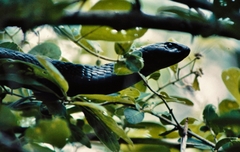
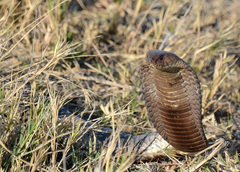
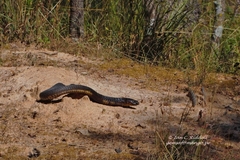
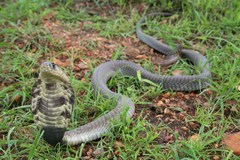
The snouted cobra (Naja annulifera), also called the banded Egyptian cobra, is a highly venomous species of cobra found in Southern Africa. The snouted cobra is a relatively large species. Adult specimens average between 1.2 and 1.8 metres (3.9 and 5.9 ft) in length, but they may reach lengths of 2.5 metres (8.2 ft). Colouration of dorsal scales may vary from yellowish to greyish-brown, dark brown or blue-black. Ventral scale colouration is yellow with darker mottles. A banded phase occurs throughout the species' range and is blue-black with 7-11 yellow to yellow-brown cross bars, the lighter bands being half the width of the darker bands. The latter colour phase is more common in males. Ventrally, it is yellow mottled with black. A darker throat band is present and is usually more prominent in juveniles.

Midbody scales are in 19 rows (rarely 21) with 175-203 ventrals. There are 51-65 paired subcaudals and the anal shield is entire. There are seven (sometimes eight) upper labials that do not enter the eye, eight or 9 (rarely 10) lower labials, as well as one preocular (sometimes two) and two (sometimes one or three) postoculars. Temporals are variable... Wikipedia →

Global Distribution

Parks Where Found

# Park Country Daily sighting probability
1 Kruger National Park 🇿🇦 South Africa
<5%

More parks will be added in future updates.

Cities Where Found

# City Country Daily sighting probability
1 Harare 🇿🇼 Zimbabwe
~10%

Zoos & Centres Where Found

# Zoo / Centre Country
1 San Diego Zoo 🇺🇸 United States In captivity
2 National Zoological Park 🇺🇸 United States In captivity
3 Bronx Zoo 🇺🇸 United States In captivity
4 Johannesburg Zoo 🇿🇦 South Africa In captivity
5 National Zoological Garden of South Africa 🇿🇦 South Africa In captivity
6 Phoenix Zoo 🇺🇸 United States In captivity
7 Central Florida Zoo and Botanical Gardens 🇺🇸 United States In captivity
8 Louisville Zoo 🇺🇸 United States In captivity
9 Reptile Gardens 🇺🇸 United States In captivity
10 Staten Island Zoo 🇺🇸 United States In captivity
11 Hartbeespoort Dam Snake and Animal Park 🇿🇦 South Africa In captivity

Before you go

What are the chances of seeing a Snouted Cobra in Harare?

With luck

About 10% of wildlife watchers report a Snouted Cobra sighting in Harare on a given day, based on 6 verified sightings from GBIF citizen-science data. It is the 7th most-seen of the 8 reptiles we can rate there. Over three days the chance rises to about 40%, and over a week to about 70%, if each day is a fresh chance.

When is the best time to see a Snouted Cobra in Harare?

January and May

In those months about 30% of wildlife watchers report a Snouted Cobra in Harare on a given day, against under 5% in March–April and June–November, the lowest months. Those are among Harare's wettest months, with about 95 mm of rain a month against almost none in August.

What time of day is best to see a Snouted Cobra?

Between 9 am and noon

Across all the parks we cover, that three-hour window holds the most Snouted Cobra sightings with a recorded time, and about 9 in 10 of them come between 6 am and 6 pm: it is a daytime animal.

Where else can you see a Snouted Cobra?

Only Harare, in our data

Harare is the only city on Wallace's Line with enough records to rate Snouted Cobra sightings: about 10% of wildlife watchers there report one on a given day.

Where does the Snouted Cobra sighting chance come from?

GBIF citizen-science records

It is estimated from how often the Snouted Cobra is recorded against all the reptiles logged in Harare (6 verified sightings), calibrated against known sighting rates. Figures are rounded to the nearest 10% because citizen-science data supports honest approximations, not decimals, and months with records from fewer than five people show "—". How it works.

← Back to Harare