Japanese Waxwing

Japanese Waxwing

Bombycilla japonica

Silhouette: Andy Wilson · PhyloPic

LCNTNear ThreatenedVUENCR
Daily sighting probability <5% · Rare
at Hefei

In 3 days ~10% in a week ~20%

6 Verified sightings at Hefei
9 In 1 park From 2019 to 2026
February Best month
☀️ Diurnal When it's spotted

About the Japanese Waxwing

The Japanese waxwing (Bombycilla japonica) is a fairly small passerine bird in the waxwing family found in the eastern Palaearctic, where it breeds south of the breeding range of the related Bohemian waxwing, but overlaps extensively with it in winter. It feeds mainly on fruit and berries but also eats insects during the summer. The nest is a cup of twigs lined with grass and moss which is built in a tree. In males, the secondary wing feathers have red tips, the resemblance of which to sealing wax gives these birds their common name. It is listed by IUCN as Near Threatened, due to loss and degradation of its preferred forest habitat.

The Japanese waxwing is one of three species placed in the genus Bombycilla by Louis Pierre Vieillot in 1808. Bombycilla is Vieillot's attempt at Latin for "silktail", translating the German name Seidenschwänze. Vieillot thought that motacilla, Latin for wagtails, was derived from mota for "move" and cilla, which he thought meant "tail"; however, Motacilla actually combines motacis, a mover, with the diminutive suffix -illa. He then combined this "cilla" with the Latin bombyx, meaning silk. The specific epithet japonica is Latin for "of Japan... Wikipedia →

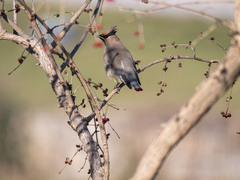
Sounds

Call0:14

China · 2020

© Ray Tsu 诸仁 · XC712745 · CC BY-NC-SA 4.0

Call0:37

China · 2023

© Dave GUO · XC890878 · CC BY-NC-SA 4.0

Call1:15

China · 2023

© Bo Shunqi 薄顺奇 · XC790531 · CC BY-NC-SA 4.0

Global Distribution

Parks Where Found

# Park Country Daily sighting probability
1 Nikko National Park 🇯🇵 Japan
<5%

More parks will be added in future updates.

Cities Where Found

# City Country Daily sighting probability
1 Fukuoka 🇯🇵 Japan
~10%
2 Chengdu 🇨🇳 China
~10%
3 Tianjin 🇨🇳 China
<5%
4 Beijing 🇨🇳 China
<5%
5 Hefei 🇨🇳 China
<5%
6 Sapporo 🇯🇵 Japan
<5%
7 Sendai 🇯🇵 Japan
<5%
8 Nanjing 🇨🇳 China
<5%
9 Wuhan 🇨🇳 China
<5%
10 Shanghai 🇨🇳 China
<5%

Before you go

What are the chances of seeing a Japanese Waxwing in Hefei?

Rare

Under 5% of wildlife watchers report a Japanese Waxwing sighting in Hefei on a given day, based on 6 verified sightings from GBIF citizen-science data. It is the 78th most-seen of the 83 birds we can rate there. Over three days the chance rises to about 10%, and over a week to about 20%, if each day is a fresh chance.

When is the best time to see a Japanese Waxwing in Hefei?

February

In that month about 20% of wildlife watchers report a Japanese Waxwing in Hefei on a given day, against under 5% in March to January, the lowest months.

What time of day is best to see a Japanese Waxwing?

Between 11 am and 2 pm

Across all the parks we cover, that three-hour window holds the most Japanese Waxwing sightings with a recorded time, and about 9 in 10 of them come between 6 am and 6 pm: it is a daytime animal.

Is Hefei the best place to see a Japanese Waxwing?

5th of 17

Of the 17 cities where we can rate Japanese Waxwing sightings, Hefei ranks 5th at under 5%. The best odds are in Fukuoka (Japan, about 10%), Chengdu (China, about 10%) and Tianjin (China, under 5%).

Where does the Japanese Waxwing sighting chance come from?

GBIF citizen-science records

It is estimated from how often the Japanese Waxwing is recorded against all the birds logged in Hefei (6 verified sightings), calibrated against known sighting rates. Figures are rounded to the nearest 10% because citizen-science data supports honest approximations, not decimals, and months with records from fewer than five people show "—". How it works.

← Back to Hefei