About the False Stable Fly
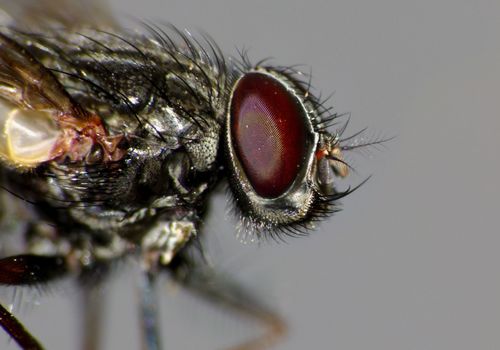
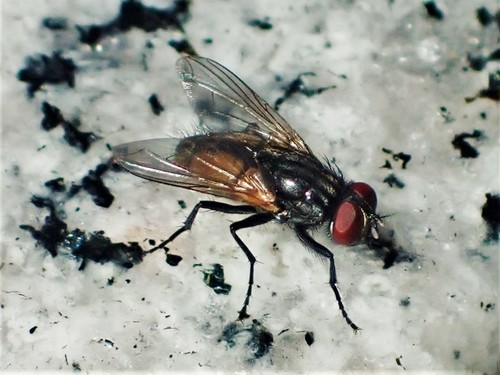
Muscina stabulans (formerly Curtonevra stabulans), commonly known as the false stable fly, is a fly from the family Muscidae. As an adult, Muscina stabulans has partially reddish-brown legs, four characteristic dark stripes along the thorax region, and a pale spot above the thorax. These flies average 8 millimeters (0.3 inches) in length. The abdomen is either entirely black or black with red sides. Its head ranges in color from a dark-grey to a whitish hue. Circular spiracular plates can be found separated by about one plate's width in the posterior area.
Larvae are dullish-white in colour, 6–7 mm long and 1–1.5 mm wide. They consist of 11 segments, with all but the last having a belt of small, well-developed spines going towards the posterior margins. The pseudo-cephalic segment has two hooks. The posterior spiracles have curved spiracular slits.
The false stable fly was found in a study determining synanthropy (ecological association with humans) of adult Muscidae collected in urban, rural and natural environments in Valdivia, Chile. According to the study, M. stabulans are mostly found in rural and natural neighborhoods, and rarely inhabit cities... Wikipedia →