Field Vole

Field Vole

Microtus agrestis

Silhouette: Edwin Price · PhyloPic

LCLeast ConcernNTVUENCR
Daily sighting probability <5% · Rare
at Helsinki

In 3 days ~10% in a week ~20%

5 Verified sightings at Helsinki
15 In all 2 parks From 2019 to 2026
February Best month
☀️ Diurnal When it's spotted

About the Field Vole

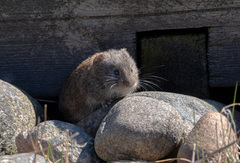
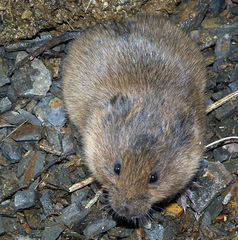
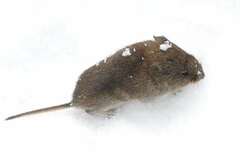
The short-tailed field vole, short-tailed vole, or simply field vole (Microtus agrestis), is a grey-brown vole, around 10 cm in length, with a short tail. It is one of the most common mammals in Europe, with a range extending from the Atlantic coast to Lake Baikal. These voles are found in moist grassy habitats, such as woodland, marsh or on river banks. Although they make shallow burrows, they usually build nests above ground. They are an important food source for owls and some other predators and their population size tends to peak and trough cyclically. Field voles breed prolifically, mainly in summer, but often all year round, even under snow. Females produce up to seven litters a year, each averaging from four to six young which are weaned after about fourteen days. The short-tailed field vole is both widespread and common and is listed as being of "Least Concern" by the IUCN.

The short-tailed field vole is a small, dark brown rodent with a short tail, distinguishable from the closely related common vole (Microtus arvalis) by its darker, longer and shaggier hair and by its more densely haired ears. The head and body length varies between 8 and 13 centimetres... Wikipedia →

Global Distribution

Parks Where Found

# Park Country Daily sighting probability
1 Cairngorms National Park 🇬🇧 United Kingdom
~10%
2 Snowdonia National Park 🇬🇧 United Kingdom
~10%

Cities Where Found

# City Country Daily sighting probability
1 Birmingham 🇬🇧 United Kingdom
~10%
2 Manchester 🇬🇧 United Kingdom
~10%
3 Liverpool 🇬🇧 United Kingdom
~10%
4 London 🇬🇧 United Kingdom
~10%
5 Helsinki 🇫🇮 Finland
<5%

Before you go

What are the chances of seeing a Field Vole in Helsinki?

Rare

Under 5% of wildlife watchers report a Field Vole sighting in Helsinki on a given day, based on 5 verified sightings from GBIF citizen-science data. It is the 22nd most-seen of the 23 mammals we can rate there. Over three days the chance rises to about 10%, and over a week to about 20%, if each day is a fresh chance.

When is the best time to see a Field Vole in Helsinki?

February–March, July and September

In those months about 10% of wildlife watchers report a Field Vole in Helsinki on a given day, against under 5% in April–June, August and October–January, the lowest months.

What time of day is best to see a Field Vole?

Between 9 am and noon

Across all the parks we cover, that three-hour window holds the most Field Vole sightings with a recorded time, and about 8 in 10 of them come between 6 am and 6 pm: it is a daytime animal.

Is Helsinki the best place to see a Field Vole?

5th of 5

Of the 5 cities where we can rate Field Vole sightings, Helsinki ranks 5th at under 5%. The best odds are in Birmingham (United Kingdom, about 10%), Manchester (United Kingdom, about 10%) and Liverpool (United Kingdom, about 10%).

Which relatives of the Field Vole live in Helsinki?

Same family: Cricetidae

The closest relatives of the Field Vole that you can see in Helsinki (family Cricetidae, Hamsters, Voles, Lemmings, and Allies) are Bank Vole (about 10%), European Water Vole (about 10%) and Muskrat (about 10%), with each one's daily chance of a sighting.

Where does the Field Vole sighting chance come from?

GBIF citizen-science records

It is estimated from how often the Field Vole is recorded against all the mammals logged in Helsinki (5 verified sightings), calibrated against known sighting rates. Figures are rounded to the nearest 10% because citizen-science data supports honest approximations, not decimals, and months with records from fewer than five people show "—". How it works.

← Back to Helsinki