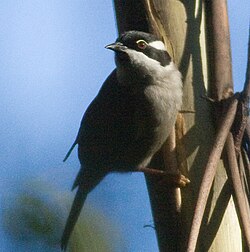
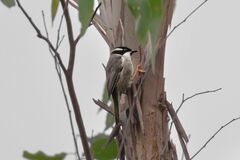

Strong-billed Honeyeater

Strong-billed Honeyeater

Melithreptus validirostris

Silhouette: Rachael Joakim · PhyloPic

LCNTVUVulnerableENCR Endemic
Daily sighting probability <5% · Rare
at Hobart

In 3 days <5%

5 Verified sightings at Hobart
143 In all 2 parks From 2019 to 2026
June Best month
☀️ Diurnal When it's spotted

About the Strong-billed Honeyeater

The strong-billed honeyeater (Melithreptus validirostris) is a species of bird in the family Meliphagidae. It is one of two species of the genus Melithreptus endemic to Tasmania. Its natural habitat is temperate forest. The strong-billed honeyeater was first described by ornithologist John Gould in 1837. Its specific name is derived from the Latin words validus 'strong', and rostrum 'bill'. It is a member of the genus Melithreptus, with several species of similar size and (apart from the brown-headed honeyeater) black-headed appearance, in the honeyeater family, Meliphagidae. Molecular markers show that the strong-billed honeyeater separated from the common ancestor of the brown-headed and black-chinned honeyeaters between 6.7 and 3.4 million years ago.

The next closest relative outside the genus is the much larger, but similarly marked, blue-faced honeyeater. More recently, DNA analysis has shown honeyeaters to be related to the Pardalotidae (pardalotes), Acanthizidae (Australian warblers, scrubwrens, thornbills, etc.), and the Maluridae (Australian fairy-wrens) in the large superfamily Meliphagoidea.

A mid-sized honeyeater at 16.5–17.5 cm (6.5–7 in... Wikipedia →

Sounds

Call0:36

Australia · 2023

© Peter Boesman · XC859961 · CC BY-NC-ND 4.0

Song0:17

Australia · 2020

© Marc Anderson · XC673995 · CC BY-NC-ND 4.0

Flight call0:07

Australia · 2020

© Ramit Singal · XC572509 · CC BY-NC-SA 4.0

Global Distribution

Parks Where Found

# Park Country Daily sighting probability
1 Cradle Mountain-Lake St Clair National Park 🇦🇺 Australia
~20%
2 Maria Island National Park 🇦🇺 Australia
~10%

Cities Where Found

# City Country Daily sighting probability
1 Hobart 🇦🇺 Australia
<5%

Before you go

What are the chances of seeing a Strong-billed Honeyeater in Hobart?

Rare

Under 5% of wildlife watchers report a Strong-billed Honeyeater sighting in Hobart on a given day, based on 5 verified sightings from GBIF citizen-science data. It is the 76th most-seen of the 79 birds we can rate there. Over three days the chance rises to under 5%, if each day is a fresh chance.

When is the best time to see a Strong-billed Honeyeater in Hobart?

Any time of year

In every month with enough records, under 5% of wildlife watchers report a Strong-billed Honeyeater in Hobart on a given day, so our monthly data shows no clear season.

What time of day is best to see a Strong-billed Honeyeater?

Between 10 am and 1 pm

Across all the parks we cover, that three-hour window holds the most Strong-billed Honeyeater sightings with a recorded time, and about 9 in 10 of them come between 6 am and 6 pm: it is a daytime animal.

Where else can you see a Strong-billed Honeyeater?

Only Hobart, in our data

Hobart is the only city on Wallace's Line with enough records to rate Strong-billed Honeyeater sightings: under 5% of wildlife watchers there report one on a given day.

Where does the Strong-billed Honeyeater sighting chance come from?

GBIF citizen-science records

It is estimated from how often the Strong-billed Honeyeater is recorded against all the birds logged in Hobart (5 verified sightings), calibrated against known sighting rates. Figures are rounded to the nearest 10% because citizen-science data supports honest approximations, not decimals, and months with records from fewer than five people show "—". How it works.

← Back to Hobart