Tasmanian Nativehen

Tasmanian Nativehen

Gallinula mortierii

Silhouette: Andy Wilson · PhyloPic

Daily sighting probability ~20% · Possible
at Hobart

In 3 days ~50% in a week ~80%

252 Verified sightings at Hobart
879 In all 3 parks From 2019 to 2026
January Best month
🌅 Crepuscular When it's spotted

About the Tasmanian Nativehen

The Tasmanian nativehen (Tribonyx mortierii) (alternative spellings: Tasmanian native-hen or Tasmanian native hen), also known by its palawa kani name piyura, is a flightless rail and one of twelve species of birds endemic to Australia's island state of Tasmania. Although many flightless birds have a history of extinction at the hands of humans, the species has actually benefited from the introduction of European-style agricultural practices in Tasmania. Its success may also be attributed to the recent extinction of its main predator, the thylacine.

The species was originally described in 1840 as Tribonyx mortierii — the mortierii being in honour of Belgian botanist Barthélemy Charles Joseph Dumortier. The palawa kani name for the Tasmanian nativehen is piyura, from the Swanport/Oyster Bay language region. Local nicknames include narkie, waterhen and turbo chook, despite the species being in the Rallidae family and not being related to junglefowl or the domestic chicken.

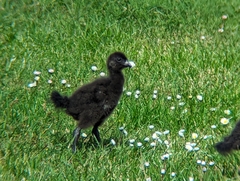
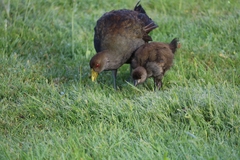
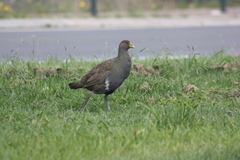
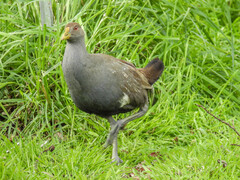
The Tasmanian nativehen is a stocky flightless bird between 43 and 51 centimetres (17 and 20 in) in length. The upperparts are olive-brown with a white patch on the flank. The underparts... Wikipedia →

Sounds

Recording0:11

Australia · 2023

© Anthony Kurek EntSocVic · iNaturalist · CC BY-NC 4.0

Recording0:16

Australia · 2024

© Hilda Jones · iNaturalist · CC BY-NC 4.0

Recording0:08

Australia · 2022

© cintajac · iNaturalist · CC BY-NC 4.0

Global Distribution

Parks Where Found

# Park Country Daily sighting probability
1 Maria Island National Park 🇦🇺 Australia
~90%
2 Cradle Mountain-Lake St Clair National Park 🇦🇺 Australia
~50%
3 Freycinet National Park 🇦🇺 Australia
<5%

Cities Where Found

# City Country Daily sighting probability
1 Hobart 🇦🇺 Australia
~20%

Zoos & Centres Where Found

# Zoo / Centre Country
1 Phillip Island Wildlife Park 🇦🇺 Australia In captivity
2 Trowunna Wildlife Park 🇦🇺 Australia In captivity

Before you go

What are the chances of seeing a Tasmanian Nativehen in Hobart?

Possible

About 20% of wildlife watchers report a Tasmanian Nativehen sighting in Hobart on a given day, based on 252 verified sightings from GBIF citizen-science data. It is the 26th most-seen of the 79 birds we can rate there. Over three days the chance rises to about 50%, and over a week to about 80%, if each day is a fresh chance.

When is the best time to see a Tasmanian Nativehen in Hobart?

December and January

In those months about 30% of wildlife watchers report a Tasmanian Nativehen in Hobart on a given day, against about 10% in March and July–August, the lowest months.

What time of day is best to see a Tasmanian Nativehen?

Between 4 and 7 am

Across all the parks we cover, that three-hour window holds the most Tasmanian Nativehen sightings with a recorded time, and about 6 in 10 of them come between 6 pm and 6 am: it is most active around dawn and dusk.

Where else can you see a Tasmanian Nativehen?

Only Hobart, in our data

Hobart is the only city on Wallace's Line with enough records to rate Tasmanian Nativehen sightings: about 20% of wildlife watchers there report one on a given day.

Where does the Tasmanian Nativehen sighting chance come from?

GBIF citizen-science records

It is estimated from how often the Tasmanian Nativehen is recorded against all the birds logged in Hobart (252 verified sightings), calibrated against known sighting rates. Figures are rounded to the nearest 10% because citizen-science data supports honest approximations, not decimals, and months with records from fewer than five people show "—". How it works.

← Back to Hobart