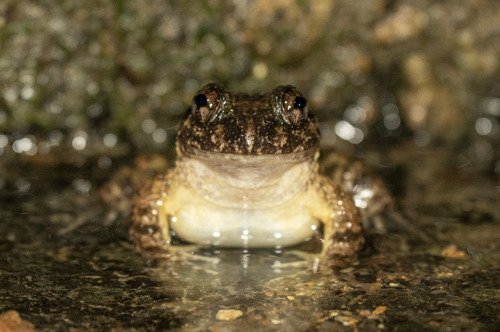
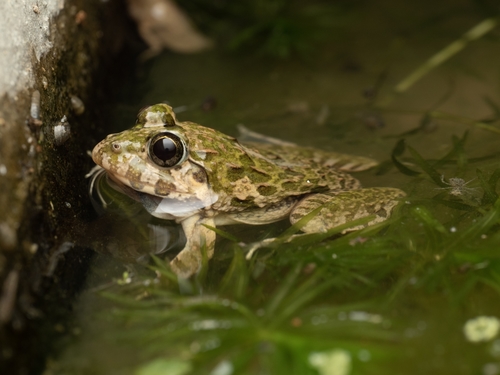
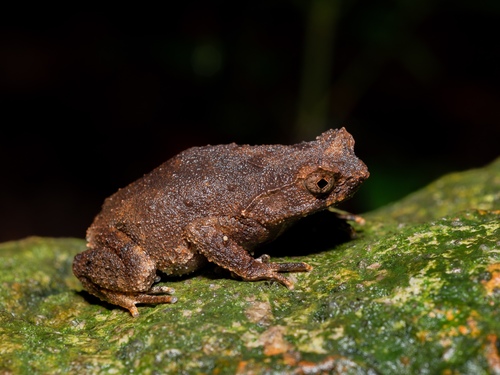
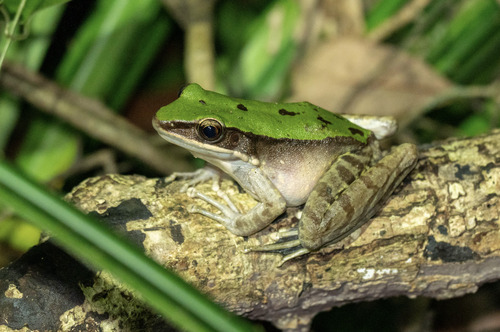
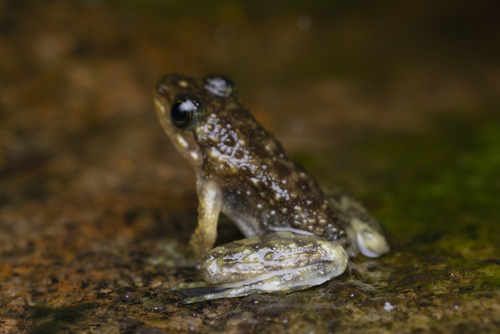
Asian Peters Frog

Asian Peters Frog

Hoplobatrachus rugulosus

Silhouette: Jose Carlos Arenas-Monroy · PhyloPic

LCLeast ConcernNTVUENCR
Daily sighting probability ~10% · With luck
at Hong Kong

In 3 days ~20% in a week ~30%

19 Verified sightings at Hong Kong
25 In all 2 parks From 2019 to 2026
August Best month
☀️ Diurnal When it's spotted

About the Asian Peters Frog

The Chinese edible frog (Hoplobatrachus chinensis), also known as East Asian bullfrog and Taiwanese frog, is a species of frog in the family Dicroglossidae. It is found in Cambodia, China, Hong Kong, Laos, Macau, Malaysia, Myanmar, the Philippines, Singapore, Taiwan, Thailand, and Vietnam. Its natural habitats are freshwater marshes, intermittent freshwater marshes, arable land, pasture land, rural gardens, urban areas, ponds, aquaculture ponds, open excavations, irrigated land, seasonally flooded agricultural land, and canals and ditches. They breed in spring to early summer.

The domesticated Thai variety and wild Chinese populations of H. chinensis belong to two separate genetic lineages respectively. Yu et al. (2015) suggest that H. chinensis may in fact be a cryptic species complex. H. chinensis is a large, robust frog, up to 12 centimetres (4+1⁄2 inches) or more in snout-vent length. Females are larger than males. They are primarily insectivores. The frogs are commonly found in wet markets, seafood markets, and pet stores. In wet markets, they are usually sold per piece or per kilogram. The medium-sized frogs are sold as pets in pet stores, and the... Wikipedia →

Sounds

Recording0:10

Taiwan · 2022

© tttoad · iNaturalist · CC BY-NC 4.0

Recording0:31

Taiwan · 2022

© Hong · iNaturalist · CC BY-NC 4.0

Recording0:27

Taiwan · 2024

© 歐陽秀華 · iNaturalist · CC BY-NC 4.0

Global Distribution

Parks Where Found

# Park Country Daily sighting probability
1 Cat Tien National Park 🇻🇳 Vietnam
~30%
2 Khao Sok National Park 🇹🇭 Thailand
~10%

Cities Where Found

# City Country Daily sighting probability
1 Hanoi 🇻🇳 Vietnam
~20%
2 Ho Chi Minh City 🇻🇳 Vietnam
~20%
3 Bangkok 🇹🇭 Thailand
~10%
4 Tuen Mun 🇨🇳 China
~10%
5 Tainan 🇹🇼 Taiwan
~10%
6 Kaohsiung 🇹🇼 Taiwan
~10%
7 Taipei 🇹🇼 Taiwan
~10%
8 Hong Kong 🇨🇳 China
~10%
9 Guangzhou 🇨🇳 China
~10%

Before you go

What are the chances of seeing an Asian Peters Frog in Hong Kong?

With luck

About 10% of wildlife watchers report an Asian Peters Frog sighting in Hong Kong on a given day, based on 19 verified sightings from GBIF citizen-science data. It is the 14th most-seen of the 16 amphibians we can rate there. Over three days the chance rises to about 20%, and over a week to about 30%, if each day is a fresh chance.

When is the best time to see an Asian Peters Frog in Hong Kong?

January and May–November

In those months about 10% of wildlife watchers report an Asian Peters Frog in Hong Kong on a given day, against under 5% in February–April and December, the lowest months.

What time of day is best to see an Asian Peters Frog?

Between 1 and 4 pm

Across all the parks we cover, that three-hour window holds the most Asian Peters Frog sightings with a recorded time, and about 8 in 10 of them come between 6 am and 6 pm: it is a daytime animal.

Is Hong Kong the best place to see an Asian Peters Frog?

8th of 9

Of the 9 cities where we can rate Asian Peters Frog sightings, Hong Kong ranks 8th at about 10%. The best odds are in Hanoi (Vietnam, about 20%), Ho Chi Minh City (Vietnam, about 20%) and Bangkok (Thailand, about 10%).

Which relatives of the Asian Peters Frog live in Hong Kong?

Same family: Dicroglossidae

The closest relatives of the Asian Peters Frog that you can see in Hong Kong (family Dicroglossidae, Fork-tongued Frogs) are Hong Kong Spiny Frog (about 20%) and Hong Kong Rice-paddy Frog (about 10%), with each one's daily chance of a sighting.

Where does the Asian Peters Frog sighting chance come from?

GBIF citizen-science records

It is estimated from how often the Asian Peters Frog is recorded against all the amphibians logged in Hong Kong (19 verified sightings), calibrated against known sighting rates. Figures are rounded to the nearest 10% because citizen-science data supports honest approximations, not decimals, and months with records from fewer than five people show "—". How it works.

← Back to Hong Kong