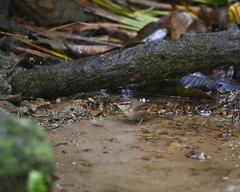
Asian Stubtail

Asian Stubtail

Urosphena squameiceps

Silhouette: Sheatherius · PhyloPic

LCLeast ConcernNTVUENCR
Daily sighting probability <5% · Rare
at Hong Kong

In 3 days ~10% in a week ~30%

104 Verified sightings at Hong Kong
146 In all 5 parks From 2019 to 2026
November Best month
🌅 Crepuscular When it's spotted

About the Asian Stubtail

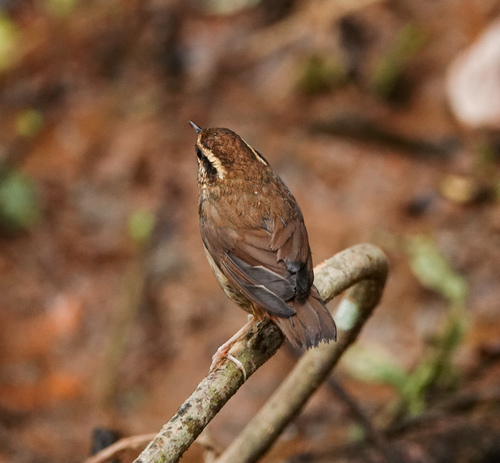
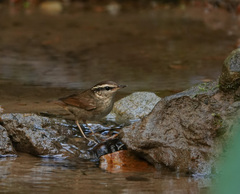
The Asian stubtail (Urosphena squameiceps) is a bird in the family Cettiidae. The species was first described by Robert Swinhoe in 1863. It breeds in Northeast Asia and Japan. Its natural habitat is temperate forest. It is a small bird with a short tail. Males and females are similar in color, as well as juveniles after fledging; they are brown all over with a paler underpart and a darker brown crest and eyeline.

Breeding Asian stubtails reside in portions of northeastern Asia; non-breeding areas include Hainan Taiwan, southeastern China and Indochina, preferring a habitat of undergrowth in evergreen broadleaf or lowland coniferous forest.

Breeding males produce a high-pitched shee-shee-shee-shee or cee-cee-cee, while both males and females make a call similar to chott-chott-chott. Wikipedia →

Sounds

Song0:21

China · 2026

© 小菜鸟 · XC1101095 · CC BY-NC-SA 4.0

Call0:12

China · 2025

© Ding Li Yong · XC1056616 · CC BY-NC-ND 4.0

Alarm call0:31

China · 2021

© Geoff Carey · XC748894 · CC BY-NC-SA 4.0

Global Distribution

Parks Where Found

# Park Country Daily sighting probability
1 Cuc Phuong National Park 🇻🇳 Vietnam
~20%
2 Nikko National Park 🇯🇵 Japan
<5%
3 Doi Inthanon National Park 🇹🇭 Thailand
<5%
4 Khao Yai National Park 🇹🇭 Thailand
<5%
5 Kaeng Krachan National Park 🇹🇭 Thailand
<5%

Cities Where Found

# City Country Daily sighting probability
1 Sendai 🇯🇵 Japan
~10%
2 Sapporo 🇯🇵 Japan
~10%
3 Busan 🇰🇷 South Korea
~10%
4 Hong Kong 🇨🇳 China
<5%
5 Guangzhou 🇨🇳 China
<5%
6 Nagoya 🇯🇵 Japan
<5%
7 Hangzhou 🇨🇳 China
<5%
8 Osaka 🇯🇵 Japan
<5%
9 Seoul 🇰🇷 South Korea
<5%
10 Tokyo 🇯🇵 Japan
<5%

Before you go

What are the chances of seeing an Asian Stubtail in Hong Kong?

Rare

Under 5% of wildlife watchers report an Asian Stubtail sighting in Hong Kong on a given day, based on 104 verified sightings from GBIF citizen-science data. It is the 61st most-seen of the 204 birds we can rate there. Over three days the chance rises to about 10%, and over a week to about 30%, if each day is a fresh chance.

When is the best time to see an Asian Stubtail in Hong Kong?

November to January

In those months about 10% of wildlife watchers report an Asian Stubtail in Hong Kong on a given day, against under 5% in February to October, the lowest months. Those are among Hong Kong's driest months, with about 30 mm of rain a month against 280 mm in June.

What time of day is best to see an Asian Stubtail?

Between 1 and 4 am

Across all the parks we cover, that three-hour window holds the most Asian Stubtail sightings with a recorded time, and about 6 in 10 of them come between 6 pm and 6 am: it is most active around dawn and dusk.

Is Hong Kong the best place to see an Asian Stubtail?

4th of 12

Of the 12 cities where we can rate Asian Stubtail sightings, Hong Kong ranks 4th at under 5%. The best odds are in Sendai (Japan, about 10%), Sapporo (Japan, about 10%) and Busan (South Korea, about 10%).

Where does the Asian Stubtail sighting chance come from?

GBIF citizen-science records

It is estimated from how often the Asian Stubtail is recorded against all the birds logged in Hong Kong (104 verified sightings), calibrated against known sighting rates. Figures are rounded to the nearest 10% because citizen-science data supports honest approximations, not decimals, and months with records from fewer than five people show "—". How it works.
← Back to Hong Kong