Northern Cottonmouth

Northern Cottonmouth

Agkistrodon piscivorus

Silhouette: Steven Traver · PhyloPic

LCLeast ConcernNTVUENCR Endemic
Daily sighting probability ~10% · With luck
at Houston

In 3 days ~20% in a week ~30%

58 Verified sightings at Houston
200 In 1 park From 2019 to 2026
September Best month
🌅 Crepuscular When it's spotted

About the Northern Cottonmouth

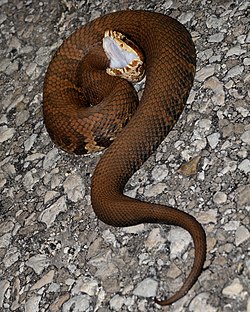
Agkistrodon piscivorus is a species of venomous snake, a pit viper in the subfamily Crotalinae of the family Viperidae. It is one of the world's few semiaquatic vipers (along with the Florida cottonmouth), and is native to the Southeastern United States. As an adult, it is large and capable of delivering a painful and potentially fatal bite. When threatened, it may respond by coiling its body and displaying its fangs. Individuals may bite when feeling threatened or being handled in any way. It tends to be found in or near water, particularly in slow-moving and shallow lakes, streams, and marshes. It is a capable swimmer, and like several species of snakes, is known to occasionally enter bays and estuaries and swim between barrier islands and the mainland.

The generic name is derived from the Greek words ἄγκιστρον agkistron "fish-hook, hook" and ὀδών odon "tooth", and the specific name comes from the Latin piscis 'fish' and voro '(I) eat greedily, devour'; thus, the scientific name translates to "hook-toothed fish-eater". Common names include cottonmouth, northern cottonmouth, water moccasin, swamp moccasin, black moccasin, and simply viper. Many of the common... Wikipedia →

Sounds

Recording0:07

United States · 2022

© bnjmncrmrn · iNaturalist · CC BY-NC 4.0

Global Distribution

Parks Where Found

# Park Country Daily sighting probability
1 Congaree National Park 🇺🇸 United States
~60%

More parks will be added in future updates.

Cities Where Found

# City Country Daily sighting probability
1 Houston 🇺🇸 United States
~10%

Zoos & Centres Where Found

# Zoo / Centre Country
1 Cincinnati Zoo and Botanical Garden 🇺🇸 United States In captivity
2 North Carolina Zoo 🇺🇸 United States In captivity
3 Greensboro Science Center 🇺🇸 United States In captivity
4 Columbus Zoo and Aquarium 🇺🇸 United States In captivity
5 Louisville Zoo 🇺🇸 United States In captivity
6 Oklahoma City Zoo and Botanical Garden 🇺🇸 United States In captivity
7 Dickerson Park Zoo 🇺🇸 United States In captivity
8 Indianapolis Zoo 🇺🇸 United States In captivity
9 Memphis Zoo 🇺🇸 United States In captivity
10 Metro Richmond Zoo 🇺🇸 United States In captivity
11 Virginia Zoological Park 🇺🇸 United States In captivity
12 Houston Zoo 🇺🇸 United States In captivity
13 ABQ BioPark Zoo 🇺🇸 United States In captivity
14 Philadelphia Zoo 🇺🇸 United States In captivity
15 Chapultepec Zoo 🇲🇽 Mexico In captivity
16 Budapest Zoo & Botanical Garden 🇭🇺 Hungary In captivity
17 Riverbanks Zoo 🇺🇸 United States In captivity
18 Little Rock Zoo 🇺🇸 United States In captivity
19 Alligator Adventure 🇺🇸 United States In captivity
20 North Carolina Aquarium at Fort Fisher 🇺🇸 United States In captivity
21 Reptile Gardens 🇺🇸 United States In captivity
22 Chattanooga Zoo at Warner Park 🇺🇸 United States In captivity
23 ZooAmerica 🇺🇸 United States In captivity
24 Oklahoma Aquarium 🇺🇸 United States In captivity
25 Wonders of Wildlife Museum & Aquarium 🇺🇸 United States In captivity
26 North Carolina Aquarium at Pine Knoll Shores 🇺🇸 United States In captivity
27 North Carolina Aquarium on Roanoke Island 🇺🇸 United States In captivity
28 South Carolina Aquarium 🇺🇸 United States In captivity
29 Children's Aquarium at Fair Park 🇺🇸 United States In captivity
30 Edisto Island Serpentarium 🇺🇸 United States In captivity
31 Maymont Farm 🇺🇸 United States In captivity
32 Medicine Park Aquarium & Natural Sciences Center 🇺🇸 United States In captivity

Before you go

What are the chances of seeing a Northern Cottonmouth in Houston?

With luck

About 10% of wildlife watchers report a Northern Cottonmouth sighting in Houston on a given day, based on 58 verified sightings from GBIF citizen-science data. It is the 23rd most-seen of the 30 reptiles we can rate there. Over three days the chance rises to about 20%, and over a week to about 30%, if each day is a fresh chance.

When is the best time to see a Northern Cottonmouth in Houston?

February, April–May and August–October

In those months about 10% of wildlife watchers report a Northern Cottonmouth in Houston on a given day, against under 5% in March, June–July and November–January, the lowest months.

What time of day is best to see a Northern Cottonmouth?

Between 3 and 6 pm

Across all the parks we cover, that three-hour window holds the most Northern Cottonmouth sightings with a recorded time, and about half of them come between 6 pm and 6 am: it is most active around dawn and dusk.

Where else can you see a Northern Cottonmouth?

Only Houston, in our data

Houston is the only city on Wallace's Line with enough records to rate Northern Cottonmouth sightings: about 10% of wildlife watchers there report one on a given day.

Where does the Northern Cottonmouth sighting chance come from?

GBIF citizen-science records

It is estimated from how often the Northern Cottonmouth is recorded against all the reptiles logged in Houston (58 verified sightings), calibrated against known sighting rates. Figures are rounded to the nearest 10% because citizen-science data supports honest approximations, not decimals, and months with records from fewer than five people show "—". How it works.

← Back to Houston