Southern Two-Striped Walkingstick

Southern Two-Striped Walkingstick

Anisomorpha buprestoides

Daily sighting probability <5% · Rare
at Houston

In 3 days ~10% in a week ~20%

21 Verified sightings at Houston
272 In all 3 parks From 2019 to 2026
July Best month
☀️🌙 Day & Night When it's spotted

About the Southern Two-Striped Walkingstick

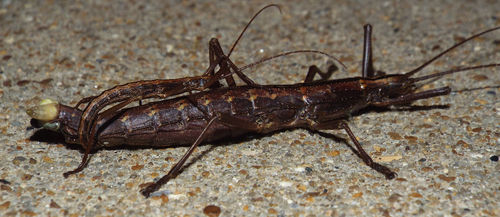
Anisomorpha buprestoides, the southern two-striped walkingstick, devil rider, or musk mare, is a stick insect (order Phasmatodea: otherwise known as "phasmids" or walkingsticks) which occurs throughout the southeastern United States.

Anisomorpha buprestoides is a large, stout (for a stick insect) brown phasmid with three conspicuous longitudinal black stripes. Females average 67.7 mm (2.67 in) in length; males are smaller and more slender, averaging 41.7 mm (1.64 in).

This species, and another in the same genus (Anisomorpha ferruginea, whose range is more west and north, but may overlap with A. buprestoides) is particularly well known for its very potent chemical defense spray which it deploys from a pair of glands which open at the front of its thorax. They are capable of selectively targeting the eyes, and are known to be capable of causing significant injury if successful. The "Devil rider" nickname for this insect likely comes from this defense, as well as the fact that they are most frequently encountered in the late summer and fall when they are active adults at a time when almost all of them are found in mating pairs, with the smaller male riding on the back of... Wikipedia →

Global Distribution

Parks Where Found

# Park Country Daily sighting probability
1 Everglades National Park 🇺🇸 United States
~30%
2 Big Cypress National Preserve 🇺🇸 United States
~20%
3 Merritt Island National Wildlife Refuge 🇺🇸 United States
~10%

Cities Where Found

# City Country Daily sighting probability
1 Miami 🇺🇸 United States
~10%
2 Houston 🇺🇸 United States
<5%
3 Austin 🇺🇸 United States
<5%

Before you go

What are the chances of seeing a Southern Two-Striped Walkingstick in Houston?

Rare

Under 5% of wildlife watchers report a Southern Two-Striped Walkingstick sighting in Houston on a given day, based on 21 verified sightings from GBIF citizen-science data. It is the 458th most-seen of the 1057 insects we can rate there. Over three days the chance rises to about 10%, and over a week to about 20%, if each day is a fresh chance.

When is the best time to see a Southern Two-Striped Walkingstick in Houston?

July

In that month about 10% of wildlife watchers report a Southern Two-Striped Walkingstick in Houston on a given day, against under 5% in August to June, the lowest months.

What time of day is best to see a Southern Two-Striped Walkingstick?

Between 7 and 10 pm

Across all the parks we cover, that three-hour window holds the most Southern Two-Striped Walkingstick sightings with a recorded time, and about 6 in 10 of them come between 6 pm and 6 am: it is seen both by day and at night.

Is Houston the best place to see a Southern Two-Striped Walkingstick?

2nd of 3

Of the 3 cities where we can rate Southern Two-Striped Walkingstick sightings, Houston ranks 2nd at under 5%. The best odds are in Miami (United States, about 10%).

Where does the Southern Two-Striped Walkingstick sighting chance come from?

GBIF citizen-science records

It is estimated from how often the Southern Two-Striped Walkingstick is recorded against all the insects logged in Houston (21 verified sightings), calibrated against known sighting rates. Figures are rounded to the nearest 10% because citizen-science data supports honest approximations, not decimals, and months with records from fewer than five people show "—". How it works.

← Back to Houston