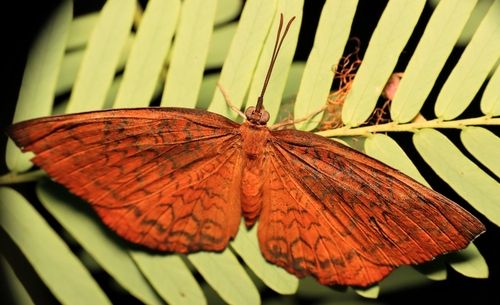
About the Teak Defoliator
Hyblaea puera, the teak defoliator, is a moth and cryptic species complex native to South Asia and Southeast Asia, though also reported from Central America and Africa. It was first described by Pieter Cramer in 1777. The caterpillar feeds on teak and other trees, and considered to be one of the major teak pests around the world.
Hyblaea puera occurs in forests across southern Asia from India, Sri Lanka and Bangladesh, and southeast Asia from Thailand to New Guinea, and north Queensland in Australia. The species has been reported from Guadeloupe, and Suriname.
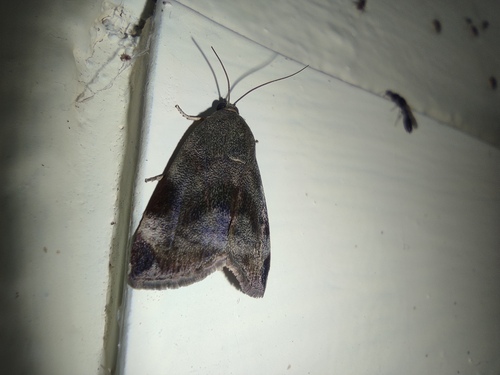
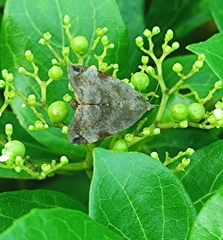
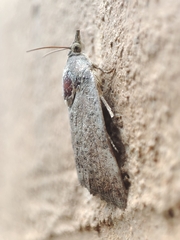
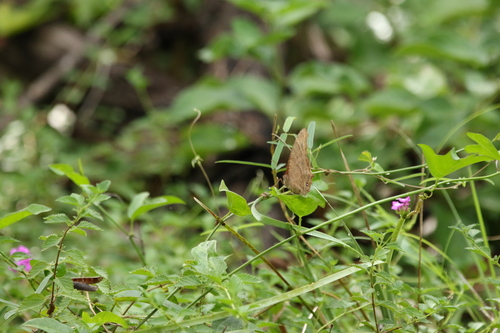
The adult moths are comparatively small, with a wingspan of 3–4 cm (1.2–1.6 in), and have a characteristic resting posture that conceals the black and orange-yellow hindwings under the greyish-brown forewings. There are five larval instars, with the last instar measuring about 3.5–4.5 cm (1.4–1.8 in), and there is considerable colour variation in the fourth and fifth instars; the body may be either wholly black or dark greyish to black, with longitudinal coloured bands which may include a dorsal orange or ocherous band and lateral white lines.
The instars have characteristic feeding... Wikipedia →