Banded Krait

Banded Krait

Bungarus fasciatus

Silhouette: Michael Scroggie, from original photograph by Gary M. Stolz, USFWS (original photograph in public domain). · PhyloPic

LCLeast ConcernNTVUENCR
Daily sighting probability ~20% · Possible
at Jakarta

In 3 days ~50% in a week ~80%

30 Verified sightings at Jakarta
27 In all 2 parks From 2019 to 2026
November Best month
☀️ Diurnal When it's spotted

About the Banded Krait

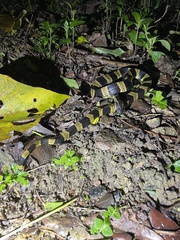
The banded krait (Bungarus fasciatus) is a venomous species of elapid endemic to Asia, from Indian subcontinent through Southeast Asia to Southern China. With a maximum length exceeding 2 m (6 ft 7 in), it is the longest krait with a distinguishable gold and black pattern. While this species is generally considered timid and docile, resembling other members of the genus, its venom is highly neurotoxic which is lethal to humans. Although toxicity of the banded krait based upon murine LD50 experiments is lower than that of many other kraits, its venom yield is the highest due to its size.

The banded krait is easily identified by its alternate black and yellow crossbands all of which encircle the body. The head is broad and depressed and it is not distinct from the neck. The eyes are black. It has arrowhead-like yellow markings on its otherwise black head and has yellow lips, lores, chin, and throat. The tail is relatively small, about one-tenth the length of the snake.

The longest banded krait measured was 2.25 m (7 ft 5 in) long, but normally the length encountered is 1.8 m (5 ft 11 in). Scalation: 15 dorsal scale rows at midbody; sub-caudal scutes undivided throughout... Wikipedia →

Global Distribution

Parks Where Found

# Park Country Daily sighting probability
1 Cat Tien National Park 🇻🇳 Vietnam
~30%
2 Khao Yai National Park 🇹🇭 Thailand
~10%

Cities Where Found

# City Country Daily sighting probability
1 Jakarta 🇮🇩 Indonesia
~20%
2 Hong Kong 🇨🇳 China
~10%
3 Guangzhou 🇨🇳 China
~10%

Zoos & Centres Where Found

# Zoo / Centre Country
1 Siam Serpentarium 🇹🇭 Thailand In captivity
2 Snake Farm of Queen Saovabha Memorial Institute 🇹🇭 Thailand In captivity

Before you go

What are the chances of seeing a Banded Krait in Jakarta?

Possible

About 20% of wildlife watchers report a Banded Krait sighting in Jakarta on a given day, based on 30 verified sightings from GBIF citizen-science data. It is the 22nd most-seen of the 47 reptiles we can rate there. Over three days the chance rises to about 50%, and over a week to about 80%, if each day is a fresh chance.

When is the best time to see a Banded Krait in Jakarta?

November

In that month about 40% of wildlife watchers report a Banded Krait in Jakarta on a given day, against about 10% in January, March, May–June and September, the lowest months.

What time of day is best to see a Banded Krait?

Between 2 and 5 pm

Across all the parks we cover, that three-hour window holds the most Banded Krait sightings with a recorded time, and about 8 in 10 of them come between 6 am and 6 pm: it is a daytime animal.

Is Jakarta the best place to see a Banded Krait?

Yes

Of the 3 cities where we can rate Banded Krait sightings, Jakarta has the highest daily chance: about 20%. Next come Hong Kong (China, about 10%) and Guangzhou (China, about 10%).

Where does the Banded Krait sighting chance come from?

GBIF citizen-science records

It is estimated from how often the Banded Krait is recorded against all the reptiles logged in Jakarta (30 verified sightings), calibrated against known sighting rates. Figures are rounded to the nearest 10% because citizen-science data supports honest approximations, not decimals, and months with records from fewer than five people show "—". How it works.

← Back to Jakarta