Blue Krait

Blue Krait

Bungarus candidus

Silhouette: Michael Scroggie, from original photograph by Gary M. Stolz, USFWS (original photograph in public domain). · PhyloPic

LCLeast ConcernNTVUENCR
Daily sighting probability ~20% · Possible
at Jakarta

In 3 days ~50% in a week ~80%

34 Verified sightings at Jakarta
17 In all 2 parks From 2019 to 2026
October Best month
☀️ Diurnal When it's spotted

About the Blue Krait

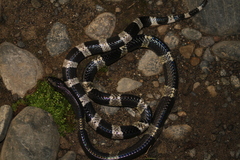
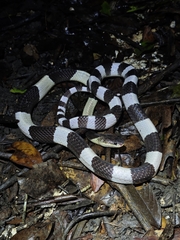
Bungarus candidus, commonly known as the Malayan krait or blue krait, is an extremely venomous species of snake. The blue krait is a member of the genus Bungarus and the family Elapidae. The Malayan krait may attain a total length of 108 cm (43 in), with a tail 16 cm (6.3 in) long.

Dorsally, it has a pattern of 27–34 dark-brown, black, or bluish-black crossbands on the body and tail, which are narrowed and rounded on the sides. The first crossband is continuous with the dark color of the head. The dark crossbands are separated by broad, yellowish-white interspaces, which may be spotted with black. Ventrally, it is uniformly white.

An unbanded black phenotype also occurs in some populations, reportedly in West and Central Java. The smooth dorsal scales are arranged in 15 rows, with the vertebral row much enlarged. The ventrals number 195–237; the anal plate is entire; and the single (undivided) subcaudals are 37–56 in number.

It is found in Southeast Asia from Indochina south to Java and Bali in Indonesia. In mice, the intravenous LD50 for this species is 0.1 mg/kg. Its mortality rate is 60–70% in untreated humans. The amount... Wikipedia →

Global Distribution

Parks Where Found

# Park Country Daily sighting probability
1 Cat Tien National Park 🇻🇳 Vietnam
~20%
2 Kaeng Krachan National Park 🇹🇭 Thailand
~10%

Cities Where Found

# City Country Daily sighting probability
1 Bandar Lampung 🇮🇩 Indonesia
~30%
2 Jakarta 🇮🇩 Indonesia
~20%
3 Bandung 🇮🇩 Indonesia
~20%

Zoos & Centres Where Found

# Zoo / Centre Country
1 Municipal Zoological Park Quinzinho de Barros 🇧🇷 Brazil In captivity
2 Siam Serpentarium 🇹🇭 Thailand In captivity
3 Snake Farm of Queen Saovabha Memorial Institute 🇹🇭 Thailand In captivity

Before you go

What are the chances of seeing a Blue Krait in Jakarta?

Possible

About 20% of wildlife watchers report a Blue Krait sighting in Jakarta on a given day, based on 34 verified sightings from GBIF citizen-science data. It is the 21st most-seen of the 47 reptiles we can rate there. Over three days the chance rises to about 50%, and over a week to about 80%, if each day is a fresh chance.

When is the best time to see a Blue Krait in Jakarta?

October

In that month about 40% of wildlife watchers report a Blue Krait in Jakarta on a given day, against under 5% in February and April, the lowest months.

What time of day is best to see a Blue Krait?

Between 2 and 5 pm

Across all the parks we cover, that three-hour window holds the most Blue Krait sightings with a recorded time, and about 8 in 10 of them come between 6 am and 6 pm: it is a daytime animal.

Is Jakarta the best place to see a Blue Krait?

2nd of 3

Of the 3 cities where we can rate Blue Krait sightings, Jakarta ranks 2nd at about 20%. The best odds are in Bandar Lampung (Indonesia, about 30%).

Where does the Blue Krait sighting chance come from?

GBIF citizen-science records

It is estimated from how often the Blue Krait is recorded against all the reptiles logged in Jakarta (34 verified sightings), calibrated against known sighting rates. Figures are rounded to the nearest 10% because citizen-science data supports honest approximations, not decimals, and months with records from fewer than five people show "—". How it works.

← Back to Jakarta