
Horsfield's Treeshrew

Horsfield's Treeshrew

Tupaia javanica

Silhouette: Margot Michaud · PhyloPic

LCLeast ConcernNTVUENCR Endemic
Daily sighting probability ~10% · With luck
at Jakarta

In 3 days ~20% in a week ~50%

6 Verified sightings at Jakarta
22 In 1 park From 2019 to 2026
February Best month
🌅 Crepuscular When it's spotted

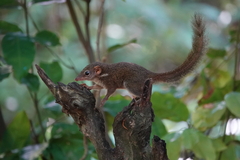
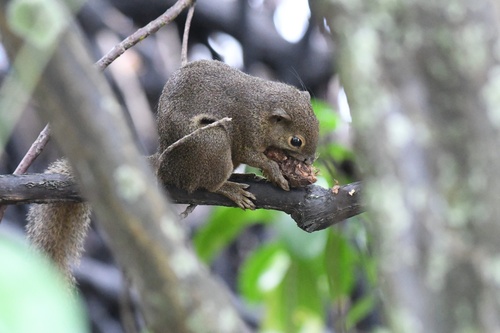
About the Horsfield's Treeshrew

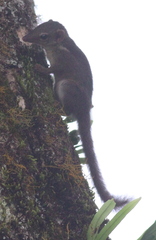
Horsfield's treeshrew (Tupaia javanica), also called Javan treeshrew, is a treeshrew species within the Tupaiidae. It is endemic to the Indonesian islands of Sumatra, Bali, Java and Nias where it inhabits foremost primary forest.

It was first described by Thomas Horsfield in 1822. Several subspecies have been proposed based on variation in colouration; however, colour is an unreliable distinguishing character. There are many variations of papillae on the surface of the Horsfield's treeshrew's tongue, which depend on the food it eats as well as the pattern and function of its tongue. The Horsfield's treeshrew has a unique skull shape that better suits its environment and differs from other treeshrew species.

The Horsfield's treeshrew eats fruits and insects while mostly consuming arthropods. It spreads plants seeds and controls insects, and therefore plays a significant role in the ecosystem; it has a special ability to adapt to agroforestry systems.

Data related to Tupaia javanica at Wikispecies Wikipedia →

Sounds

Call1:19

Indonesia · 2015

© Marc Anderson · XC1014192 · CC BY-NC-ND 4.0

Recording0:29

Indonesia · 2018

© Bruno Durand · iNaturalist · CC BY-NC 4.0

Recording0:43

Indonesia · 2021

© ꦥꦤ꧀ꦗꦶꦒꦸꦱ꧀ꦠꦶꦄꦏ꧀ꦧꦂ · iNaturalist · CC BY 4.0

Global Distribution

Parks Where Found

# Park Country Daily sighting probability
1 Bali Barat National Park 🇮🇩 Indonesia
~40%

More parks will be added in future updates.

Cities Where Found

# City Country Daily sighting probability
1 Bandung 🇮🇩 Indonesia
~10%
2 Jakarta 🇮🇩 Indonesia
~10%

Before you go

What are the chances of seeing a Horsfield's Treeshrew in Jakarta?

With luck

About 10% of wildlife watchers report a Horsfield's Treeshrew sighting in Jakarta on a given day, based on 6 verified sightings from GBIF citizen-science data. It is the 6th most-seen of the 7 mammals we can rate there. Over three days the chance rises to about 20%, and over a week to about 50%, if each day is a fresh chance.

When is the best time to see a Horsfield's Treeshrew in Jakarta?

February

In that month about 30% of wildlife watchers report a Horsfield's Treeshrew in Jakarta on a given day, against under 5% in January, April–July and September–November, the lowest months. That is one of Jakarta's wettest months, with about 370 mm of rain against 55 mm in August.

What time of day is best to see a Horsfield's Treeshrew?

Between 2 and 5 am

Across all the parks we cover, that three-hour window holds the most Horsfield's Treeshrew sightings with a recorded time, and about 7 in 10 of them come between 6 pm and 6 am: it is most active around dawn and dusk.

Is Jakarta the best place to see a Horsfield's Treeshrew?

Among the best

Of the 2 cities where we can rate Horsfield's Treeshrew sightings, Jakarta ranks 2nd at about 10%, level with the leaders once rounded. The best odds are in Bandung (Indonesia, about 10%).

Where does the Horsfield's Treeshrew sighting chance come from?

GBIF citizen-science records

It is estimated from how often the Horsfield's Treeshrew is recorded against all the mammals logged in Jakarta (6 verified sightings), calibrated against known sighting rates. Figures are rounded to the nearest 10% because citizen-science data supports honest approximations, not decimals, and months with records from fewer than five people show "—". How it works.

← Back to Jakarta