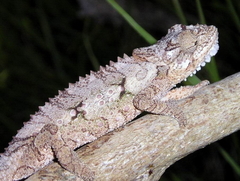
Eastern Cape Dwarf Chameleon

Eastern Cape Dwarf Chameleon

Bradypodion ventrale

Silhouette: T. Michael Keesey (from a photograph by Frank Glaw, Jörn Köhler, Ted M. Townsend & Miguel Vences) · PhyloPic

LCLeast ConcernNTVUENCR Endemic
Daily sighting probability ~10% · With luck
at Johannesburg

In 3 days ~20% in a week ~40%

8 Verified sightings at Johannesburg
51 In all 2 parks From 2019 to 2026
August Best month
🌅 Crepuscular When it's spotted

About the Eastern Cape Dwarf Chameleon

Bradypodion ventrale, the southern dwarf chameleon, occurs in the Eastern Cape, South Africa. It is also known as the eastern Cape dwarf chameleon. It is a relatively large species of dwarf chameleon, reaching lengths of 14 cm (5.5 in). It has a very prominent casque on the back of its head and a long, beard-like throat crest. It lives in dense thickets and shrub, and is usually very difficult to spot because of its colouring. It adapts very well to living in suburban gardens, but domestic cats – being introduced predators – will usually kill all chameleons in the immediate area. Consequently, one should not bring chameleons into a garden which is frequented by cats. It gives birth to litters of between 10 and 20 babies in the summer.

Tolley, K. and Burger, M. 2007. Chameleons of Southern Africa. ISBN 978-1-77007-375-3. Search for Distribution of Bradypodion ventrale Wikipedia →

Global Distribution

Parks Where Found

# Park Country Daily sighting probability
1 Addo Elephant National Park 🇿🇦 South Africa
~10%
2 Table Mountain National Park 🇿🇦 South Africa
<5%

Cities Where Found

# City Country Daily sighting probability
1 Johannesburg 🇿🇦 South Africa
~10%

Closest Relatives at Johannesburg

No species of the same family or order lives in Johannesburg, so these are its closest relatives here: other reptiles.

Before you go

What are the chances of seeing an Eastern Cape Dwarf Chameleon in Johannesburg?

With luck

About 10% of wildlife watchers report an Eastern Cape Dwarf Chameleon sighting in Johannesburg on a given day, based on 8 verified sightings from GBIF citizen-science data. It is the 12th most-seen of the 15 reptiles we can rate there. Over three days the chance rises to about 20%, and over a week to about 40%, if each day is a fresh chance.

When is the best time to see an Eastern Cape Dwarf Chameleon in Johannesburg?

February, August–September and November–December

In those months about 10% of wildlife watchers report an Eastern Cape Dwarf Chameleon in Johannesburg on a given day, against under 5% in January, March–July and October, the lowest months.

What time of day is best to see an Eastern Cape Dwarf Chameleon?

Between 1 and 4 pm

Across all the parks we cover, that three-hour window holds the most Eastern Cape Dwarf Chameleon sightings with a recorded time, and about 7 in 10 of them come between 6 am and 6 pm: it is most active around dawn and dusk.

Where else can you see an Eastern Cape Dwarf Chameleon?

Only Johannesburg, in our data

Johannesburg is the only city on Wallace's Line with enough records to rate Eastern Cape Dwarf Chameleon sightings: about 10% of wildlife watchers there report one on a given day.

Where does the Eastern Cape Dwarf Chameleon sighting chance come from?

GBIF citizen-science records

It is estimated from how often the Eastern Cape Dwarf Chameleon is recorded against all the reptiles logged in Johannesburg (8 verified sightings), calibrated against known sighting rates. Figures are rounded to the nearest 10% because citizen-science data supports honest approximations, not decimals, and months with records from fewer than five people show "—". How it works.

← Back to Johannesburg