Common Brown Water Snake

Common Brown Water Snake

Lycodonomorphus rufulus

Silhouette: SeismicShrimp · PhyloPic

LCLeast ConcernNTVUENCR
Daily sighting probability ~10% · With luck
at Johannesburg

In 3 days ~20% in a week ~40%

5 Verified sightings at Johannesburg
273 In all 2 parks From 2019 to 2026
January Best month
☀️ Diurnal When it's spotted

About the Common Brown Water Snake

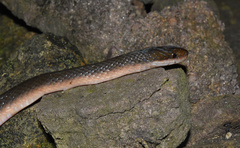
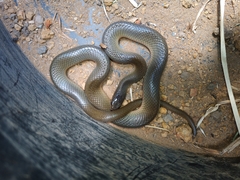
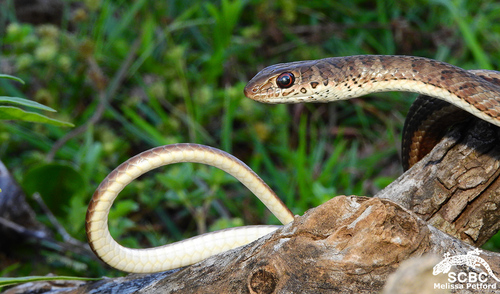
The common brown water snake (Lycodonomorphus rufulus) is a species of nonvenomous South African snake. This gentle, harmless snake is by far the most common water snake in southern Africa. It can be found from Cape Town in the south, along the wet east coast of South Africa and inland as far as Gauteng, Lesotho, and Zimbabwe. Throughout its range, its natural habitat is water margins, where it shelters under leaves and logs. It emerges at night to hunt frogs and sometimes rodents. It lays up to 10 eggs at the end of summer.

Scale count of Lycodonomorphus members [1] Broadley, D.G. (1967). A review of the genus Lycodonomorphus Fitzinger (Serpentes: Colubridae) in southeastern Africa, with a key to the genus. Arnoldia 3 (16): 1–9 Haagner, G.V. 1992. Life History Notes - Lycodonomorphus rufulus Jour. Herp. Ass. Afr. (41): 42–42

Lichtenstein, M. HINRICH C. 1823. Verzeichniss der Doubletten des zoologischen Museums der Königl. Universität zu Berlin nebst Beschreibung vieler bisher unbekannter Arten von Säugethieren, Vögeln, Amphibien und Fischen. Königl. Preuss. Akad. Wiss./ T. Trautwein, Berlin. x, 118 pages

Marais, J. 2004. A Complete Guide to the Snakes of Southern... Wikipedia →

Global Distribution

Parks Where Found

# Park Country Daily sighting probability
1 Table Mountain National Park 🇿🇦 South Africa
~20%
2 Garden Route National Park 🇿🇦 South Africa
~10%

Cities Where Found

# City Country Daily sighting probability
1 Cape Town 🇿🇦 South Africa
~20%
2 Durban 🇿🇦 South Africa
~10%
3 Johannesburg 🇿🇦 South Africa
~10%

Before you go

What are the chances of seeing a Common Brown Water Snake in Johannesburg?

With luck

About 10% of wildlife watchers report a Common Brown Water Snake sighting in Johannesburg on a given day, based on 5 verified sightings from GBIF citizen-science data. It is the 14th most-seen of the 15 reptiles we can rate there. Over three days the chance rises to about 20%, and over a week to about 40%, if each day is a fresh chance.

When is the best time to see a Common Brown Water Snake in Johannesburg?

November to February

In those months about 10% of wildlife watchers report a Common Brown Water Snake in Johannesburg on a given day, against under 5% in March to October, the lowest months. Those are among Johannesburg's wettest months, with about 110 mm of rain a month against almost none in July.

What time of day is best to see a Common Brown Water Snake?

Between 9 am and noon

Across all the parks we cover, that three-hour window holds the most Common Brown Water Snake sightings with a recorded time, and about 8 in 10 of them come between 6 am and 6 pm: it is a daytime animal.

Is Johannesburg the best place to see a Common Brown Water Snake?

3rd of 3

Of the 3 cities where we can rate Common Brown Water Snake sightings, Johannesburg ranks 3rd at about 10%. The best odds are in Cape Town (South Africa, about 20%) and Durban (South Africa, about 10%).

Which relatives of the Common Brown Water Snake live in Johannesburg?

Same family: Lamprophiidae

The closest relatives of the Common Brown Water Snake that you can see in Johannesburg (family Lamprophiidae, Lamprophiid Snakes) are Brown House Snake (about 20%) and Aurora House Snake (about 10%), with each one's daily chance of a sighting.

Where does the Common Brown Water Snake sighting chance come from?

GBIF citizen-science records

It is estimated from how often the Common Brown Water Snake is recorded against all the reptiles logged in Johannesburg (5 verified sightings), calibrated against known sighting rates. Figures are rounded to the nearest 10% because citizen-science data supports honest approximations, not decimals, and months with records from fewer than five people show "—". How it works.

← Back to Johannesburg