
Southern Rock Agama

Southern Rock Agama

Agama atra

Silhouette: Natalie Claunch · PhyloPic

LCLeast ConcernNTVUENCR
Daily sighting probability ~20% · Possible
at Johannesburg

In 3 days ~40% in a week ~70%

27 Verified sightings at Johannesburg
1,982 In all 6 parks From 2019 to 2026
November Best month
☀️ Diurnal When it's spotted

About the Southern Rock Agama

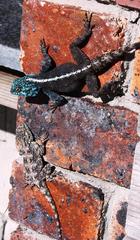
The southern rock agama or southern African rock agama (Agama atra) is a species of lizard from the family Agamidae that occurs in Southern Africa in Zambia, South Africa, Eswatini, Mozambique, Zimbabwe and Botswana. It lives in small colonies on rocky outcrops, and the males are very conspicuous for their bright blue heads.

The natural range of this species is over the entire South Africa and Botswana, excluding only sandy areas of the Northern Cape and portions of the Limpopo, Mpumalanga, and KwaZulu-Natal provinces. This rather sociable agama is normally found in small groups or colonies. It grows up to about 25 cm and has a thin dorsal crest that runs the length of its body. It typically has a short, plump body and a thin tail, with a triangular head. During the breeding season, the heads of the males become bright blue. The males also take to sitting on top of prominent rocks and are therefore a common sight in mountainous areas of South Africa. The females and young are a more uniform greyish-brown and are much more shy.

These active, diurnal lizards normally hunt small insects such as ants and termites. They sometimes adjust to living near... Wikipedia →

Global Distribution

Parks Where Found

# Park Country Daily sighting probability
1 De Hoop Nature Reserve 🇿🇦 South Africa
~70%
2 Golden Gate Highlands National Park 🇿🇦 South Africa
~40%
3 Table Mountain National Park 🇿🇦 South Africa
~40%
4 Garden Route National Park 🇿🇦 South Africa
~20%
5 Addo Elephant National Park 🇿🇦 South Africa
~10%
6 Pilanesberg National Park 🇿🇦 South Africa
~10%

Cities Where Found

# City Country Daily sighting probability
1 Johannesburg 🇿🇦 South Africa
~20%
2 Cape Town 🇿🇦 South Africa
~10%

Zoos & Centres Where Found

# Zoo / Centre Country
1 Zoo La Barben 🇫🇷 France In captivity

Closest Relatives at Johannesburg

No species of the same family or order lives in Johannesburg, so these are its closest relatives here: other reptiles.

Before you go

What are the chances of seeing a Southern Rock Agama in Johannesburg?

Possible

About 20% of wildlife watchers report a Southern Rock Agama sighting in Johannesburg on a given day, based on 27 verified sightings from GBIF citizen-science data. It is the 7th most-seen of the 15 reptiles we can rate there. Over three days the chance rises to about 40%, and over a week to about 70%, if each day is a fresh chance.

When is the best time to see a Southern Rock Agama in Johannesburg?

January and October–November

In those months about 30% of wildlife watchers report a Southern Rock Agama in Johannesburg on a given day, against under 5% in February, April and June–August, the lowest months. Those are among Johannesburg's wettest months, with about 90 mm of rain a month against almost none in July.

What time of day is best to see a Southern Rock Agama?

Between noon and 3 pm

Across all the parks we cover, that three-hour window holds the most Southern Rock Agama sightings with a recorded time, and nearly all of them come between 6 am and 6 pm: it is a daytime animal.

Is Johannesburg the best place to see a Southern Rock Agama?

Yes

Of the 2 cities where we can rate Southern Rock Agama sightings, Johannesburg has the highest daily chance: about 20%. Next come Cape Town (South Africa, about 10%).

Where does the Southern Rock Agama sighting chance come from?

GBIF citizen-science records

It is estimated from how often the Southern Rock Agama is recorded against all the reptiles logged in Johannesburg (27 verified sightings), calibrated against known sighting rates. Figures are rounded to the nearest 10% because citizen-science data supports honest approximations, not decimals, and months with records from fewer than five people show "—". How it works.

← Back to Johannesburg