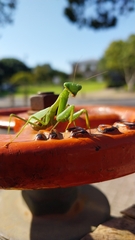
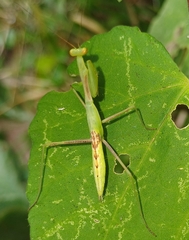
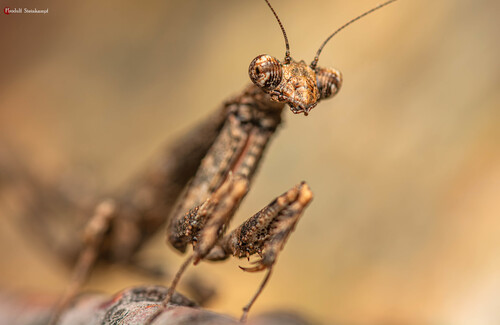
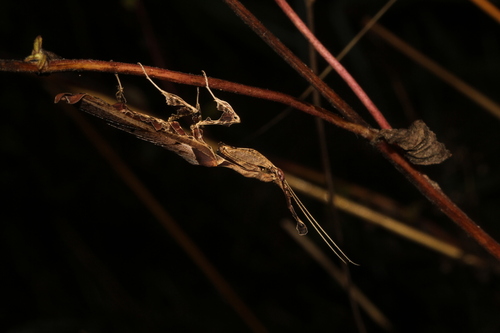
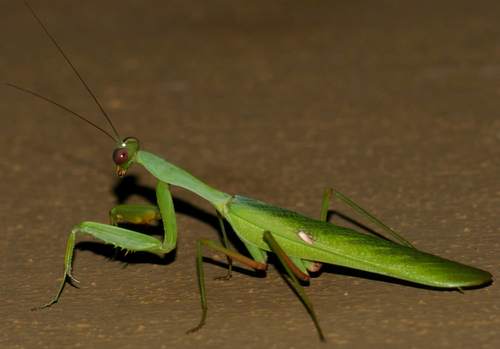
South African Mantis

South African Mantis

Miomantis caffra

Daily sighting probability ~10% · With luck
at Johannesburg

In 3 days ~20% in a week ~50%

23 Verified sightings at Johannesburg
261 In all 5 parks From 2019 to 2026
May Best month
☀️ Diurnal When it's spotted

About the South African Mantis

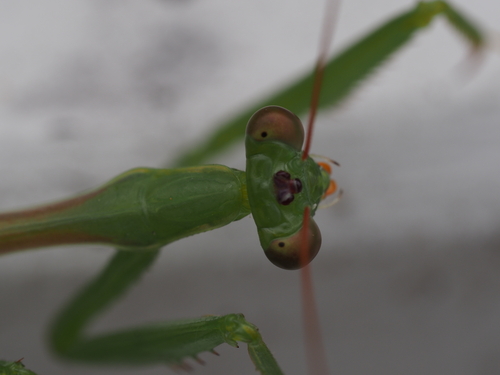
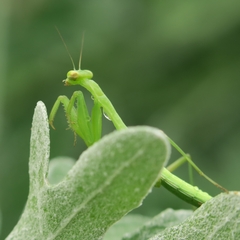
Miomantis caffra (common name: springbok mantis) is a species of praying mantis native to Southern Africa. It was first detected in New Zealand in 1978, and was found more recently in Portugal and Los Angeles, USA. Females are facultatively parthenogenetic and unmated females can produce viable offspring.

The ootheca (egg case) of M. caffra is 12–30 mm long with rounded sides, soft creamy-brown, fawn or beige with a terminal handle-like extension. Hatching is not synchronised, and nymphs may emerge over a period of weeks or even over two seasons. Refrigeration of ootheca in the exotic pet trade can delay their hatching.

The oothecae are extremely hardy, and can survive winter to hatch even in the far south and alpine regions of New Zealand. The nymphs are green or brown, body often longitudinally striped, limbs mottled, tip of abdomen curved upwards. Significant colour variation exists in nymphs and sub-adults, with bodies varying from pale straw-colour, bright green, and reddish brown, and legs varying from pale to almost black. Nymphs of M. caffra are cannibalistic, and will attack and eat one-another even in the presence of alternative... Wikipedia →
Global Distribution

Parks Where Found

# Park Country Daily sighting probability
1 Egmont National Park 🇳🇿 New Zealand
~20%
2 Abel Tasman National Park 🇳🇿 New Zealand
~20%
3 Garden Route National Park 🇿🇦 South Africa
~10%
4 Table Mountain National Park 🇿🇦 South Africa
~10%
5 Addo Elephant National Park 🇿🇦 South Africa
~10%

Cities Where Found

# City Country Daily sighting probability
1 Auckland 🇳🇿 New Zealand
~40%
2 Pretoria 🇿🇦 South Africa
~10%
3 Cape Town 🇿🇦 South Africa
~10%
4 Johannesburg 🇿🇦 South Africa
~10%
5 Los Angeles 🇺🇸 United States
~10%
6 Melbourne 🇦🇺 Australia
<5%
7 Durban 🇿🇦 South Africa
<5%
8 San Diego 🇺🇸 United States
<5%
9 Perth 🇦🇺 Australia
<5%

Before you go

What are the chances of seeing a South African Mantis in Johannesburg?

With luck

About 10% of wildlife watchers report a South African Mantis sighting in Johannesburg on a given day, based on 23 verified sightings from GBIF citizen-science data. It is the 72nd most-seen of the 213 insects we can rate there. Over three days the chance rises to about 20%, and over a week to about 50%, if each day is a fresh chance.

When is the best time to see a South African Mantis in Johannesburg?

May

In that month about 20% of wildlife watchers report a South African Mantis in Johannesburg on a given day, against under 5% in June to October, the lowest months. That is one of Johannesburg's driest months, with about 15 mm of rain against 130 mm in December.

What time of day is best to see a South African Mantis?

Between 11 am and 2 pm

Across all the parks we cover, that three-hour window holds the most South African Mantis sightings with a recorded time, and about 8 in 10 of them come between 6 am and 6 pm: it is a daytime animal.

Is Johannesburg the best place to see a South African Mantis?

4th of 9

Of the 9 cities where we can rate South African Mantis sightings, Johannesburg ranks 4th at about 10%. The best odds are in Auckland (New Zealand, about 40%), Pretoria (South Africa, about 10%) and Cape Town (South Africa, about 10%).

Which relatives of the South African Mantis live in Johannesburg?

Same order: Mantodea

The closest relatives of the South African Mantis that you can see in Johannesburg (order Mantodea, Mantises) are African Twig Mantis (about 10%) and Common Ghost Mantis (about 10%), with each one's daily chance of a sighting.

Where does the South African Mantis sighting chance come from?

GBIF citizen-science records

It is estimated from how often the South African Mantis is recorded against all the insects logged in Johannesburg (23 verified sightings), calibrated against known sighting rates. Figures are rounded to the nearest 10% because citizen-science data supports honest approximations, not decimals, and months with records from fewer than five people show "—". How it works.

← Back to Johannesburg