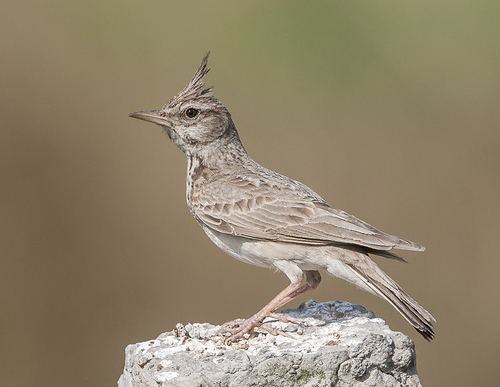
White-eared Bulbul

White-eared Bulbul

Pycnonotus leucotis

Silhouette: Andy Wilson · PhyloPic

LCLeast ConcernNTVUENCR
Daily sighting probability ~70% · Very likely
at Karaj

In 3 days >90%

89 Verified sightings at Karaj
2,011 In all 2 parks From 2019 to 2026
April Best month
☀️ Diurnal When it's spotted

About the White-eared Bulbul

The white-eared bulbul (Pycnonotus leucotis) is a member of the bulbul family. It is found in south-western Asia from India to the Arabian peninsula. The white-eared bulbul was originally described in the genus Ixos. The white-eared bulbul is considered to belong to a superspecies along with the Himalayan bulbul, white-spectacled bulbul, African red-eyed bulbul, Cape bulbul, and the common bulbul. Formerly, some authorities considered the white-eared bulbul to be a subspecies of the Himalayan Bulbul.

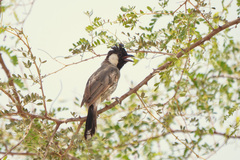
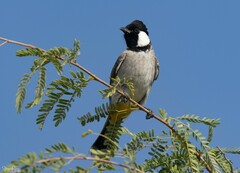
The white-eared bulbul is rotund in appearance, and has a brownish-grey body. The tail of this bird is relatively long, tapering outwards. Starting off black, the tail feathers end in white tips. The head of the white-eared bulbul is black, with the area around its cheeks bearing a large white spot. The eye rings of the bulbul are... Wikipedia →

Sounds

Subsong0:04

Iran · 2019

© Ding Li Yong · XC863417 · CC BY-NC-ND 4.0

Song0:33

Oman · 2023

© Peter Boesman · XC781393 · CC BY-NC-ND 4.0

Call0:36

India · 2012

© Jelle Scharringa · XC630861 · CC BY-NC-SA 4.0

Global Distribution

Parks Where Found

# Park Country Daily sighting probability
1 Keoladeo National Park 🇮🇳 India
~70%
2 Ranthambore National Park 🇮🇳 India
<5%

Cities Where Found

# City Country Daily sighting probability
1 Doha 🇶🇦 Qatar
>90%
2 Abu Dhabi 🇦🇪 United Arab Emirates
>90%
3 Dubai 🇦🇪 United Arab Emirates
~90%
4 Tehran 🇮🇷 Iran
~90%
5 Riyadh 🇸🇦 Saudi Arabia
~90%
6 Kuwait City 🇰🇼 Kuwait
~90%
7 Mashhad 🇮🇷 Iran
~80%
8 Karaj 🇮🇷 Iran
~70%
9 Jodhpur 🇮🇳 India
~60%
10 Manama 🇧🇭 Bahrain
~40%

Zoos & Centres Where Found

# Zoo / Centre Country
1 Zoo Miami 🇺🇸 United States In captivity
2 San Antonio Zoo 🇺🇸 United States In captivity
3 Bird Paradise 🇸🇬 Singapore In captivity
4 Rainforest Wild Asia 🇸🇬 Singapore In captivity
5 National Zoological Gardens of Sri Lanka 🇱🇰 Sri Lanka In captivity
6 Bird Kingdom 🇨🇦 Canada In captivity

Before you go

What are the chances of seeing a White-eared Bulbul in Karaj?

Very likely

About 70% of wildlife watchers report a White-eared Bulbul sighting in Karaj on a given day, based on 89 verified sightings from GBIF citizen-science data. It is the 6th most-seen of the 43 birds we can rate there. Over three days the chance rises to over 90%, if each day is a fresh chance.

When is the best time to see a White-eared Bulbul in Karaj?

April, September and November–December

In those months about 80% of wildlife watchers report a White-eared Bulbul in Karaj on a given day, against about 60% in January–March and May, the lowest months. August has too few records to rate.

What time of day is best to see a White-eared Bulbul?

Between 6 and 9 am

Across all the parks we cover, that three-hour window holds the most White-eared Bulbul sightings with a recorded time, and about 8 in 10 of them come between 6 am and 6 pm: it is a daytime animal.

Is Karaj the best place to see a White-eared Bulbul?

8th of 25

Of the 25 cities where we can rate White-eared Bulbul sightings, Karaj ranks 8th at about 70%. The best odds are in Doha (Qatar, over 90%), Abu Dhabi (United Arab Emirates, over 90%) and Dubai (United Arab Emirates, about 90%).

Which relatives of the White-eared Bulbul live in Karaj?

Same order: Passeriformes

The closest relatives of the White-eared Bulbul that you can see in Karaj (order Passeriformes, Perching Birds) are House Sparrow (about 90%), Hooded Crow (about 90%) and Eurasian Magpie (about 80%), with each one's daily chance of a sighting.

Where does the White-eared Bulbul sighting chance come from?

GBIF citizen-science records

It is estimated from how often the White-eared Bulbul is recorded against all the birds logged in Karaj (89 verified sightings), calibrated against known sighting rates. Figures are rounded to the nearest 10% because citizen-science data supports honest approximations, not decimals, and months with records from fewer than five people show "—". How it works.

← Back to Karaj