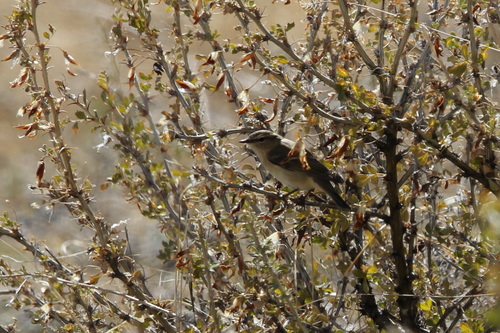
Pale-rumped Warbler

Pale-rumped Warbler

Phylloscopus chloronotus

Silhouette: Jiekun He · PhyloPic

LCLeast ConcernNTVUENCR
Daily sighting probability <5% · Rare
at Kathmandu

In 3 days ~10% in a week ~20%

110 Verified sightings at Kathmandu
329 In all 4 parks From 2019 to 2026
February Best month
🌅 Crepuscular When it's spotted

About the Pale-rumped Warbler

The Lemon-rumped Warbler (Phylloscopus chloronotus), also known as the Pale-rumped Warbler, is a small species of Old World warbler in the family Phylloscopidae. It is native to the Himalayas, breeding in montane forests and wintering in the southern foothills and the Purvanchal Range. The species is structurally identical to the Sichuan Leaf Warbler (Phylloscopus forresti), but differs in vocalizations.

The Lemon-rumped Warbler was once grouped with the Sichuan Leaf Warbler (Phylloscopus forresti) and was previously classified within P. proregulus. Vocal and genetic studies confirmed its separation as a distinct species. Related taxa in China, including P. kansuensis and P. yunnanensis, are also now recognized as separate.

The Lemon-rumped Warbler is 9–10 cm long and weighs about 4.6–5.1 g. It has a whitish crown stripe bordered by darker olive-brown sides, a pale line above the eye, and a dark eyestripe that often curves downward. The upperparts are greenish-grey, and the rump is yellowish or whitish, which gives the species its name. The wings are grey-brown with green edging and usually show one or two pale wingbars. The underparts are whitish or... Wikipedia →

Sounds

Call0:38

India · 2025

© Peter Boesman · XC1030767 · CC BY-NC-ND 4.0

Song1:18

India · 2019

© Andrew Spencer · XC547830 · CC BY-NC-ND 4.0

Song0:36

India · 2018

© Rolf A. de By · XC407468 · CC BY-NC-SA 4.0

Global Distribution

Parks Where Found

# Park Country Daily sighting probability
1 Langtang National Park 🇳🇵 Nepal
~20%
2 Royal Manas National Park 🇧🇹 Bhutan
~10%
3 Jim Corbett National Park 🇮🇳 India
~10%
4 Manas National Park 🇮🇳 India
<5%

Cities Where Found

# City Country Daily sighting probability
1 Dehradun 🇮🇳 India
~10%
2 Srinagar 🇮🇳 India
~10%
3 Kathmandu 🇳🇵 Nepal
<5%

Before you go

What are the chances of seeing a Pale-rumped Warbler in Kathmandu?

Rare

Under 5% of wildlife watchers report a Pale-rumped Warbler sighting in Kathmandu on a given day, based on 110 verified sightings from GBIF citizen-science data. It is the 141st most-seen of the 312 birds we can rate there. Over three days the chance rises to about 10%, and over a week to about 20%, if each day is a fresh chance.

When is the best time to see a Pale-rumped Warbler in Kathmandu?

February–March and December

In those months about 10% of wildlife watchers report a Pale-rumped Warbler in Kathmandu on a given day, against under 5% in January and April–November, the lowest months. Those are among Kathmandu's driest months, with about 15 mm of rain a month against 280 mm in July.

What time of day is best to see a Pale-rumped Warbler?

Between 9 am and noon

Across all the parks we cover, that three-hour window holds the most Pale-rumped Warbler sightings with a recorded time, and about 6 in 10 of them come between 6 am and 6 pm: it is most active around dawn and dusk.

Is Kathmandu the best place to see a Pale-rumped Warbler?

3rd of 3

Of the 3 cities where we can rate Pale-rumped Warbler sightings, Kathmandu ranks 3rd at under 5%. The best odds are in Dehradun (India, about 10%) and Srinagar (India, about 10%).

Which relatives of the Pale-rumped Warbler live in Kathmandu?

Same genus: Phylloscopus

The closest relatives of the Pale-rumped Warbler that you can see in Kathmandu (genus Phylloscopus, Leaf Warblers) are Grey-hooded Warbler (about 20%), Hume's Warbler (about 20%) and Greenish Warbler (about 10%), with each one's daily chance of a sighting.

Where does the Pale-rumped Warbler sighting chance come from?

GBIF citizen-science records

It is estimated from how often the Pale-rumped Warbler is recorded against all the birds logged in Kathmandu (110 verified sightings), calibrated against known sighting rates. Figures are rounded to the nearest 10% because citizen-science data supports honest approximations, not decimals, and months with records from fewer than five people show "—". How it works.

← Back to Kathmandu