Gram Blue
Daily sighting probability ~30% · Possible
at Kota

In 3 days ~60% in a week ~90%

11 Verified sightings at Kota
17 In all 2 parks From 2019 to 2026
January Best month
☀️ Diurnal When it's spotted

About the Gram Blue

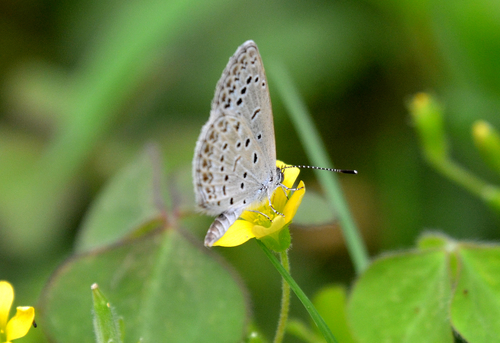
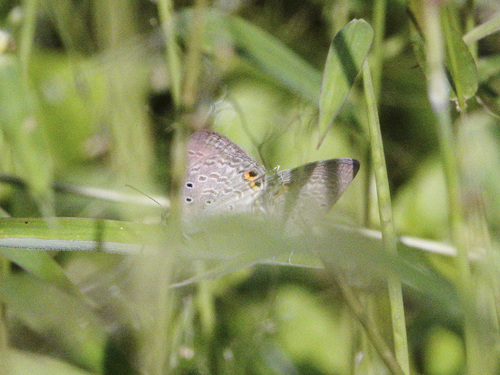
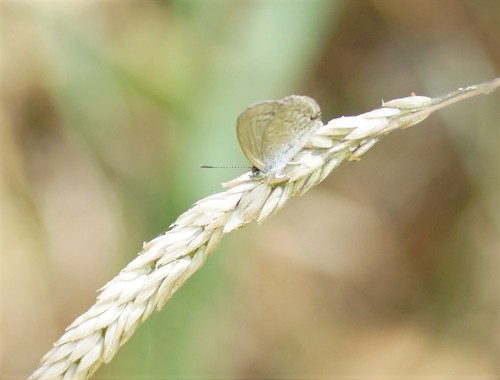
Euchrysops cnejus, the gram blue, is a small butterfly that belongs to the lycaenids or blues family. It is found from India to Australia. The species was first described by Johan Christian Fabricius in 1798. Male upperside: pale purplish suffused with a bluish shade, apparent only in certain lights. Forewing: a slender black anteciliary line edged on the inner side narrowly with fuscous dark brown, broader at apex than at the tornal angle. Hindwing: a subterminal black spot in interspace 1 and another similar spot in interspace 2, the two spots subequal in size, edged on the outer side by a white thread and on the inner side with ochraceous, more prominent in the spot in interspace 2; a slender anteciliary black line with an inner narrow margin of diffuse fuscous brown. Cilia of both forewings and hindwings pale; tail at apex of vein 2 of the hindwing black tipped with white.

Underside: silver grey, in some with a pale yellowish, in others with a faint brown tint. Forewings and hindwings: each with the following brown spots edged slenderly on either side with white: a transverse elongate spot on the discocellulars; a transverse discal series of spots straight on... Wikipedia →

Global Distribution

Parks Where Found

# Park Country Daily sighting probability
1 Kanha National Park 🇮🇳 India
~20%
2 Lamington National Park 🇦🇺 Australia
~10%

Cities Where Found

# City Country Daily sighting probability
1 Kota 🇮🇳 India
~30%
2 Kolkata 🇮🇳 India
~20%
3 Salem 🇮🇳 India
~20%
4 Dhaka 🇧🇩 Bangladesh
~20%
5 Pune 🇮🇳 India
~20%
6 Chennai 🇮🇳 India
~20%
7 Jabalpur 🇮🇳 India
~20%
8 Chattogram 🇧🇩 Bangladesh
~20%
9 Mumbai 🇮🇳 India
~20%
10 Davao City 🇵🇭 Philippines
~20%

Before you go

What are the chances of seeing a Gram Blue in Kota?

Possible

About 30% of wildlife watchers report a Gram Blue sighting in Kota on a given day, based on 11 verified sightings from GBIF citizen-science data. It is the 15th most-seen of the 33 insects we can rate there. Over three days the chance rises to about 60%, and over a week to about 90%, if each day is a fresh chance.

When is the best time to see a Gram Blue in Kota?

January

In that month about 50% of wildlife watchers report a Gram Blue in Kota on a given day, against under 5% in March–May and November, the lowest months. That is one of Kota's driest months, with about 5 mm of rain against 260 mm in August.

What time of day is best to see a Gram Blue?

Between 11 am and 2 pm

Across all the parks we cover, that three-hour window holds the most Gram Blue sightings with a recorded time, and about 9 in 10 of them come between 6 am and 6 pm: it is a daytime animal.

Is Kota the best place to see a Gram Blue?

Yes

Of the 24 cities where we can rate Gram Blue sightings, Kota has the highest daily chance: about 30%. Next come Kolkata (India, about 20%) and Salem (India, about 20%).

Which relatives of the Gram Blue live in Kota?

Same family: Lycaenidae

The closest relatives of the Gram Blue that you can see in Kota (family Lycaenidae, Gossamer-winged Butterflies) are Lesser Grass Blue (about 40%), Zebra Blue (about 20%) and Pale Grass Blue (about 20%), with each one's daily chance of a sighting.

Where does the Gram Blue sighting chance come from?

GBIF citizen-science records

It is estimated from how often the Gram Blue is recorded against all the insects logged in Kota (11 verified sightings), calibrated against known sighting rates. Figures are rounded to the nearest 10% because citizen-science data supports honest approximations, not decimals, and months with records from fewer than five people show "—". How it works.
← Back to Kota