True Cochineal Bug

True Cochineal Bug

Dactylopius coccus

Daily sighting probability ~10% · With luck
at La Paz

In 3 days ~30% in a week ~50%

7 Verified sightings at La Paz
January Best month

About the True Cochineal Bug

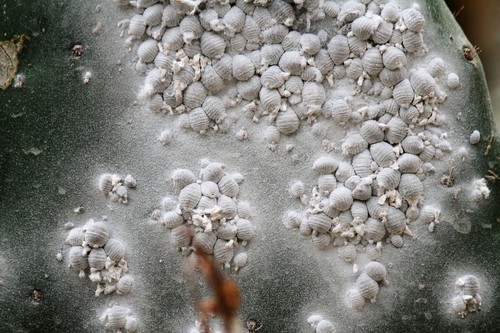
The cochineal ( KOTCH-in-EEL, -⁠eel, US also KOH-chin-EEL, -⁠eel; Dactylopius coccus) is a scale insect in the suborder Sternorrhyncha, from which the natural dye carmine is derived. A primarily sessile parasite native to tropical and subtropical South America through North America (Mexico and the Southwest United States), this insect lives on cacti in the genus Opuntia, feeding on plant moisture and nutrients. The insects are found on the pads of prickly pear cacti, collected by brushing them off the plants, and dried.

The insect produces carminic acid that deters predation by other insects. Carminic acid, typically 17–24% of dried insects' weight, can be extracted from the body and eggs, then mixed with aluminium or calcium salts to make carmine dye, also known as cochineal. Today, carmine is primarily used as a colorant in food and in lipstick (E120 or Natural Red 4).

Carmine dye was used in the Americas for coloring fabrics and became an important export good in the 16th century during the colonial period. Production of cochineal is depicted in the Codex Osuna (1565). After synthetic pigments and dyes such as alizarin were invented in the late 19th century, use of natural-dye products gradually diminished. Fears over the safety of artificial food additives renewed the popularity of cochineal dyes, and the increased demand has made cultivation of the insect profitable again, with Peru being the largest producer, followed by Mexico, Chile, Argentina and the Canary Islands.

Other species in the genus Dactylopius can be used to produce "cochineal extract", and are extremely difficult to distinguish from D. coccus, even for expert taxonomists; the scientific term D. coccus and the vernacular "cochineal insect" are sometimes used, intentionally or casually, and possibly with misleading effect, to refer to other species. Wikipedia →
Global Distribution

Parks Where Found

# Park Country Daily sighting probability

More parks will be added in future updates.

Cities Where Found

# City Country Daily sighting probability
1 Cochabamba 🇧🇴 Bolivia
~10%
2 La Paz 🇧🇴 Bolivia
~10%

Before you go

What are the chances of seeing a True Cochineal Bug in La Paz?

With luck

About 10% of wildlife watchers report a True Cochineal Bug sighting in La Paz on a given day, based on 7 verified sightings from GBIF citizen-science data. It is the 29th most-seen of the 32 insects we can rate there. Over three days the chance rises to about 30%, and over a week to about 50%, if each day is a fresh chance.

When is the best time to see a True Cochineal Bug in La Paz?

January and October

In those months about 30% of wildlife watchers report a True Cochineal Bug in La Paz on a given day, against under 5% in February–March, May–September and November–December, the lowest months. Those are among La Paz's wettest months, with about 90 mm of rain a month against 10 mm in June.

Is La Paz the best place to see a True Cochineal Bug?

Among the best

Of the 2 cities where we can rate True Cochineal Bug sightings, La Paz ranks 2nd at about 10%, level with the leaders once rounded. The best odds are in Cochabamba (Bolivia, about 10%).

Where does the True Cochineal Bug sighting chance come from?

GBIF citizen-science records

It is estimated from how often the True Cochineal Bug is recorded against all the insects logged in La Paz (7 verified sightings), calibrated against known sighting rates. Figures are rounded to the nearest 10% because citizen-science data supports honest approximations, not decimals, and months with records from fewer than five people show "—". How it works.

← Back to La Paz