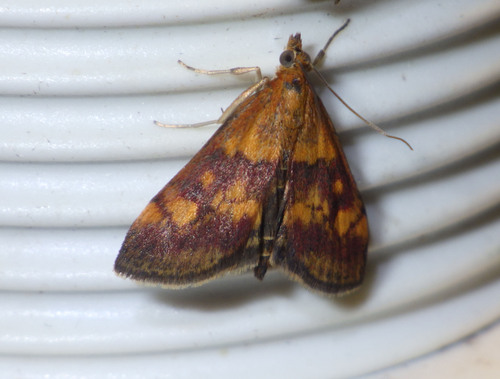
Yellow-Barred Longhorn

Yellow-Barred Longhorn

Nemophora degeerella

Daily sighting probability ~10% · With luck
at Leeds

In 3 days ~30% in a week ~60%

36 Verified sightings at Leeds
9 In 1 park From 2019 to 2026
May Best month
☀️ Diurnal When it's spotted

About the Yellow-Barred Longhorn

The longhorn moth or yellow-barred long-horn (Nemophora degeerella) is a diurnal lepidopteran from the moths family Adelidae (fairy longhorn moths). This species is present on most of Europe, but it is fairly common in north west Europe. The habitat of these moths is damp deciduous forests with wooded lanes and hedgerows.

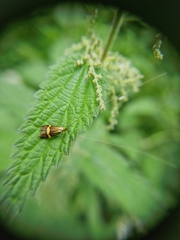
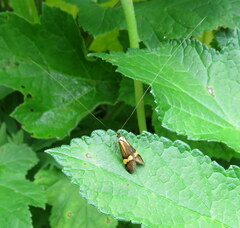
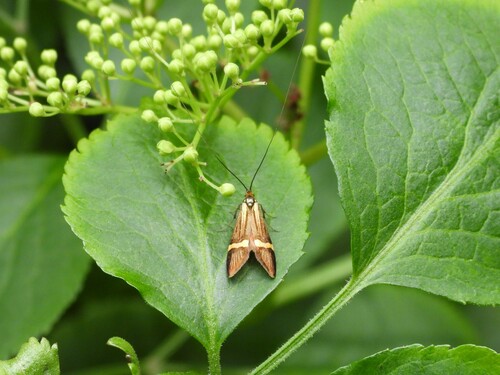
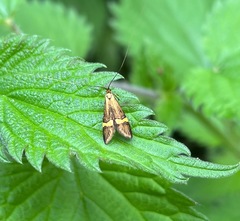
The wingspan of Nemophora degeerella ranges from 18–20 millimetres (0.71–0.79 in) in males, from 15–18 millimetres (0.59–0.71 in) in females. The head is dark brown, with dark and yellow hair-like scales. The thorax has a bronzy golden shining. Forewings are shiny bronzy golden yellow or shiny ochreous with longitudinal dark brown and lead-gray blueish-violet shining streaks. A yellow transversal band cross the whole forewings, framed by two lead-gray blueish-violet shining stripes with a dark brown border. The three longitudinal lead-gray, blueish-violet shining stripes situated in the basal part of the wings do not treach the transversal fascia. Rear wings are brownish gray.

The longhorn moth males have filiform antennae ranging up to five times their body length, while the female has much shorter antennae. Moreover... Wikipedia →
Global Distribution

Parks Where Found

# Park Country Daily sighting probability
1 Pyrénées National Park 🇫🇷 France
<5%

More parks will be added in future updates.

Cities Where Found

# City Country Daily sighting probability
1 Leeds 🇬🇧 United Kingdom
~10%
2 Birmingham 🇬🇧 United Kingdom
~10%
3 London 🇬🇧 United Kingdom
~10%
4 Warsaw 🇵🇱 Poland
~10%
5 Hamburg 🇩🇪 Germany
~10%
6 Helsinki 🇫🇮 Finland
~10%
7 Rotterdam [The Hague] 🇳🇱 Netherlands
~10%
8 Manchester 🇬🇧 United Kingdom
~10%
9 Liverpool 🇬🇧 United Kingdom
~10%
10 Berlin 🇩🇪 Germany
~10%

Before you go

What are the chances of seeing a Yellow-Barred Longhorn in Leeds?

With luck

About 10% of wildlife watchers report a Yellow-Barred Longhorn sighting in Leeds on a given day, based on 36 verified sightings from GBIF citizen-science data. It is the 52nd most-seen of the 284 insects we can rate there. Over three days the chance rises to about 30%, and over a week to about 60%, if each day is a fresh chance.

When is the best time to see a Yellow-Barred Longhorn in Leeds?

May and June

In those months about 20% of wildlife watchers report a Yellow-Barred Longhorn in Leeds on a given day, against under 5% in July to April, the lowest months.

What time of day is best to see a Yellow-Barred Longhorn?

Between 8 and 11 am

Across all the parks we cover, that three-hour window holds the most Yellow-Barred Longhorn sightings with a recorded time, and nearly all of them come between 6 am and 6 pm: it is a daytime animal.

Is Leeds the best place to see a Yellow-Barred Longhorn?

Yes

Of the 17 cities where we can rate Yellow-Barred Longhorn sightings, Leeds has the highest daily chance: about 10%. Next come Birmingham (United Kingdom, about 10%) and London (United Kingdom, about 10%).

Where does the Yellow-Barred Longhorn sighting chance come from?

GBIF citizen-science records

It is estimated from how often the Yellow-Barred Longhorn is recorded against all the insects logged in Leeds (36 verified sightings), calibrated against known sighting rates. Figures are rounded to the nearest 10% because citizen-science data supports honest approximations, not decimals, and months with records from fewer than five people show "—". How it works.

← Back to Leeds