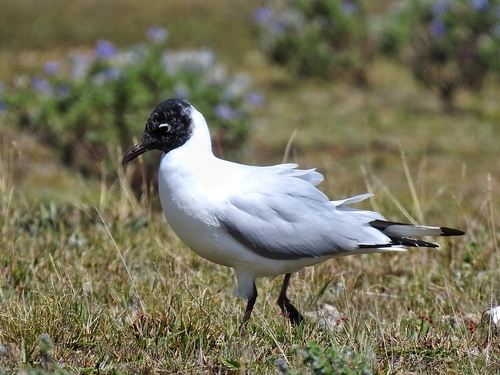
Swallow-tailed Gull

Swallow-tailed Gull

Creagrus furcatus

Silhouette: Sue Cantan (photograph) and T. Michael Keesey (vectorization) · PhyloPic

LCLeast ConcernNTVUENCR
Daily sighting probability <5% · Rare
at Lima

In 3 days <5%

15 Verified sightings at Lima
5,452 In 1 park From 2019 to 2026
July Best month
☀️ Diurnal When it's spotted

About the Swallow-tailed Gull

The swallow-tailed gull (Creagrus furcatus) is an equatorial seabird in the gull family, Laridae. It is the only species in the genus Creagrus, which derives from the Latin Creagra and the Greek kreourgos which means butcher, also from kreas, meat; according to Jobling it would mean "hook for meat" referring to the hooked bill of this species. It was first described by French naturalist and surgeon Adolphe-Simon Neboux in 1846. Its scientific name is originally derived from the Greek word for gull, "Glaros" and via Latin Larus, "gull" and furca "two-tined fork". It spends most of its life flying and hunting over the open ocean. The main breeding location is in the Galápagos Islands, particularly the rocky shores and cliffs of Hood, Tower and Wolf Islands, with lower numbers on most of the other islands. It is more common on the eastern islands where the water is warmer.

It is the only fully nocturnal gull and seabird in the world, preying on squid and small fish which rise to the surface at night to feed on plankton. The swallow-tailed gull has no structural or plumage differences between the male and female. In the breeding season, the adult has a black plumaged... Wikipedia →

Sounds

Begging call0:29

Ecuador · 2022

© Jacob Guachisaca Salínas · XC743757 · CC BY-NC-SA 4.0

Call0:12

Ecuador · 2011

© Jesse Fagan · XC277771 · CC BY-NC-SA 4.0

Song0:20

Ecuador · 2011

© Eric DeFonso · XC114149 · CC BY-NC-SA 3.0

Global Distribution

Parks Where Found

# Park Country Daily sighting probability
1 Galápagos Islands 🇪🇨 Ecuador
~40%

More parks will be added in future updates.

Cities Where Found

# City Country Daily sighting probability
1 Lima 🇵🇪 Peru
<5%

Before you go

What are the chances of seeing a Swallow-tailed Gull in Lima?

Rare

Under 5% of wildlife watchers report a Swallow-tailed Gull sighting in Lima on a given day, based on 15 verified sightings from GBIF citizen-science data. It is the 160th most-seen of the 171 birds we can rate there. Over three days the chance rises to under 5%, if each day is a fresh chance.

When is the best time to see a Swallow-tailed Gull in Lima?

Any time of year

In every month with enough records, under 5% of wildlife watchers report a Swallow-tailed Gull in Lima on a given day, so our monthly data shows no clear season.

What time of day is best to see a Swallow-tailed Gull?

Between 3 and 6 pm

Across all the parks we cover, that three-hour window holds the most Swallow-tailed Gull sightings with a recorded time, and about 9 in 10 of them come between 6 am and 6 pm: it is a daytime animal.

Where else can you see a Swallow-tailed Gull?

Only Lima, in our data

Lima is the only city on Wallace's Line with enough records to rate Swallow-tailed Gull sightings: under 5% of wildlife watchers there report one on a given day.

Which relatives of the Swallow-tailed Gull live in Lima?

Same family: Laridae

The closest relatives of the Swallow-tailed Gull that you can see in Lima (family Laridae, Gulls, Terns, and Skimmers) are Dominican Gull (about 30%), Belcher's Gull (about 30%) and Franklin's Gull (about 30%), with each one's daily chance of a sighting.

Where does the Swallow-tailed Gull sighting chance come from?

GBIF citizen-science records

It is estimated from how often the Swallow-tailed Gull is recorded against all the birds logged in Lima (15 verified sightings), calibrated against known sighting rates. Figures are rounded to the nearest 10% because citizen-science data supports honest approximations, not decimals, and months with records from fewer than five people show "—". How it works.

← Back to Lima