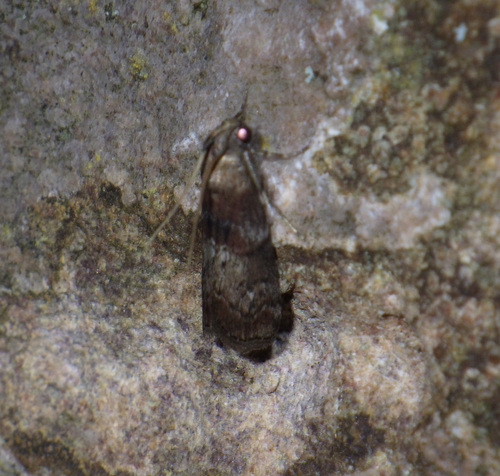
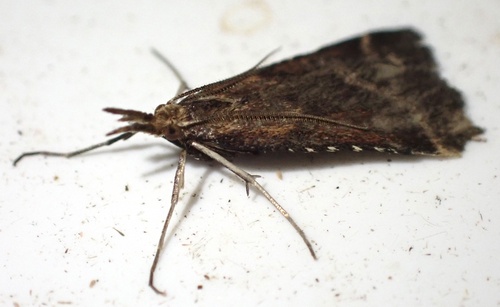
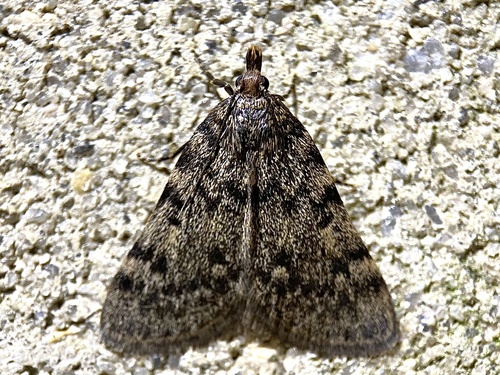
Grey Knot-Horn

Grey Knot-Horn

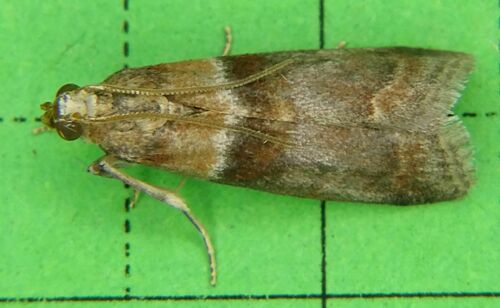
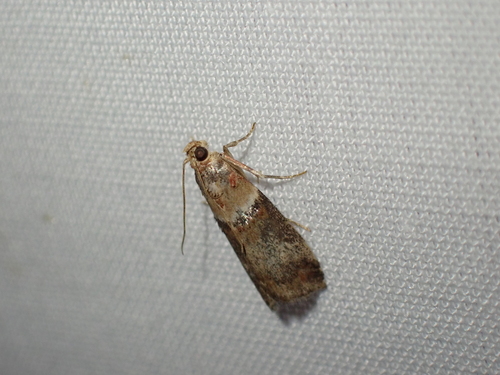
Acrobasis advenella

Daily sighting probability ~10% · With luck
at London

In 3 days ~20% in a week ~40%

154 Verified sightings at London
50 In all 2 parks From 2019 to 2026
August Best month
☀️🌙 Day & Night When it's spotted

About the Grey Knot-Horn

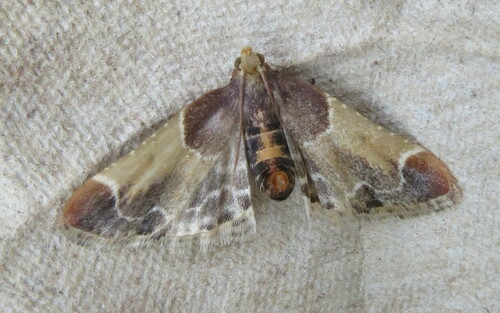
Acrobasis advenella is a species of snout moth in the genus Acrobasis. It was described by Johann Zincken in 1818 and is found in most of Europe. They have an oligophagous diet primarily feeding on plants from the Rosaceae family including the black chokeberry (Aronia melanocarpa). They cause significant damage to organic chokeberry farming, due to their widespread impact on the quality and quantity of the black chokeberry plants.

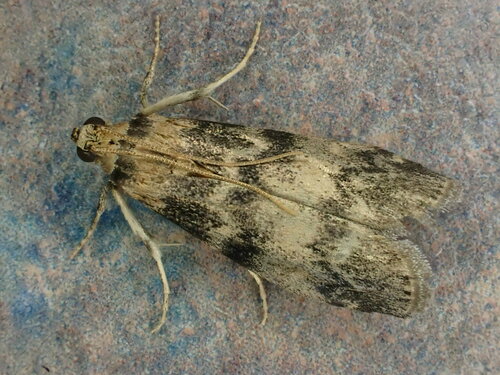
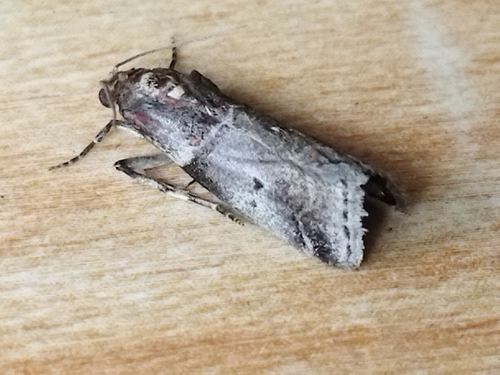
The wingspan is 17–24 mm.Similar to Acrobasis suavella. but the an area on the dorsal half of the forewing enclosed by the sub-basal line and pre median line is more sharply defined in A. advenella The red scales, mixed with black and white, enclosed by this area cover the basal area, thorax and head of A. advenella to a lesser extent than in A. suavella which has a grey head.The discal spots differ in position. Meyrick describes it - Head and front of thorax ferruginous-reddish. Forewings brownish-ochreous, none or less mixed or suffused with reddish and dark fuscous; lines slender, obscurely whitish, first bent, preceded by a straight whitish line joining it near costa, space between them reddish suffused anteriorly with dark fuscous, second darker-edged; a broad fascia of grey-whitish irroration from costa before second

line to lower extremity of first, including two obliquely placed darker discal dots; some whitish irroration towards termen. Hindwings fuscous.Larva light green; subdorsal line purplish-pink; head pale brown: in a silken gallery amongst flowers and leaves of hawthorn and Pyrus; 5, 6.

The moth flies in one generation from July to August [1].. The larvae feed on Crataegus, Pyrus and Sorbus aucuparia. Wikipedia →
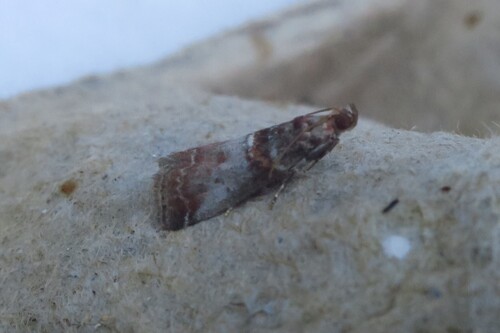
Global Distribution

Parks Where Found

# Park Country Daily sighting probability
1 Wadden Sea National Park 🇩🇪 Germany
~10%
2 Bavarian Forest National Park 🇩🇪 Germany
~10%

Cities Where Found

# City Country Daily sighting probability
1 Liverpool 🇬🇧 United Kingdom
~10%
2 London 🇬🇧 United Kingdom
~10%
3 Birmingham 🇬🇧 United Kingdom
<5%
4 Helsinki 🇫🇮 Finland
<5%
5 Copenhagen 🇩🇰 Denmark
<5%
6 Paris 🇫🇷 France
<5%
7 Moscow 🇷🇺 Russia
<5%

Before you go

What are the chances of seeing a Grey Knot-Horn in London?

With luck

About 10% of wildlife watchers report a Grey Knot-Horn sighting in London on a given day, based on 154 verified sightings from GBIF citizen-science data. It is the 262nd most-seen of the 1504 insects we can rate there. Over three days the chance rises to about 20%, and over a week to about 40%, if each day is a fresh chance.

When is the best time to see a Grey Knot-Horn in London?

August

In that month about 20% of wildlife watchers report a Grey Knot-Horn in London on a given day, against under 5% in May–June and September–March, the lowest months.

What time of day is best to see a Grey Knot-Horn?

Between 11 pm and 2 am

Across all the parks we cover, that three-hour window holds the most Grey Knot-Horn sightings with a recorded time, and about 6 in 10 of them come between 6 pm and 6 am: it is seen both by day and at night.

Is London the best place to see a Grey Knot-Horn?

Among the best

Of the 7 cities where we can rate Grey Knot-Horn sightings, London ranks 2nd at about 10%, level with the leaders once rounded. The best odds are in Liverpool (United Kingdom, about 10%).

Where does the Grey Knot-Horn sighting chance come from?

GBIF citizen-science records

It is estimated from how often the Grey Knot-Horn is recorded against all the insects logged in London (154 verified sightings), calibrated against known sighting rates. Figures are rounded to the nearest 10% because citizen-science data supports honest approximations, not decimals, and months with records from fewer than five people show "—". How it works.

← Back to London