Indian Nuthatch

Indian Nuthatch

Sitta castanea

Silhouette: Alan and Elaine Wilson (Modified) · PhyloPic

LCLeast ConcernNTVUENCR
Daily sighting probability ~10% · With luck
at Lucknow

In 3 days ~30% in a week ~60%

109 Verified sightings at Lucknow
3,606 In all 8 parks From 2019 to 2026
January Best month
🌅 Crepuscular When it's spotted

About the Indian Nuthatch

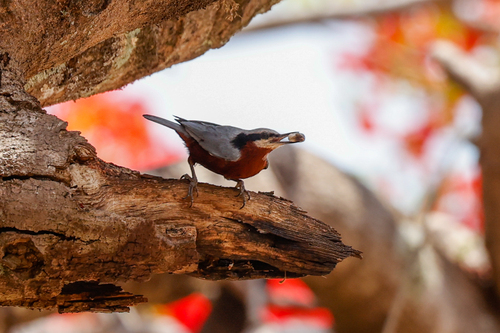
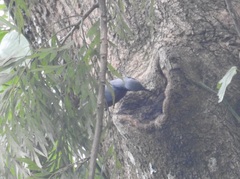
The Indian nuthatch (Sitta castanea) is a species of bird in the family Sittidae. It is found in Bangladesh, India and Nepal. Its natural habitats are subtropical or tropical dry forests, subtropical or tropical moist lowland forests, and subtropical or tropical moist montane forests.

This species has been split by Rasmussen and Anderton (2005) from the chestnut-bellied nuthatch. The Indian nuthatch (including the older prateri of the Eastern Ghats) is found south of the Ganges river. It is the only grey-backed, rufous-bellied nuthatch in the peninsula. Similar to the chestnut-bellied nuthatch but has a smaller bill and a frosty crown that is paler than the mantle. The wing and tail patterns lack contrast and has grey centres to the chestnut undertail coverts. Resident in the Terai and Gangetic plain extending into central India, the Eastern Ghats, Sunderbans and a disjunct population in the Western Ghats. Breeds from February to July. Different in vocalization from the chestnut-bellied nuthatch. Wikipedia →

Sounds

Song1:05

Nepal · 2023

© Marc Anderson · XC810303 · CC BY-NC-ND 4.0

Call0:28

India · 2016

© Frank Lambert · XC409705 · CC BY-NC-ND 4.0

Song0:07

India · 1986

© Jelle Scharringa · XC626123 · CC BY-NC-SA 4.0

Global Distribution

Parks Where Found

# Park Country Daily sighting probability
1 Kanha National Park 🇮🇳 India
~30%
2 Mudumalai National Park 🇮🇳 India
~30%
3 Bandhavgarh National Park 🇮🇳 India
~20%
4 Bandipur National Park 🇮🇳 India
~10%
5 Royal Bardia National Park 🇳🇵 Nepal
~10%
6 Nagarhole National Park 🇮🇳 India
~10%
7 Satpura National Park 🇮🇳 India
<5%
8 Jim Corbett National Park 🇮🇳 India
<5%

Cities Where Found

# City Country Daily sighting probability
1 Lucknow 🇮🇳 India
~10%
2 Jabalpur 🇮🇳 India
<5%

Before you go

What are the chances of seeing an Indian Nuthatch in Lucknow?

With luck

About 10% of wildlife watchers report an Indian Nuthatch sighting in Lucknow on a given day, based on 109 verified sightings from GBIF citizen-science data. It is the 69th most-seen of the 200 birds we can rate there. Over three days the chance rises to about 30%, and over a week to about 60%, if each day is a fresh chance.

When is the best time to see an Indian Nuthatch in Lucknow?

January

In that month about 30% of wildlife watchers report an Indian Nuthatch in Lucknow on a given day, against under 5% in April and July–August, the lowest months. That is one of Lucknow's driest months, with about 20 mm of rain against 320 mm in July.

What time of day is best to see an Indian Nuthatch?

Between 3 and 6 am

Across all the parks we cover, that three-hour window holds the most Indian Nuthatch sightings with a recorded time, and about half of them come between 6 pm and 6 am: it is most active around dawn and dusk.

Is Lucknow the best place to see an Indian Nuthatch?

Yes

Of the 2 cities where we can rate Indian Nuthatch sightings, Lucknow has the highest daily chance: about 10%. Next come Jabalpur (India, under 5%).

Which relatives of the Indian Nuthatch live in Lucknow?

Same order: Passeriformes

The closest relatives of the Indian Nuthatch that you can see in Lucknow (order Passeriformes, Perching Birds) are Red-whiskered Bulbul (about 80%), House Crow (about 80%) and Purple Sunbird (about 70%), with each one's daily chance of a sighting.

Where does the Indian Nuthatch sighting chance come from?

GBIF citizen-science records

It is estimated from how often the Indian Nuthatch is recorded against all the birds logged in Lucknow (109 verified sightings), calibrated against known sighting rates. Figures are rounded to the nearest 10% because citizen-science data supports honest approximations, not decimals, and months with records from fewer than five people show "—". How it works.
← Back to Lucknow