Collared Palmthrush

Collared Palmthrush

Cichladusa arquata

Silhouette: Martin Bulla, based on François Desbordes' illustration · PhyloPic

LCLeast ConcernNTVUENCR
Daily sighting probability ~10% · With luck
at Lusaka

In 3 days ~30% in a week ~50%

22 Verified sightings at Lusaka
885 In all 13 parks From 2019 to 2026
August Best month
☀️ Diurnal When it's spotted

About the Collared Palmthrush

The collared palm thrush (Cichladusa arquata) is a species of bird in the family Muscicapidae. It is found in Botswana, Burundi, Democratic Republic of the Congo, Kenya, Malawi, Mozambique, Rwanda, Tanzania, Uganda, Zambia, and Zimbabwe. Its natural habitats are dry savannah and subtropical or tropical moist shrubland.

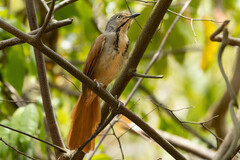
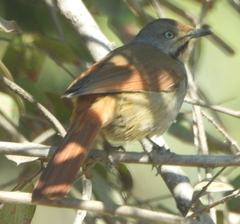
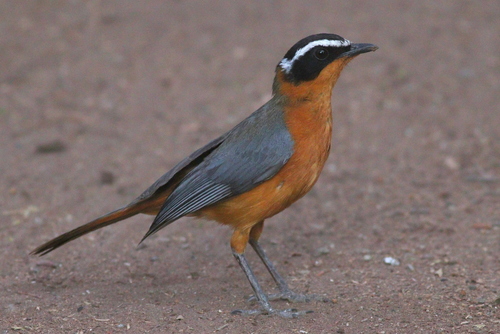
The Collared palm thrush is an odd and distinctive bird, easily recognized by its unique features. With a gray head, pale eye, and striking rufous back, it stands out among its feathered counterparts. One of its most defining characteristics is the black mark outlining its throat. This bird prefers to inhabit thickets within palm savannas, where its beautiful song fills the air. Its distinctive song consists of a series of airy, wailing notes, accompanied by chattering and rasping calls. While it may bear some resemblance to the Spotted Morning-Thrush, the Collared thrush stands apart with its pale eye, bright rufous back, and absence of spotting below. Although it shares similarities with nightingales and scrub-robins, the black throat markings serve as a clear distinguishing feature.

Image at ADW Collared palm... Wikipedia →

Sounds

Call0:19

Zambia · 2023

© Marc Anderson · XC890549 · CC BY-NC-ND 4.0

Song1:07

Malawi · 2015

© Frank Lambert · XC365252 · CC BY-NC-ND 4.0

Alarm call0:39

Zimbabwe · 2016

© Derek Solomon · XC329472 · CC BY-NC-SA 4.0

Global Distribution

Parks Where Found

# Park Country Daily sighting probability
1 Liwonde National Park 🇲🇼 Malawi
~70%
2 Mikumi National Park 🇹🇿 Tanzania
~30%
3 Gorongosa National Park 🇲🇿 Mozambique
~20%
4 Ruaha National Park 🇹🇿 Tanzania
~20%
5 Kafue National Park 🇿🇲 Zambia
~20%
6 Lower Zambezi National Park 🇿🇲 Zambia
~10%
7 Mana Pools National Park 🇿🇼 Zimbabwe
~10%
8 Gonarezhou National Park 🇿🇼 Zimbabwe
~10%
9 Chobe National Park 🇧🇼 Botswana
~10%
10 Lake Manyara National Park 🇹🇿 Tanzania
~10%
11 South Luangwa National Park 🇿🇲 Zambia
~10%
12 Tarangire National Park 🇹🇿 Tanzania
<5%
13 Kruger National Park 🇿🇦 South Africa
<5%

Cities Where Found

# City Country Daily sighting probability
1 Lusaka 🇿🇲 Zambia
~10%

Before you go

What are the chances of seeing a Collared Palmthrush in Lusaka?

With luck

About 10% of wildlife watchers report a Collared Palmthrush sighting in Lusaka on a given day, based on 22 verified sightings from GBIF citizen-science data. It is the 38th most-seen of the 87 birds we can rate there. Over three days the chance rises to about 30%, and over a week to about 50%, if each day is a fresh chance.

When is the best time to see a Collared Palmthrush in Lusaka?

August

In that month about 20% of wildlife watchers report a Collared Palmthrush in Lusaka on a given day, against under 5% in February–March and July, the lowest months. That is one of Lusaka's driest months, with almost no rain against 210 mm in January.

What time of day is best to see a Collared Palmthrush?

Between 7 and 10 am

Across all the parks we cover, that three-hour window holds the most Collared Palmthrush sightings with a recorded time, and about 8 in 10 of them come between 6 am and 6 pm: it is a daytime animal.

Where else can you see a Collared Palmthrush?

Only Lusaka, in our data

Lusaka is the only city on Wallace's Line with enough records to rate Collared Palmthrush sightings: about 10% of wildlife watchers there report one on a given day.

Where does the Collared Palmthrush sighting chance come from?

GBIF citizen-science records

It is estimated from how often the Collared Palmthrush is recorded against all the birds logged in Lusaka (22 verified sightings), calibrated against known sighting rates. Figures are rounded to the nearest 10% because citizen-science data supports honest approximations, not decimals, and months with records from fewer than five people show "—". How it works.

← Back to Lusaka