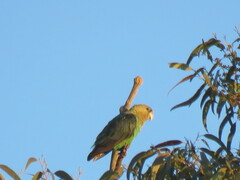

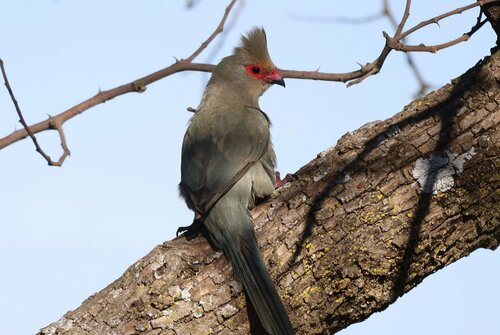
Levaillant's Parrot

Levaillant's Parrot

Poicephalus robustus

Silhouette: Sheatherius · PhyloPic

LCNTVUVulnerableENCR
Daily sighting probability ~10% · With luck
at Lusaka

In 3 days ~20% in a week ~30%

15 Verified sightings at Lusaka
368 In all 9 parks From 2019 to 2026
December Best month
☀️ Diurnal When it's spotted

About the Levaillant's Parrot

The Cape parrot (Poicephalus robustus) or Levaillant's parrot is a large, temperate forest dwelling parrot of the genus Poicephalus endemic to South Africa. It was formerly grouped as a subspecies along with the savanna-dwelling brown-necked parrot (Poicephalus fuscicollis) and grey-headed parrot (P. f. suahelicus), but is now considered a distinct species.

The Cape parrot was described in 1781 by the English ornithologist John Latham under the English name, the "robust parrot". When in 1788 the German naturalist Johann Friedrich Gmelin revised and expanded Carl Linnaeus's Systema Naturae, he included the Cape parrot with a short description, coined the binomial name Psittacus robustus and cited Latham's work. The type locality is South Africa. The Cape parrot is now placed with nine other species in the genus Poicephalus that was introduced by the English naturalist William Swainson in 1837. The genus name is from the Ancient Greek phaios "grey" and -kephalos "headed". The specific epithet rubustus is Latin for "strong" or "robust". The species is monotypic: no subspecies are recognised.

The Cape parrot was formerly considered to be one of the three subspecies of the... Wikipedia →

Sounds

Call0:50

South Africa · 2016

© Lynette Rudman · XC313694 · CC BY-NC-SA 4.0

Call1:02

South Africa · 2014

© Peter Boesman · XC280598 · CC BY-NC-ND 4.0

Call1:03

South Africa · 1991

© Rick Nuttall · XC779363 · CC BY-NC-SA 4.0

Global Distribution

Parks Where Found

# Park Country Daily sighting probability
1 Liwonde National Park 🇲🇼 Malawi
~10%
2 Gonarezhou National Park 🇿🇼 Zimbabwe
~10%
3 Kafue National Park 🇿🇲 Zambia
~10%
4 Mana Pools National Park 🇿🇼 Zimbabwe
~10%
5 Lower Zambezi National Park 🇿🇲 Zambia
~10%
6 Gorongosa National Park 🇲🇿 Mozambique
<5%
7 South Luangwa National Park 🇿🇲 Zambia
<5%
8 Lake Mburo National Park 🇺🇬 Uganda
<5%
9 Kruger National Park 🇿🇦 South Africa
<5%

Cities Where Found

# City Country Daily sighting probability
1 Lusaka 🇿🇲 Zambia
~10%

Zoos & Centres Where Found

# Zoo / Centre Country
1 Szeged Zoo 🇭🇺 Hungary In captivity

Before you go

What are the chances of seeing a Levaillant's Parrot in Lusaka?

With luck

About 10% of wildlife watchers report a Levaillant's Parrot sighting in Lusaka on a given day, based on 15 verified sightings from GBIF citizen-science data. It is the 60th most-seen of the 87 birds we can rate there. Over three days the chance rises to about 20%, and over a week to about 30%, if each day is a fresh chance.

When is the best time to see a Levaillant's Parrot in Lusaka?

October and December

In those months about 20% of wildlife watchers report a Levaillant's Parrot in Lusaka on a given day, against under 5% in January–August and November, the lowest months. Those are among Lusaka's wettest months, with about 110 mm of rain a month against almost none in August.

What time of day is best to see a Levaillant's Parrot?

Between 4 and 7 pm

Across all the parks we cover, that three-hour window holds the most Levaillant's Parrot sightings with a recorded time, and about 8 in 10 of them come between 6 am and 6 pm: it is a daytime animal.

Where else can you see a Levaillant's Parrot?

Only Lusaka, in our data

Lusaka is the only city on Wallace's Line with enough records to rate Levaillant's Parrot sightings: about 10% of wildlife watchers there report one on a given day.

Where does the Levaillant's Parrot sighting chance come from?

GBIF citizen-science records

It is estimated from how often the Levaillant's Parrot is recorded against all the birds logged in Lusaka (15 verified sightings), calibrated against known sighting rates. Figures are rounded to the nearest 10% because citizen-science data supports honest approximations, not decimals, and months with records from fewer than five people show "—". How it works.

← Back to Lusaka